fetching data ... 
Background: Psoriatic arthritis (PsA) is among the most prevalent rheumatic diseases, affecting approximately 0.5% of the European population. Beyond pharmacological treatment, physical activity has a substantial impact on disease activity, symptom burden, quality of life, and the elevated cardiovascular risk associated with PsA. In contrast to conventional high-load resistance training (HRT), Kaatsu blood flow restriction (BFR) training, originally developed in Japan as a rehabilitative strategy, utilizes pneumatic cuffs applied to the limbs that are intermittently inflated to a predefined pressure. By partially restricting arterial inflow and venous outflow, BFR promises to allow resistance exercise with markedly reduced external loads while still providing a sufficient hypertrophic stimulus, thereby offering a potentially more joint-sparing training modality. However, concerns have been raised regarding hypoxia-induced systemic inflammation. Data on longitudinal cytokine responses to BFR in inflammatory arthritis are scarce.
Objectives: Based on this world-first study to compare the effect of BFR training to conventional resistance training in PsA patients, data was investigated for acute and long-term effects of both trainings on inflammatory biomarkers, with a particular focus on interleukin-8 (IL-8/CXCL8), serving as a chronic tissue inflammation parameter, and the safety profile regarding systemic inflammatory activation (key proinflammatory cytokines: IL-6, TNF-α, and IFN-γ).
Methods: This pilot study was conducted with approval of the local Institutional Review Board (IRB #217/20). Participants were randomized across three groups: BFR training, HRT training, and a non-exercising control group. Training interventions were performed twice weekly over a 12-week period. Disease activity and patient-reported outcomes were assessed using standardized instruments, including FFbH-P, IPAQ, DAS28 or PsAID12, complemented by clinical examination and C-reactive protein (CRP) measurements. In addition, ultrasound assessments of muscle diameter, body composition analysis, and clinical characteristics were recorded. Circulating cytokine concentrations were quantified using multiplex immunoassays from serum samples obtained at four predefined time points: before and after the first training session (TP1, TP2) and before and after the final training session (TP3, TP4). This study design enabled the differentiation between acute exercise-induced responses and long-term training-related adaptations.
Results: A total of 32 patients with PsA completed the study, including 11 patients in the BFR training group, 10 in the HRT group, and 11 in the non-exercising control group.
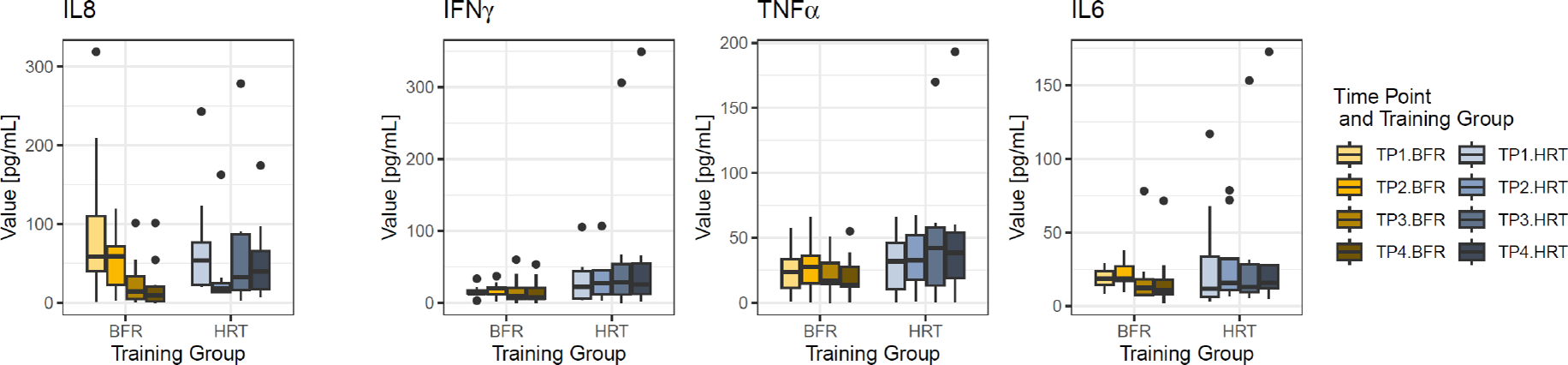
As figure 1 illustrates, PsA patients demonstrated a progressive decline in circulating IL-8 levels throughout the course of the training (TP1: 95.2 ±98.1 pg/mL; TP2: 52.2 ±36.6 pg/mL; TP3: 26.5 ±31.5 pg/mL; TP4: 21.9 ±32.3 pg/mL). Key proinflammatory cytokines, including IL-6, TNF-α, and IFN-γ did not show any acute spikes after the first or the final BFR training session or notable long-term increases ( see figure 1 ). Systemic inflammation as reflected by C-reactive protein remained stable or tended to decrease in both training groups (BFR: mean ΔTP3-TP1 CRP -2.007 ±4.331 mg/L; HRT: mean ΔTP3-TP1 CRP +0.639 ±3.023 mg/L).
Conclusions: In PsA patients, structured BFR training is associated with a favorable modulation of inflammatory biomarkers, particularly a sustained reduction in interleukin-8 (IL-8/CXCL8), a key chemokine involved in neutrophil recruitment and chronic inflammation. This pattern suggests a chronic anti-inflammatory training effect and may indicate a potential beneficial influence on synovial inflammatory processes. Although causality cannot be firmly established, a parallel trend toward lower levels of the systemic inflammatory marker C-reactive protein was also observed. Crucially, despite the hypoxic stimulus inherent to BFR training, the training does not incur a systemic inflammatory “cost”, underscoring the immunological safety of this exercise modality. These findings support BFR as a feasible and potentially valuable training approach for PsA patients, especially for individuals with limited tolerance to high mechanical loads.
Longitudinal cytokine responses to blood flow restriction training and conventional resistance training in patients with psoriatic arthritis
REFERENCES: NIL.
Acknowledgments: NIL.
Disclosure of Interests: None declared.