fetching data ... 
Background: Individuals with psoriatic arthritis (PsA) have an unfavourable body composition, contributing to a higher comorbidity burden [1]. Although a cross-sectional study has reported inverse associations between physical activity (PA) and body composition, specifically visceral fat mass and percentage body fat [2], evidence on longitudinal associations is lacking.
Objectives: To examine the relationship of changes in PA over approximately 11 years with visceral fat mass and percentage body fat in individuals with PsA.
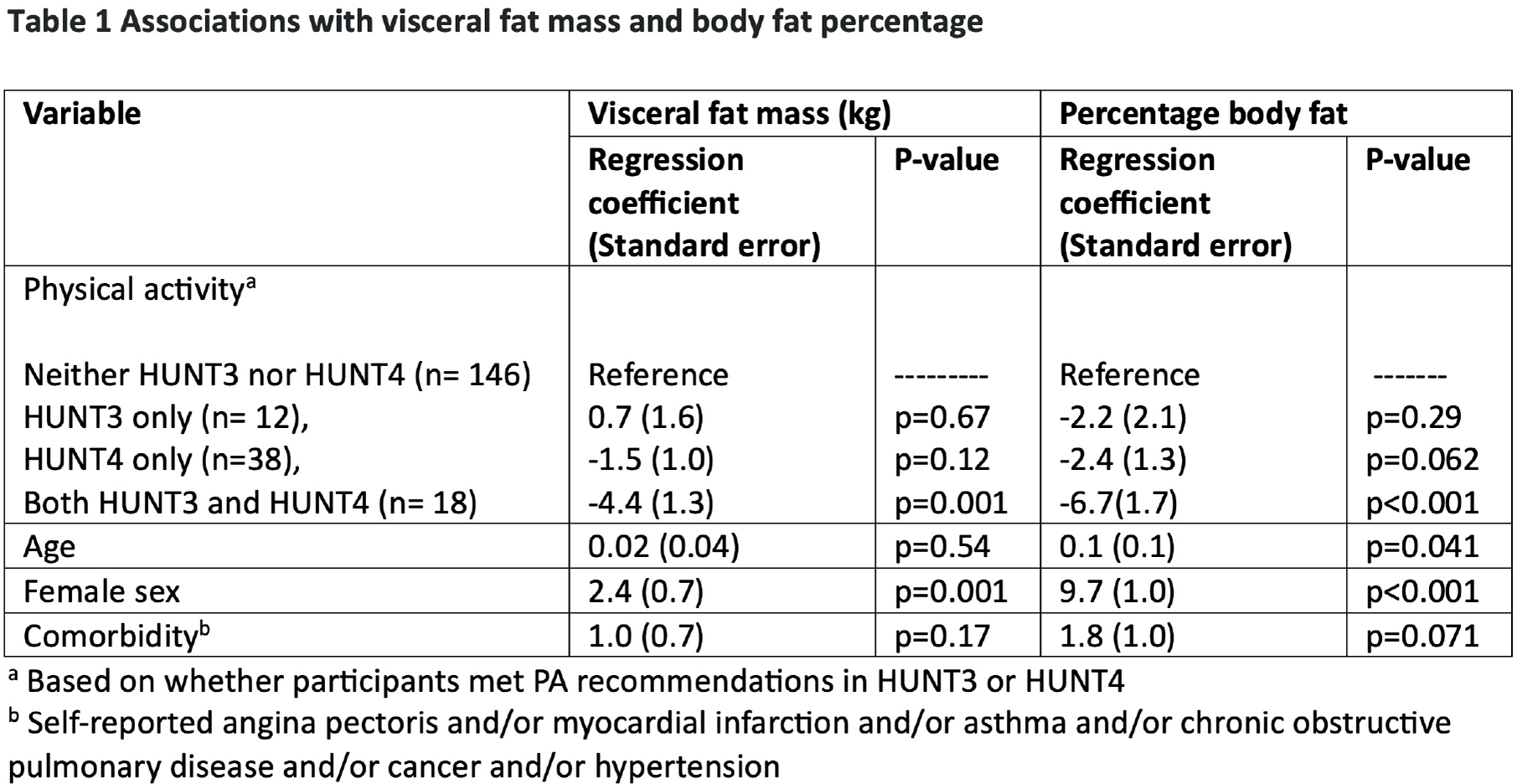
Methods: The study included 214 Individuals with PsA (CASPAR criteria) who participated in the third and fourth surveys of the Trøndelag Health Study (HUNT3, 2006-2008; HUNT4, 2017-2019). Demographic and clinical characteristics were collected at baseline in HUNT3. Body composition was assessed using bioelectrical impedance analysis in HUNT4. Self-reported PA was assessed in both HUNT3 and HUNT4 and categorized according to whether participants met recommendations from the American College of Sports Medicine/American Heart Association for aerobic PA for healthy adults [3]: neither in HUNT3 nor HUNT4 (n= 146), in HUNT3 only (n= 12), in HUNT4 only (n=38), or in both HUNT3 and HUNT4 (n= 18). Multivariable linear regression analysis was used to assess the associations between change in PA from HUNT3 to HUNT4 with visceral fat mass and percentage body fat, after adjusting for age, sex and comorbidity.
Results: At baseline, 30 individuals with PsA (14%) met the recommended levels of PA. Compared to those who did not meet the recommendations, physically active individuals with PsA had statistically significantly lower weight and visceral fat mass, and a lower prevalence of hypertension. Other baseline characteristics, including age, sex, smoking status, as well as comorbidities such as diabetes, heart disease and respiratory disease were similar among the groups. The regression analysis showed that participants who met the recommended levels of PA in both HUNT3 and HUNT4 had significantly lower visceral fat mass (−4.4 kg; 95% CI: −7.0 to −1.8; p = 0.001) and body fat percentage (−6.7%; 95% CI: −10.1 to −3.2; p < 0.001) compared to those whose who neither met these levels in HUNT3 nor HUNT4 (Table 1). Although not statistically significant, participants who met the recommendations only in HUNT4 tended to have both lower visceral fat mass and body fat percentage compared to those who neither met the recommendations in HUNT3 nor HUNT4.
Conclusions: Meeting the recommended levels PA over a long timeframe was associated with a more favourable body composition among individuals with PsA. Sustained engagement in PA may therefore play an important role in improving body composition and potentially reducing cardiometabolic risk among individuals with PsA.
REFERENCES: [1] Blake T, Gullick NJ, Hutchinson CE, Barber TM (2020) Psoriatic disease and body composition: a systematic review and narrative synthesis. PLoS ONE 15:e0237598.
[2] Osman AA, Hoff M, Videm V (2023) High physical activity in persons with psoriatic arthritis is associated with reduced visceral fat mass and percentage body fat: the Trøndelag Health study. Rheumatol Int 43, 1685 - 1693.
[3] Haskell WL, Lee IM, Pate RR et al (2007) Physical activity and public health: updated recommendation for adults from the American College of Sports Medicine and the American Heart Association. Med Sci Sports Exerc 39:1423–1434.
Acknowledgments: NIL.
Disclosure of Interests: None declared.