fetching data ... 
Background: Systemic sclerosis (SSc) is a rare auto-immune disease characterized by skin sclerosis, microvascular dysfunction and diffuse fibrosis of internal organs. While >90% of SSc patients report gastrointestinal (GI) symptoms of varying severity that significantly impair quality of life, the mechanisms underlying GI involvement remain poorly understood.
Objectives: To identify differences in serum protein abundances in SSc patients with and without significant GI involvement that could serve to decipher disease mechanisms and GI therapeutic targets.
Methods: We prospectively enrolled 84 patients meeting the European League Against Rheumatism/American College of Rheumatology (EULAR/ACR) 2013 criteria for SSc and classified them as having none-to-mild (GIT 0-0.49), or moderate-to-very severe (GIT 0.5-3) GI symptoms, based on the University of California Los Angeles Clinical Trials Consortium GI Tract (UCLA GIT) 2.0 score. A targeted inflammatory proteomics assay (Olink Target 96 Inflammation) was performed on patient serum samples. Multivariate regression analysis was conducted to detect proteins differentially abundant by GI symptom severity and to explore relationships with UCLA GIT 2.0 subscale scores.
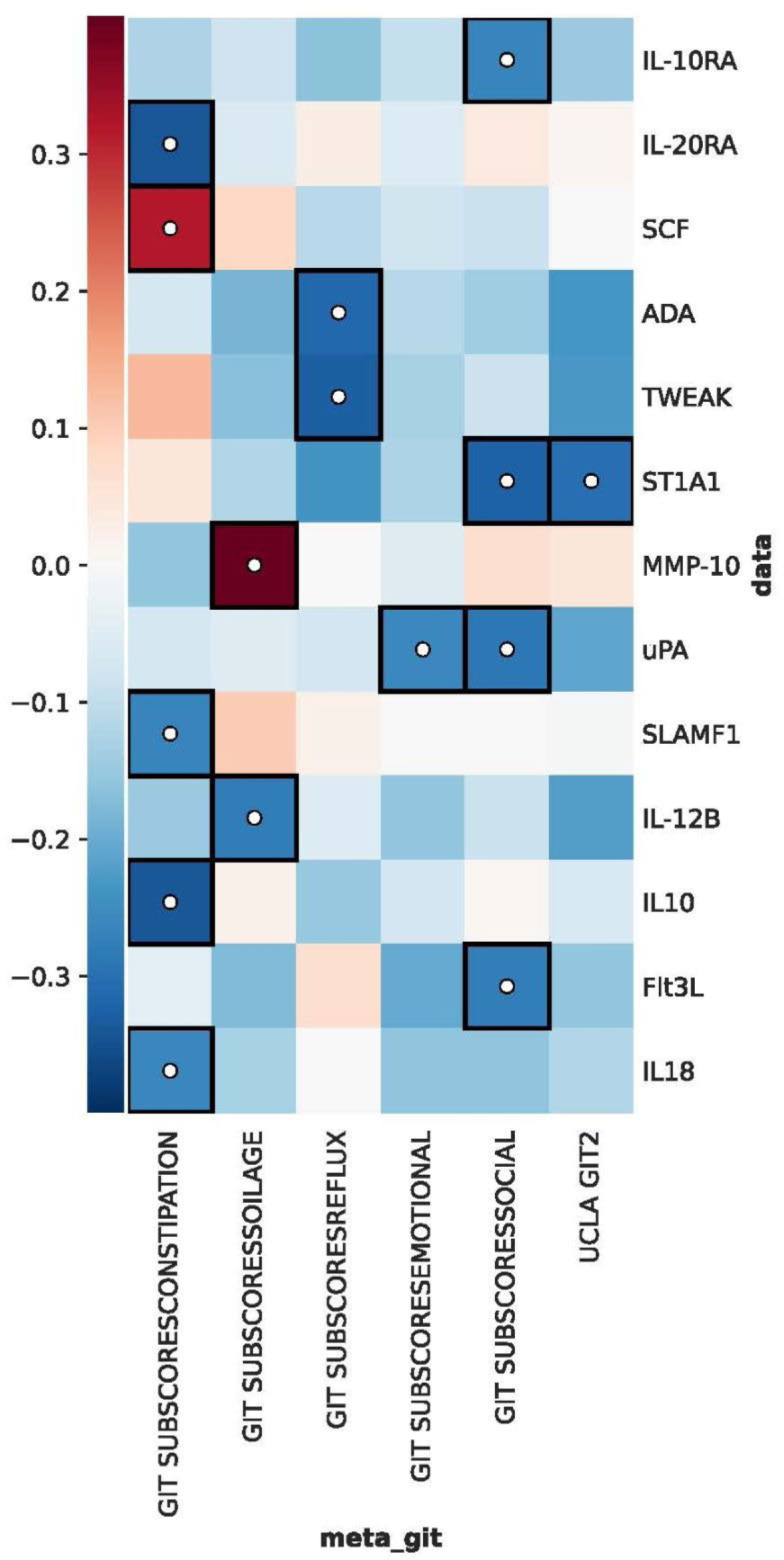
Results: Forty-three patients (88% F) were categorized into having none to mild GI symptom severity (mean GIT=0.24) and 41 patients (78% F) into having moderate to very severe GI symptoms (mean GIT=0.85, p<0.001). After correcting for multiple testing, 14 serum proteins were significantly differentially abundant between both groups of SSc patients (Table 1). Of these, 8 inflammatory proteins (HGF, EN-RAGE, TNFSF14, CCL28, OSM, SIRT2, NT-3, and TGF-alpha) were higher in abundance in SSc patients with moderate to very severe GI symptoms and have been reportedly increased in serum collected from patients diagnosed with GI diseases like ulcerative colitis and Crohn’s. A total of 6 proteins (TNFRSF9, IL-12B, CX3CL1, Flt3L, CST5, and MCP-3) were lower in abundance in this group compared to none to mild GI symptoms In addition, multivariate analyses revealed the abundance of 7 serum proteins (IL-20RA, SCF, ADA, TWEAK, ST1A1, MMP-10 and IL-10) correlated with both UCLA GIT 2.0 total scores and subscores for severity in constipation, fecal soilage, esophageal reflux and social functioning (Figure 1).
Conclusions: Systemic sclerosis patients with higher GI symptom severity demonstrate a unique serum proteomic signature, including increased abundance of key inflammatory and tissue remodeling proteins. These findings underscore the potential role of serum biomarkers in delineating disease mechanisms and guiding targeted therapies for GI involvement in SSc.

Correlations between serum proteins and UCLA GIT 2.0 subscores. Heatmap depicting serum protein abundance in relation to subscores for constipation, fecal soilage, esophageal reflux, and social functioning in patients with systemic sclerosis. All displayed correlations are significant (Padj <0.05).
REFERENCES: NIL.
Acknowledgments: NIL.
Disclosure of Interests: Ashima Makol Site PI for Clinical trials (Boehringer-Ingelheim, AstraZeneca, Cabaletta-Bio, Sanofi), Thomas Guedens: None declared, Erik Jessen: None declared, Elvira Lesmana: None declared, Jonah Pedelty: None declared, Margaret Breen-Lyles: None declared, Adam Edwinson: None declared, Madhusudan Grover Alfasigma, Evoke, Takeda, Alfasigma.