fetching data ... 
Background: Degenerative joint diseases (DJDs) are among the leading causes of chronic pain and disability worldwide. However, the relationship between DJDs and risk of dementia, as well as the underlying molecular mechanisms, remains poorly understood.
Objectives: To evaluate the association between DJDs and incidence of dementia, and identify circulating proteomic mediators that may underlie this association.
Methods: We conducted a prospective cohort study using data from 500,805 participants in the UK Biobank. Three DJD diagnoses (osteoarthritis [OA], intervertebral disc degeneration [IVDD], and degenerative spinal diseases [DSD]) were identified from the clinical records. Dementia outcomes (all-cause dementia [ACD], Alzheimer’s disease [AD], and vascular dementia [VaD]) were tracked over 14.45 years. Cox regression models were used to assess DJD-dementia associations, adjusted for demographics, lifestyle, and comorbidities. Propensity score matching (PSM) was employed for validation. Plasma proteomic profiling of 2,923 proteins was analyzed to identify potential mediators, followed by causal mediation analysis.
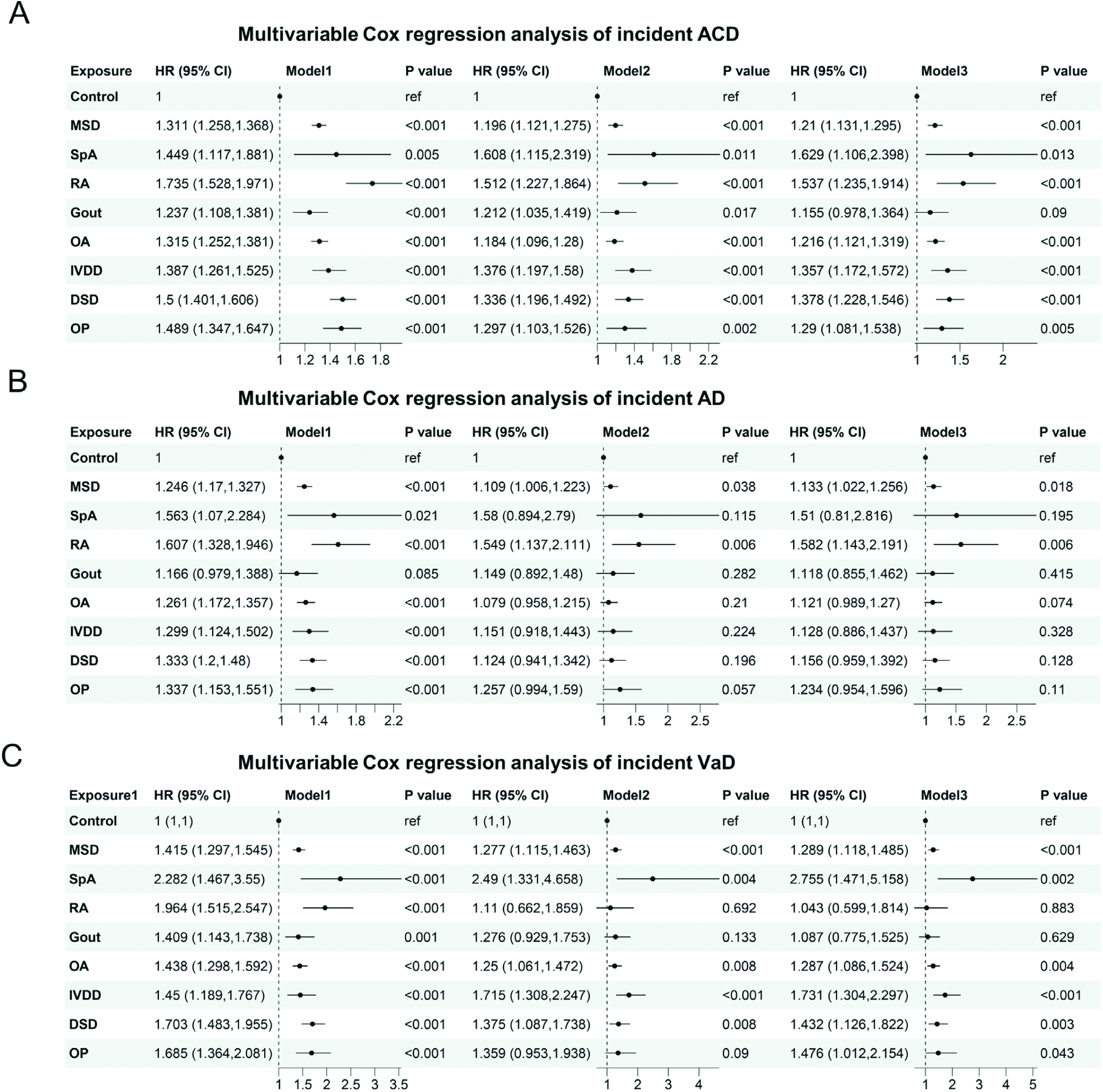
Results: After a median follow-up of 14.45 years, 9,884 participants developed ACD, including 4,404 with AD and 2,224 with VaD. In the fully adjusted Cox regression models, the DJD group exhibited a significantly elevated risk of ACD (HR: 1.158, 95% CI: 1.059-1.276) and VaD (HR: 1.291, 95% CI: 1.058–1.574), but not AD (HR: 1.063, 95% CI: 0.928–1.216). Subgroup analyses revealed significant effect modifications according to age, sex, hypertension, and diabetes status. Propensity score matching (PSM) analyses confirmed the robustness of these associations. Proteomic analysis identified 296 proteins associated with both DJDs and ACD risk. Mediation analysis revealed that 18 proteins, including HAVCR1 (mediation proportion 52.6%, 95% CI: 39.1–78), GDF15 (22%, 95% CI: 14.5–46.8), and COL6A3 (14.3%, 95% CI: 7.7–28.4), significantly mediated the association between DJDs and ACD.
Conclusions: DJDs are independently associated with an increased risk of developing dementia. This correlation is mediated by systemic proteomic alterations. Our findings highlight inflammation and vascular dysfunction as central mechanisms, offering insights into risk stratification and therapeutic targets for preventing dementia.
Associations between DJDs and dementia risk estimated using multivariable-adjusted Cox proportional hazard models.
REFERENCES: [1] Global, regional, and national burden of osteoarthritis, 1990-2020 and projections to 2050: a systematic analysis for the Global Burden of Disease Study 2021. Lancet Rheumatol 2023;5:e508–22.
[2] De Roover A, Escribano-Núñez A, Monteagudo S, et al. Fundamentals of osteoarthritis: inflammatory mediators in osteoarthritis. Osteoarthr Cartil 2023;31:1303–11.
[3] Doroszkiewicz J, Mroczko J, Winkel I, et al. Metabolic and Immune System Dysregulation: Unraveling the Connections between Alzheimer’s Disease, Diabetes, Inflammatory Bowel Diseases, and Rheumatoid Arthritis. J Clin Med 2024;13.
Acknowledgments: NIL.
Disclosure of Interests: None declared.