fetching data ... 
Background: Fibromyalgia is a complex nociplastic pain condition characterized by widespread pain, fatigue, sleep disturbance, and cognitive symptoms. Pharmacological treatments offer limited benefit, making self-management strategies - such as physical activity, psychoeducation, and mind–body-interventions central to care. Digital health technologies increasingly provide scalable formats to deliver these interventions; however, their evidence base, therapeutic completeness, and alignment with patient needs remain unclear.
Objectives: To develop an evidence-based framework for digital fibromyalgia self-management by:
synthesizing guideline and systematic review evidence for non-digital self-management interventions;
analysing the therapeutic content and regulatory status of existing fibromyalgia apps;
identifying patient preferences and design requirements for mHealth self-management tools.
Methods: We conducted a multi-phase investigation.
Phase 1: A review of international guidelines and randomized controlled trial-based systematic reviews (PubMed, Cochrane) to categorize evidence across three domains: physical exercise, psychoeducational therapies, and mind–body interventions.
Phase 2: A landscape analysis of available fibromyalgia and chronic pain applications (PubMed, Google, DiGA registry, app stores) to assess integration of evidence-based therapeutic components and certification status.
Phase 3: Two online patient surveys (n=53 and n=33) and three focus groups with patients, a rheumatologist, and an app designer. Participants tested a prototype multicomponent self-management app including Cognitive Behavioral Therapy (CBT), mind–body strategies, and exercise modules. In the final session, the prototype was connected to an Large Language Model (LLM)-based chatbot to explore feasibility and user reactions.
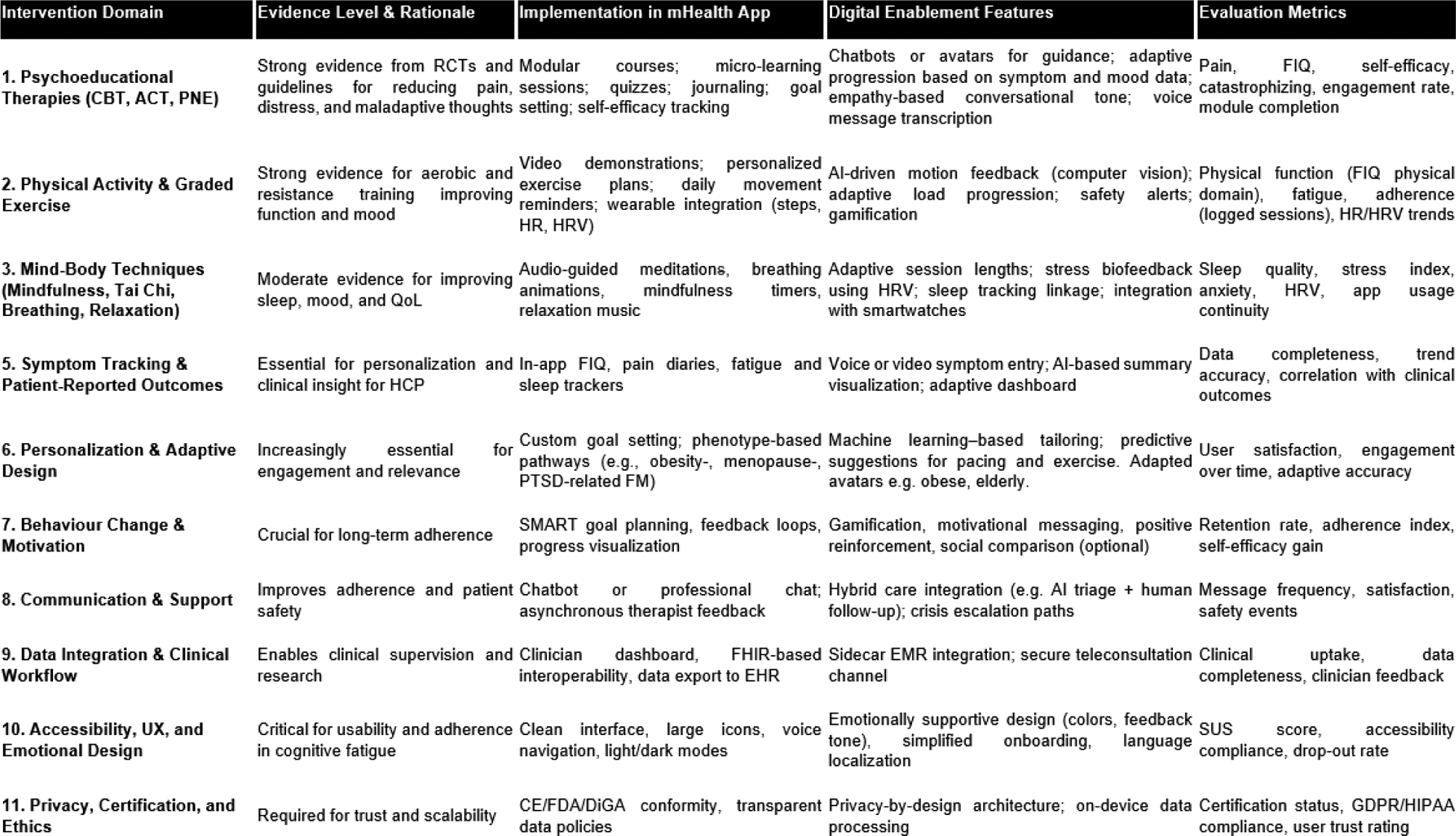
Results: Phase 1: Data from 30 systematic reviews rated as high or moderate confidence using AMSTAR 2 and from 8 clinical guidelines with an AGREE II global rating score >18 were synthesized to categorize and summarize evidence on self-management interventions. Strong evidence supports aerobic and resistance exercise, CBT, acceptance and commitment therapy (ACT), and meditative movement therapies for improving pain, physical function, and mood. Educational interventions, pacing strategies, and pain neuroscience education provided additional benefits. Multicomponent interventions integrating physical and psychological approaches demonstrated the largest effect sizes.
Phase 2: Twelve existing apps were identified. Most incorporated CBT or Acceptance and Commitment Therapy (ACT) modules (83%), while fewer provided evidence-based physical activity guidance (50%) or mind–body techniques (42%). Only five apps (42%) were truly multicomponent. Two were certified as digital therapeutics (DiGA or FDA). Many non-certified apps included unstructured or low-evidence content.
Phase 3: Patients emphasized the need for simplicity, short modules, supportive language, personalization, and trustworthy scientific content. Symptom tracking, visualization of progress, and high-quality exercise instructions were highly valued. Cognitive load (“fibrofog”) and poor navigation were major barriers. The LLM-enhanced prototype was perceived as empathic and motivating, highlighting potential for adaptive, conversational guidance.
Conclusions: Across all phases, three validated pillars - psychoeducation, physical activity, and mind–body techniques - emerged as essential foundations for effective fibromyalgia self-management. Existing apps only partially integrate these components, and many lack transparency or personalization. Patient preference data supports the development of streamlined, multimodal, adaptive mHealth programs with emotionally intelligent conversational support and clear clinical grounding. A unified evidence-based framework can guide the next generation of digital therapeutics toward improved usability, engagement, and clinical relevance for fibromyalgia.
REFERENCES: NIL.
Acknowledgments: NIL.
Disclosure of Interests: Thomas Lebeau Foustoukos: None declared, Isabelle Leclercq: None declared, Marc Blanchard Atreon S.A., Thomas Hügle GSK, Johnson & Johnson, Eli Lilly, Abbvie and others., Atreon S.A., Novartis. Fresenius Kabi.