fetching data ... 
Background: Exercise is recognized as cornerstone treatment for people with spondyloarthritis (SpA). Clear, detailed reporting of exercise interventions is essential so clinicians can replicate effective programs, researchers can compare and synthesize findings, and health services can implement evidence-based care. The Consensus on Exercise Reporting Template (CERT) was developed to standardize and improve completeness of exercise intervention descriptions [1], but adherence to CERT in SpA trials has not been examined.
Objectives: To evaluate how exercise interventions are reported in randomized controlled trials (RCTs) involving adults with SpA, to describe strengths and gaps in reporting that affect reproducibility and clinical implementation, and to explore temporal change in CERT reporting completeness over the past two decades.
Methods: Systematic review (PROSPERO: CRD42023438199) of RCTs of exercise interventions (cardiorespiratory, resistance, flexibility, and/or neuromotor exercise) in adults with SpA published 2003–November 2025. Searches covered MEDLINE, EMBASE, CINAHL, Cochrane Library and PEDro. Intervention reporting was assessed using CERT; each of the 19 scored CERT items was scored 1 point if the RCT described that item clearly enough to permit replication and 0 points if the element was missing or inadequately described. Descriptive statistics summarized overall completeness and item-level frequencies. Temporal trends in percentage completeness of CERT were assessed using linear regression with publication year as the predictor.
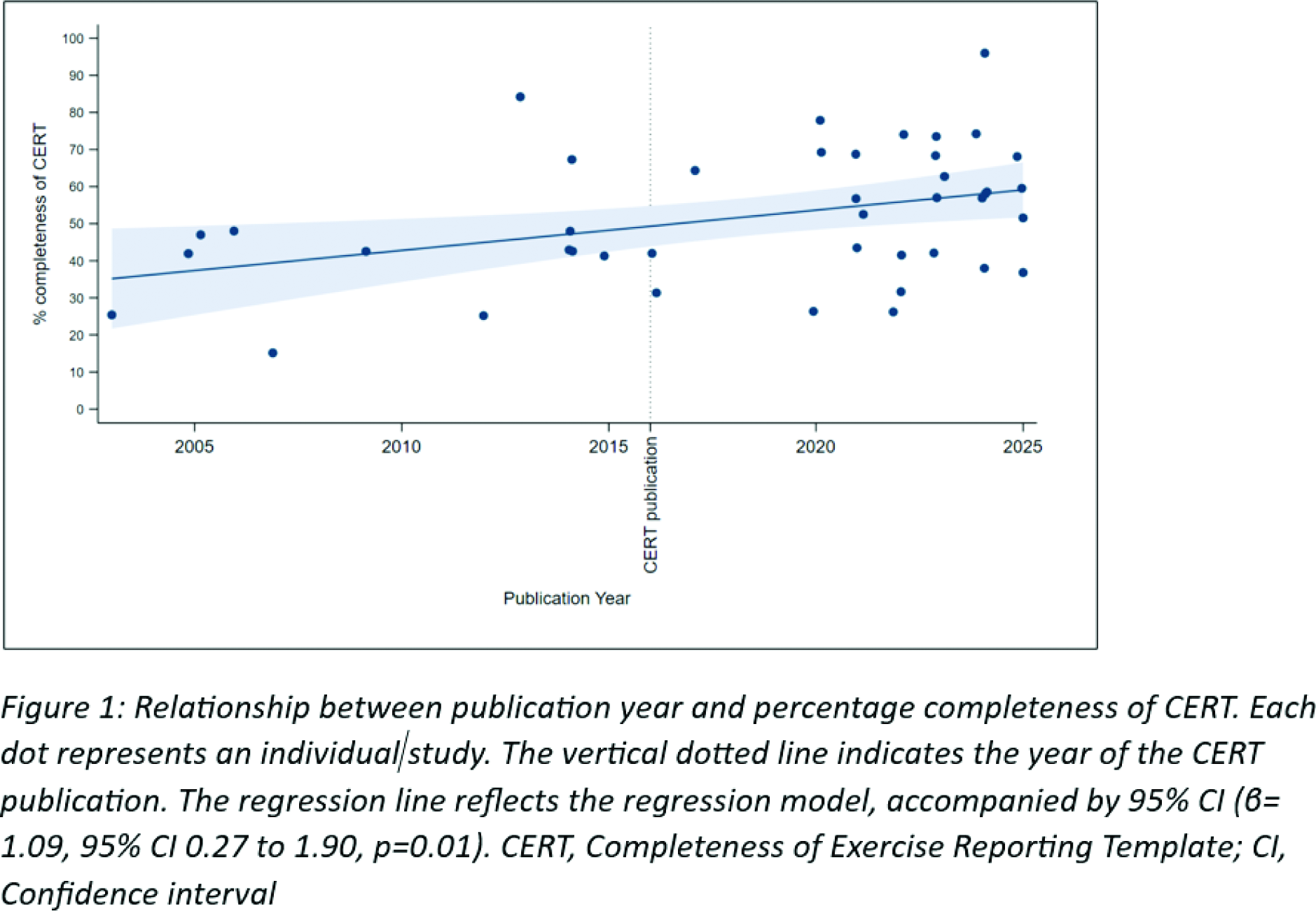
Results: Forty-two RCTs met inclusion criteria. Mean CERT score was 9.9 (SD 3.4) of 19, corresponding to 52% completeness overall. Item-level reporting showed that the most frequently reported items were basic intervention description (item 13) in 40 trials (95.2%); supervision (item 4) in 38 trials (90.5%); and type of equipment (item 1) in 37 trials (88.1%). In contrast, fidelity of the provider (item 16a) was described in only 3 trials (7.1%), motivational strategies (item 6) in 9 trials (21.4%), and adverse events (item 11) in 12 trials (25.6%). While some trials provided near-complete descriptions (highest observed score 18/19), many clustered around the mean and 21 (50%) trials were considered to have a poor level of reporting. Linear regression indicated a modest improvement in CERT completeness over the past two decades with an average increase of 1.09 percentage points per year (95% CI 0.27 to 1.90; p = 0.01), though recent publications exhibited considerable variability in intervention reporting (Figure 1).
Conclusions: Reporting of exercise interventions in SpA RCTs is inconsistent and, overall, only moderately complete. Published reports commonly describe basic elements such as session structure, supervision and equipment, but frequently omit crucial implementation details including provider fidelity, motivational strategies, and adverse-event monitoring. Although completeness has improved modestly over time, large variability persists, and many studies lack the level of detail required for reliable replication and clinical implementation. To address this, researchers, peer reviewers and journals should routinely use exercise reporting templates and ensure that full, replication-level intervention details are available in manuscripts, supplementary materials or linked protocols.
REFERENCES: [1] Slade SC, Dionne CE, Underwood M, et al. Consensus on Exercise Reporting Template (CERT): Explanation and Elaboration Statement. Br J Sports Med . 2016;50(23):1428-1437.
Acknowledgments: NIL.
Disclosure of Interests: Kristine Norden UCB Pharma (no relation to present work), Hanne Solveig Dagfinrud: None declared, Geir Smedslund: None declared