fetching data ... 
Background: Patients with interstitial lung disease (ILD) associated with autoimmune diseases (AD) suffer from higher disease-related morbidity and mortality [1]. Even though the accurate diagnosis of AD-ILD is essential, it often remains a challenge. This is due partially to the similarity of AD-ILD with other ILDs, in particular with idiopathic pulmonary fibrosis (IPF), the most severe and common ILD with different prognoses and therapies than AD-ILD [1]. In this regard, inflammasomes are cytoplasmic protein complexes that play a critical role in protecting the host by initiating inflammation [2]. Thus, inflammasomes have been involved in several AD [3]. Interestingly, polymorphisms in the genes that codified the components of the inflammasomes are receiving increasing attention [3]. Accordingly, it is plausible to think that inflammasome-related polymorphisms could have a relevant role in AD-ILD and may be useful in differentiating this disease from other ILDs where inflammation is not the main process involved
Objectives: The aim of this study was to clarify the role of polymorphisms in inflammasome-related genes ( NLRP3 , NLRP1 , NLRC4 , CARD8 , CASP1 , IL1B, and IL18 ) in accurately diagnosing AD-ILD.
Methods: Peripheral venous blood was collected from a total of 737 Caucasian patients with ILDs comprising: 199 patients with AD-ILD, of whom 154 had connective tissue diseases (CTD)-ILD and 45 had interstitial pneumonia with autoimmune features (IPAF); and 538 patients with ILDs without an underlying CTD (ILD-nonAD), of whom 242 had IPF. All patients were genotyped for NLRP3 (rs4925659, rs10159239, rs10754558, and rs4353135); NLRP1 (rs2670660, rs12150220, and rs6502867); NLRC4 (rs385076 and rs479333); CARD8 (rs11672725, rs6509365, and rs2043211); CASP1 (rs501192 and rs488992); IL1B (rs1143634 and rs16944); and IL18 (rs187238) polymorphisms by qPCR TaqMan assays.
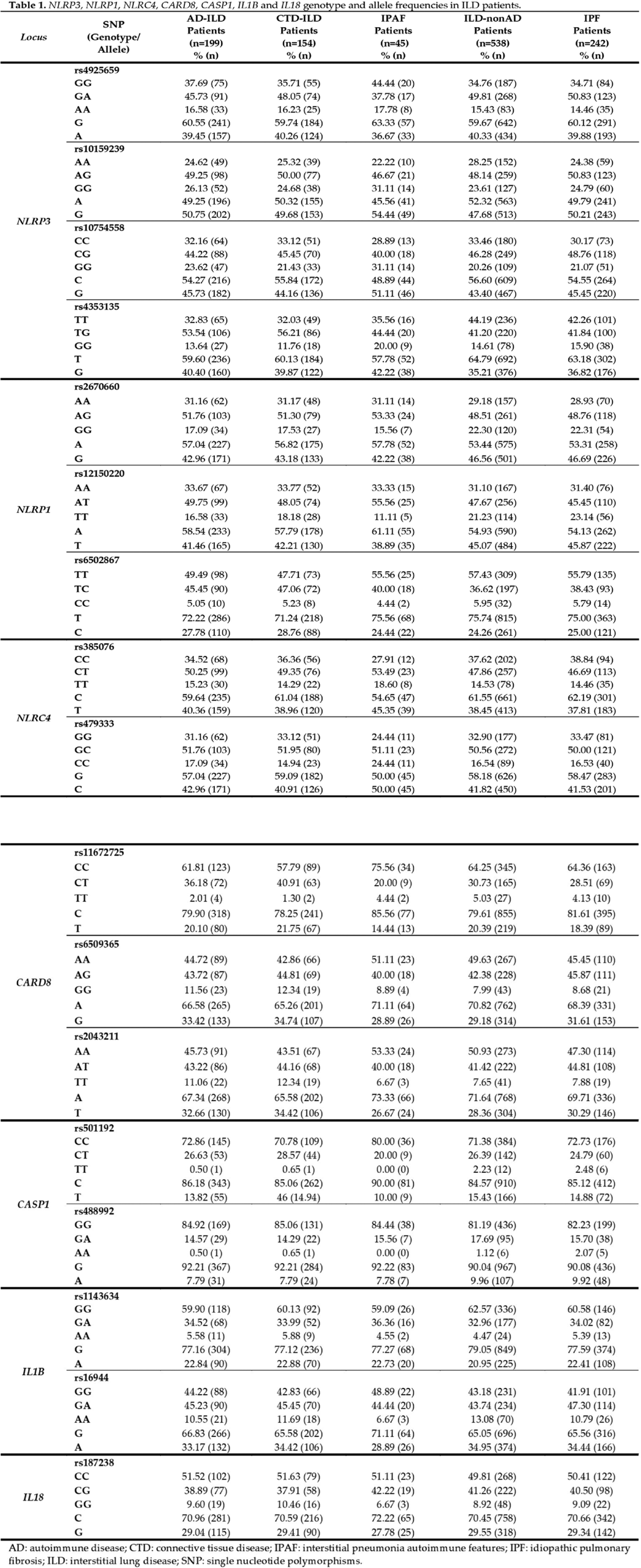
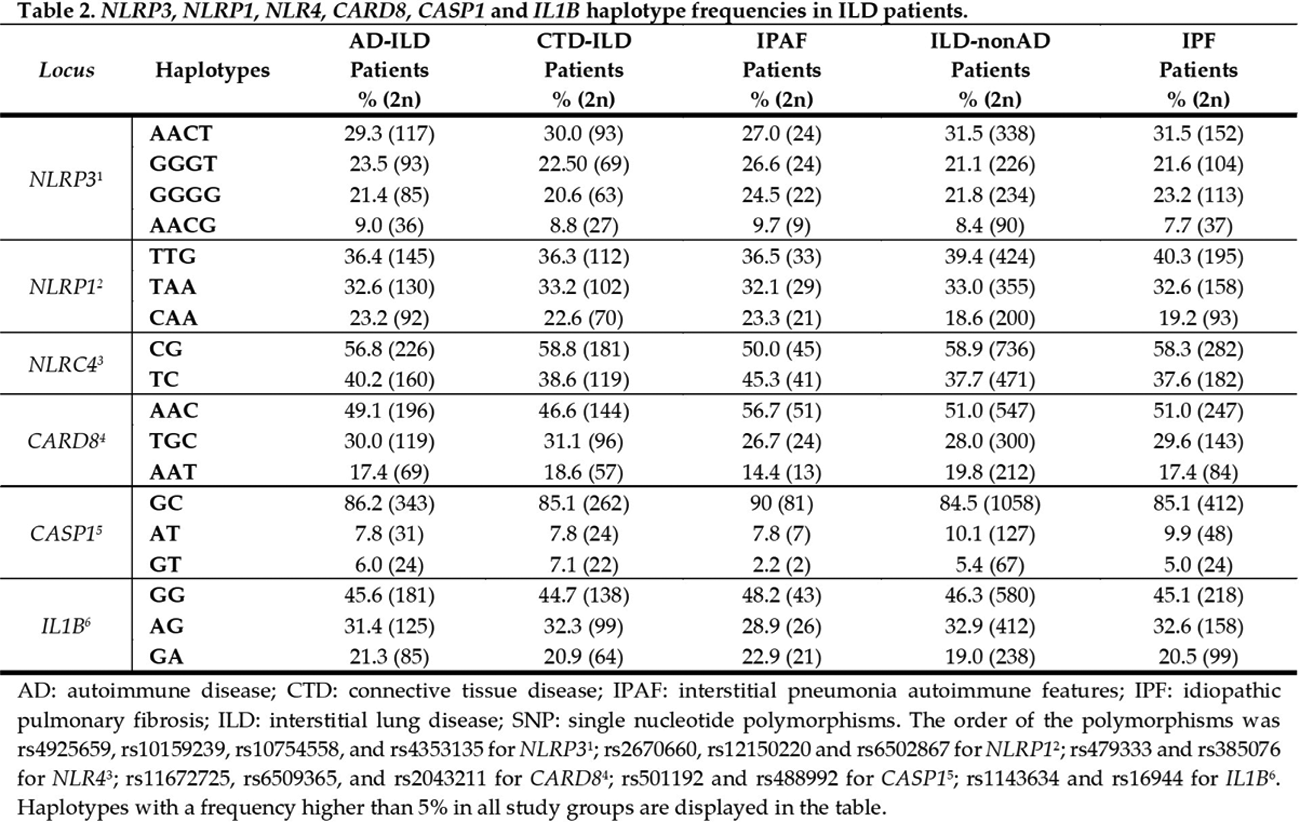
Results: The genotype distribution of all polymorphisms was in Hardy-Weinberg equilibrium, and the genotype and allele frequencies were consistent with those reported in the 1000 Genomes Project for Europeans. We compared genotype, allele, and haplotype frequencies between the whole cohort of patients with AD-ILD and those with ILDs without an underlying AD (ILD-nonAD). No statistically significant differences were found between these groups ( Tables 1 and 2 ). When AD-ILD patients were stratified, similar genetic distribution was found between patients with CTD-ILD and those with IPAF ( Tables 1 and 2 ). Further analyses revealed no genotypic, allelic, and haplotypic differences between patients with AD-ILD and those with IPF ( Tables 1 and 2 ).
Conclusions: Our findings do not support the idea that inflammasome-related polymorphisms play a significant role in accurately diagnosing AD-ILD, as they are not useful as biomarkers for discriminating AD-ILD from other ILDs.
REFERENCES: [1] Expert Rev Clin Immunol.2018;14(1):69-82
[2] MedComm. 2023 Oct 9;4(5):e391
[3] J Autoimmun. 2015 Jul:61:1-8.
Acknowledgments: NIL.
Disclosure of Interests: Verónica Pulito-Cueto: None declared, Joao Carlos Batista-Liz: None declared, Belén Atienza-Mateo: None declared, David Iturbe Fernández: None declared, Victor Manuel Mora-Cuesta: None declared, María Sebastián Mora-Gil: None declared, Carolina Aguirre Portilla: None declared, José M. Cifrián-Martínez: None declared, Ricardo Blanco Abbvie, Pfizer, Roche, Bristol-Myers, Lilly, Janssen, and MSD, Abbvie, MSD, and Roche, Raquel López-Mejías: None declared.