fetching data ... 
Background: Clonal hematopoiesis (CH) refers to the clonal expansion of hematopoietic progenitor-derived cells carrying somatic mutations, which can be readily detected in peripheral blood specimens [1]. Accumulating evidence has revealed a bidirectional interplay between CH and rheumatoid arthritis (RA): On one hand, somatic cells harboring CH driver mutations are capable of activating downstream inflammatory cascades and inducing immune dysregulation, thereby potentially promoting the initiation and progression of RA [2]. On the other hand, the sustained pro-inflammatory microenvironment characteristic of RA may serve as a pathogenic trigger for the acquisition of CH-related somatic mutations[3,4]. In this context, elucidating the bidirectional causal relationship between CH and RA will yield critical insights to inform the optimization of diagnostic algorithms and therapeutic strategies for patients with these conditions.
Objectives: Mendelian randomization (MR) is a genetic approach with the ability to assess and estimate the magnitude of a causal effect of an exposure on an outcome. Herein, this research aimed to examine the bidirectional causal relationship between overall CH, large CH, small CH, DNMT3A CH and TET2 CH and RA by leveraging the MR approach.
Methods: Genetic summary statistics for CH were retrieved from a previously published Genome-Wide Association Study (GWAS) by Kar et al., which included 173,918 controls and the corresponding cases (10,203 overall-CH, 4,049 large-CH, 6,154 small-CH, 5,185 DNMT3A-CH, and 2,042 TET2-CH) of predominantly European ancestry (
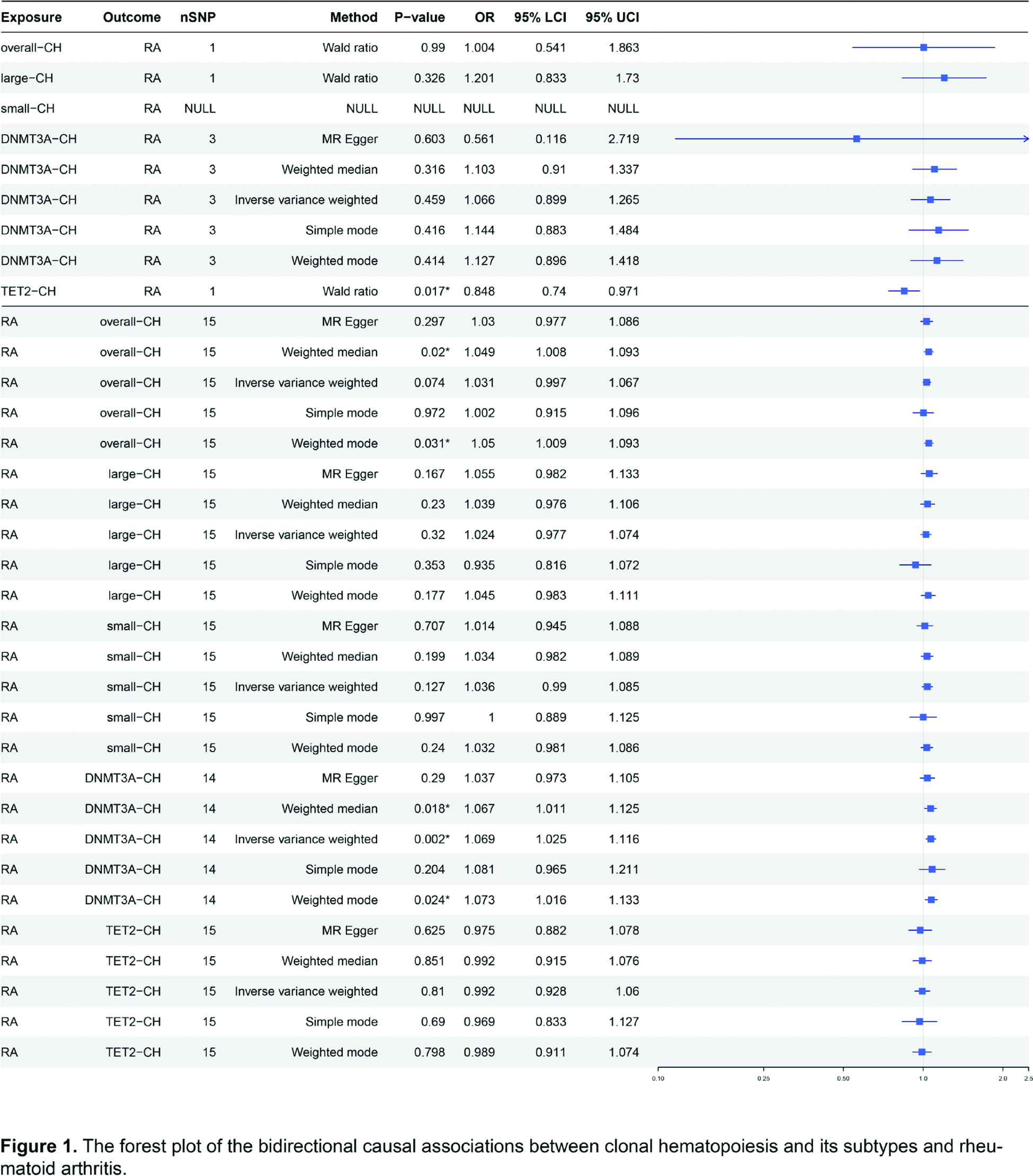
Results: The outcomes from MR analysis elucidated that genetically predicted RA causally increased the risk of overall-CH occurrence by weighted median (OR = 1.049, 95% CI [1.008, 1.093], p = 0.020) and weighted mode (OR = 1.050, 95% CI [1.009, 1.093], p = 0.031). Genetically proxied RA demonstrated a significant positive causal relationship with DNMT3A-CH by utilizing inverse variance weighted (OR = 1.069, 95% CI [1.025, 1.116], p = 0.002), weighted median (OR = 1.067, 95% CI [1.011, 1.125], p = 0.018) and weighted mode (OR = 1.073, 95% CI [1.016, 1.133], p = 0.024). Surprisingly, the MR approach detected that TET2-CH led to decreased RA risk by the Wald ratio (OR = 0.848, 95% CI [0.740, 0.971], p = 0.017), which should be interpreted rigorously. A variety of potential confounding factors, such as inappropriate selection of IVs and covariate interference, may affect the final result.
Conclusions: In this research, the evidence from MR revealed a potential causal relationship between RA and CH, highlighting the important impact of inflammation activation and immune dysregulation induced by RA in CH development. Future investigations should involve more expanded cohorts and stringent scientific approaches to further explore the underlying mechanistic associations behind them.
REFERENCES: [1] Jaiswal S, Ebert BL. Clonal hematopoiesis in human aging and disease. Science. 2019 Nov 1;366(6465):eaan4673. doi: 10.1126/science.aan4673
[2] Hiitola E, Korhonen J, Kokkonen H, Koskela J, Kankainen M, Alakuijala M, Liu A, Lundgren S, Häppölä P, Almusa H, Ellonen P, Savola P, Kelkka T, Leirisalo-Repo M, Koivuniemi R, Peltomaa R, Pirilä L, Isomäki P, Kauppi M, Kaipiainen-Seppänen O, Starskaia I, Virtanen AT, Lahesmaa R, Silvennoinen O; FinnGen; Genovese G, Ganna A, Rantapää-Dahlqvist S, Mustjoki S, Myllymäki M. Clonal hematopoiesis is associated with distinct rheumatoid arthritis phenotypes. Sci Adv. 2025 May 2;11(18):eadt9846. doi: 10.1126/sciadv.adt9846
[3] Kishtagari A, Corty RW, Visconte V. Clonal hematopoiesis and autoimmunity. Semin Hematol. 2024 Feb;61(1):3-8. doi: 10.1053/j.seminhematol.2024.01.012
[4] Savola P, Lundgren S, Keränen MAI, Almusa H, Ellonen P, Leirisalo-Repo M, Kelkka T, Mustjoki S. Clonal hematopoiesis in patients with rheumatoid arthritis. Blood Cancer J. 2018 Jul 26;8(8):69. doi: 10.1038/s41408-018-0107-2
Acknowledgments: NIL.
Disclosure of Interests: None declared.