fetching data ... 
Background: Arthritis is a leading cause of disability in older adults, yet little is known about how biological ageing (BA) relates to arthritis in Latin American populations. Chronological age (CA) alone often fails to capture the heterogeneity of ageing, as individuals of the same age can differ markedly in their physiological and functional decline. Biological ageing measures, such as the Klemera–Doubal Method Age (KDMAge) and PhenoAge, integrate information from multiple clinical biomarkers to estimate an individual’s underlying ageing process and risk of age-related disease. However, whether accelerated biological aging is associated with arthritis in older adults in the region has not been previously examined.
Objectives: To evaluate whether accelerated biological ageing (KDMAge and PhenoAge) is associated with arthritis in a nationally representative sample of Colombian adults aged ≥60 years, and to explore differences by sex and ageing trajectories.
Methods: We analysed 3,385 participants aged ≥60 years from SABE-Colombia 2015 who had complete biomarker and anthropometric data. Arthritis status was based on self-report of a prior medical diagnosis. Biological ageing was estimated using two established metrics, KDMAge and PhenoAge, derived from a panel of cardiometabolic, anthropometric, and haematological biomarkers. Age acceleration was defined as the residual of each biological age measure regressed on chronological age (ΔKDMAge, ΔPhenoAge), with positive residuals indicating accelerated ageing. Logistic regression models were used to assess associations between biological age acceleration and arthritis, progressively adjusting for demographic, socioeconomic, and lifestyle factors. Analyses were also stratified by sex.
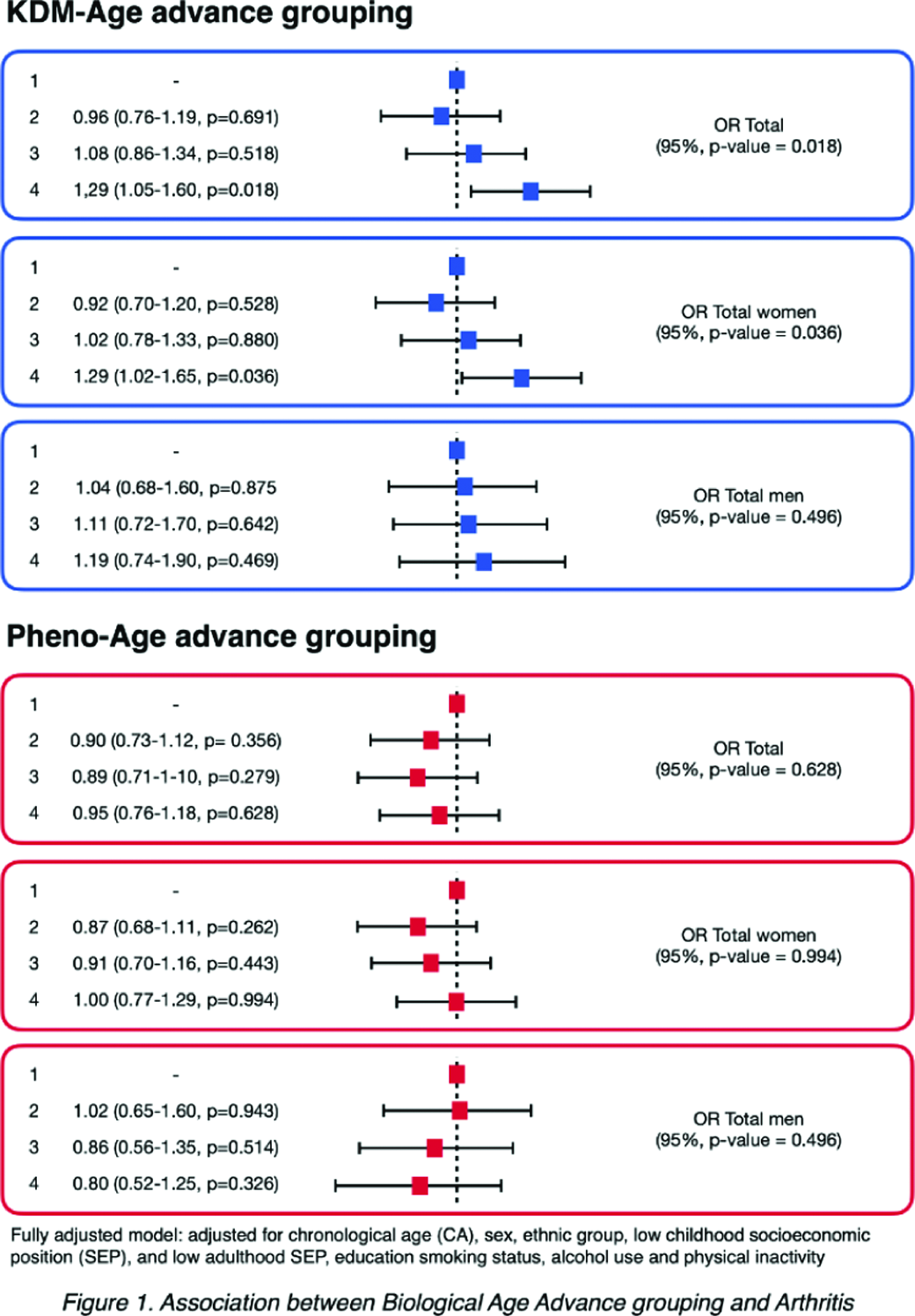
Results: Arthritis was present in 29.5 percent of participants (n=998). Compared with those without arthritis, affected individuals were older (70.0 vs. 68.8 years), predominantly women (77.7 percent vs. 52.4 percent), and showed a heavier burden of comorbidities, including obesity, cardiovascular disease, and diabetes. They also reported lower levels of physical activity and lower socioeconomic position. Biological ageing values were higher in the arthritis group for both KDMAge and PhenoAge, but only KDMAge distinguished cases from non-cases in a meaningful way. Participants with arthritis were, on average, 0.46 years biologically older according to KDMAge, and 52.4 percent of the entire sample showed accelerated aging (ΔKDMAge > 0), with acceleration being more frequent among those with arthritis. In multivariable models adjusted for demographics, socioeconomic factors, and lifestyle, each one-year increase in ΔKDMAge corresponded to a 3 percent increase in the odds of arthritis (OR 1.03; CI 1.01–1.05) (Table 1). PhenoAge showed no significant associations in any model. A clear dose–response gradient was observed: individuals in the highest KDMAge quartile had significantly greater odds of arthritis than those in the lowest quartile (p for trend <0.05) (Figure 1). Sex-stratified analyses revealed notable heterogeneity, the association between accelerated ageing and arthritis was evident only among women, where higher KDMAge quartiles and positive ageing residuals were consistently linked to greater odds of disease. No associations were observed in men.
Conclusions: Although the cross-sectional design prevents firm causal conclusions, our findings suggest that biological age particularly measured by KDMAge may capture a dimension of vulnerability to arthritis that chronological age alone does not reflect. This first analysis in a Latin American older population points to biological ageing as a potential marker of subclinical susceptibility to arthritis, especially among women, and highlights the need for longitudinal studies to clarify causal pathways and sex-specific mechanisms.
Association of biological aging measures with arthritis risk among older adults, Colombia, 2015
| Arthritis | ||
|---|---|---|
| Predictors | OR (95% IC) | CI |
| ∆KDMAge residual (units in years) | ||
| Unadjusted model | 1.03 | (1.01 –1.05) |
| Demographic adjusted model | 1.03 | (1.01 –1.05) |
| Socioeconomic position adjusted model | 1.03 | (1.01 – 1.05) |
| Lifestyle adjusted model | 1.03 | (1.01-1.05) |
| KDMAge acceleration (Yes) | ||
| Unadjusted model | 1.21 | (1.04 –1.40) |
| Demographic adjusted model | 1.21 | (1.04 – 1.42) |
| Socioeconomic position adjusted model | 1.22 | (1.04 – 1.42) |
| Lifestyle adjusted model | 1.22 | (1.04 –1.42) |
| ∆PhenoAge residual (units in years) | ||
| Unadjusted model | 0.96 | (0.94 –0.99) |
| Demographic adjusted model | 0.99 | (0.97-1.02) |
| Socioeconomic position adjusted model | 1.00 | (0.97 – 1.02) |
| Lifestyle adjusted model | 0.99 | (0.97 –1.02) |
| PhenoAge acceleration (Yes) | ||
| Unadjusted model | 0.83 | (0.66 – 1.03) |
| Demographic adjusted model | 1.00 | (0.80 – 1.26) |
| Socioeconomic position adjusted model | 1.00 | (0.80 – 1.26) |
| Lifestyle adjusted model | 1.00 | (0.80 –1.26) |
REFERENCES: NIL.
Acknowledgments: NIL.
Disclosure of Interests: julian arias: None declared, Pedro Santos-Moreno Abbvie, Abbott, Biopas-UCB, Bristol, Janssen, Pfizer, Roche, Sanofi., Abbvie, Abbott, Biopas-UCB, Bristol, Janssen, Pfizer, Roche, Sanofi., Mariangel Zapata-Victoria: None declared, Jessica Vargas: None declared, Juan Carlos Rivillas: None declared.