fetching data ... 
Background: Gout is a chronic inflammatory joint disease and an increasingly important public health burden worldwide. Estimates from the Global Burden of Disease (GBD) Study 2021 indicate sustained increases in gout prevalence and years lived with disability (YLDs) since 1990, particularly in high-income regions, with a consistently higher burden observed in men than in women. Against this backdrop, the European Union (EU) has undergone substantial demographic and lifestyle transitions that are likely to influence gout burden; however, comprehensive assessments of long-term trends, sex-specific patterns, and the contribution of modifiable risk factors across EU member states remain limited.
Objectives: This study aimed to characterise the epidemiological burden of gout across the EU from 1990 to 2023, with particular emphasis on long-term trends, sex differences, and the contribution of major modifiable risk factors.
Methods: Data were obtained from the GBD 2023 study, which synthesises worldwide data to generate comprehensive estimates of fatal and non-fatal health loss for 375 diseases and injuries across 204 countries and territories. Using these data, the burden of gout across all 27 EU member states was assessed based on estimates of prevalence and YLDs. Absolute counts and age-standardised rates (ASRs) per 100,000 population were calculated, along with corresponding 95% uncertainty intervals (UIs). Estimates were stratified by sex, country, and age, using 5-year age groups from 0 to 94 years, with an open-ended category for individuals aged 95 years and older. Temporal trends in ASRs from 1990 to 2023 were evaluated using joinpoint regression, with annual percentage change (APC) and average annual percentage change (AAPC) used to quantify changes over time. Furthermore, to assess the contribution of modifiable risk factors, we quantified the proportion of gout-related YLDs attributable to high body mass index (BMI) and kidney dysfunction across EU member states and examined associated sex-specific differences.
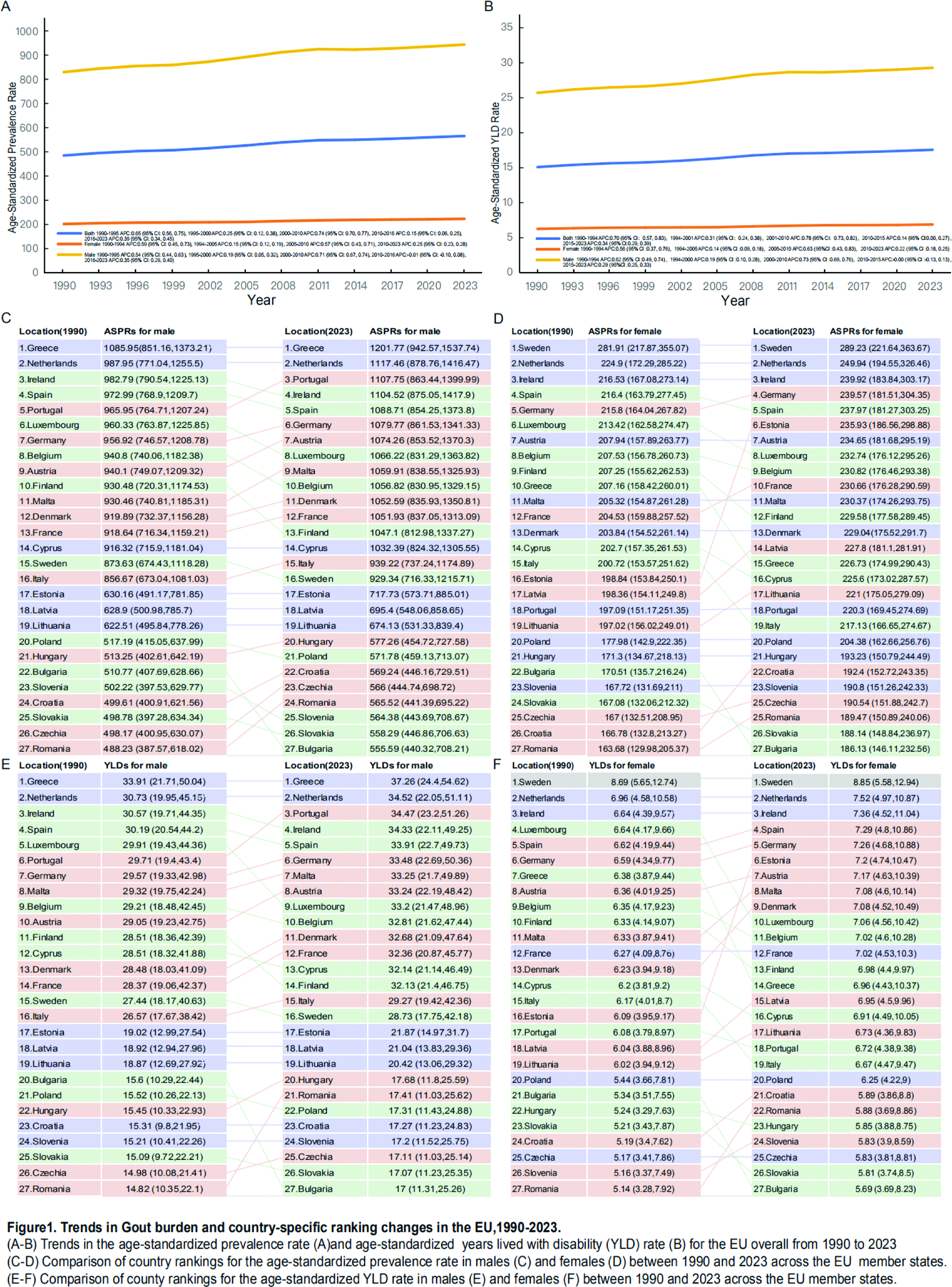
Results: From 1990 to 2023, the age-standardized prevalence rates (ASPRs) of gout increased across the EU, with an overall AAPC of 0.40% (95% CI 0.36–0.43). A faster rise was observed among males (AAPC 0.47%, 95% CI 0.44–0.50) than females (AAPC 0.31%, 95% CI 0.28–0.34), and males consistently exhibited higher ASPRs than females. At the country level, substantial heterogeneity in gout prevalence was observed. Among males, Greece consistently recorded the highest ASPR in both 1990 and 2023, while the Netherlands remained among the countries with the second highest prevalence. Among females, Sweden consistently ranked highest in both 1990 and 2023, with the Netherlands and Ireland also remaining among the countries with the highest female ASPRs over time. From 1990 to 2023, the age-standardized rate (ASR) of YLDs attributable to gout in the EU showed a sustained upward trend, with an overall AAPC of 0.40% (95% CI 0.37–0.43). Growth in gout-related YLDs was faster among males (AAPC 0.47%, 95% CI 0.43–0.50) than females (AAPC 0.29%, 95% CI 0.25–0.34), and males consistently experienced a higher YLD burden than females. Marked country-level variation in gout-related YLDs was evident. Greece and the Netherlands ranked among the highest-burden countries for males in both 1990 and 2023, whereas Ireland consistently remained within the top tier. Among females, the Netherlands and Ireland were persistently ranked among the countries with the highest YLD rates across the study period. In 2023, high BMI and kidney dysfunction were the leading modifiable risk factors for gout-related YLDs across EU member states, accounting for 39.73%–48.68% and 13.30%–34.96% of YLDs, respectively. Pronounced sex differences were observed in risk attribution: high BMI contributed more substantially to gout-related YLDs in men, whereas kidney dysfunction accounted for a higher proportion of YLDs in women across most EU countries.
Conclusions: From 1990 to 2023, the burden of gout in the EU increased substantially, as reflected by rising prevalence and YLDs, with pronounced sex-specific differences. Together, these findings underscore the importance of early and targeted preventive strategies addressing major modifiable risk factors—particularly high BMI and kidney dysfunction—to mitigate the growing burden of gout.
REFERENCES: [1] Dalbeth N, Gosling AL, Gaffo A, Abhishek A. Gout. Lancet. 2021;397(10287):1843-55.
[2] Wang J, Zhao Y, Zhao B, Zhang Y. Global burden and future projections of geriatric gout (1990-2021): a comprehensive analysis and Bayesian Age-Period-Cohort modeling. Front Public Health. 2025;13:1577265.
[3] Safiri S, Kolahi AA, Cross M, Carson-Chahhoud K, Hoy D, Almasi-Hashiani A, et al. Prevalence, Incidence, and Years Lived With Disability Due to Gout and Its Attributable Risk Factors for 195 Countries and Territories 1990-2017: A Systematic Analysis of the Global Burden of Disease Study 2017. Arthritis Rheumatol. 2020;72(11):1916-27.
[4] Li Y, Chen Z, Xu B, Wu G, Yuan Q, Xue X, et al. Global, regional, and national burden of gout in elderly 1990-2021: an analysis for the global burden of disease study 2021. BMC Public Health. 2024;24(1):3298.
[5] Global, regional, and national burden of gout, 1990-2020, and projections to 2050: a systematic analysis of the Global Burden of Disease Study 2021. Lancet Rheumatol. 2024;6(8):e507-e17.
Acknowledgments: NIL.
Disclosure of Interests: None declared.