fetching data ... 
Background: Timely assessment of patients with suspected inflammatory back pain (IBP) is essential to support early diagnosis of axial spondyloarthritis (axSpA), as diagnostic delay is associated with worse functional outcomes, reduced quality of life and increased healthcare utilisation [1]. However, access to specialist rheumatology services remains limited due to workforce shortages. The British Society for Rheumatology recommend a benchmark of Consultant Rheumatologist to population of approximately 1:90,000 [2]. At Royal Berkshire Hospital the ratio is only 0.54:90,000. Workforce transformation initiatives include expanding advanced practice roles to improve service efficiency and increase access to specialist services [3]. Advanced Practice Physiotherapist (APP)–led pathways for suspected IBP may therefore help reduce waiting times, improve specialist access, and support earlier diagnosis.
To assess the effectiveness of an APP-led clinic assessing new IBP patients.
To determine the diagnostic yield from referral to confirmed AxSpA.
To estimate consultant rheumatology clinic time saved through APP-led new patient IBP clinics
Methods: A prospective service evaluation was conducted within an APP-led rheumatology clinic between May and October 2025. Two new patients with suspected IBP were assessed per clinic. All patients underwent clinical assessment and, where indicated, investigations aligned with EULAR/ASAS AxSpA guidance [4]. Data collected included patient numbers, referral source, APP clinical suspicion of AxSpA, MRI referrals and outcomes, CRP and HLA-B27 status, confirmed diagnoses, and subsequent clinical pathways. Descriptive analysis summarised findings, including referral sources, diagnostic yield (conversion rate of referral to diagnosis) and service impact. Consultant time saved was calculated from new referrals managed independently by the APP.
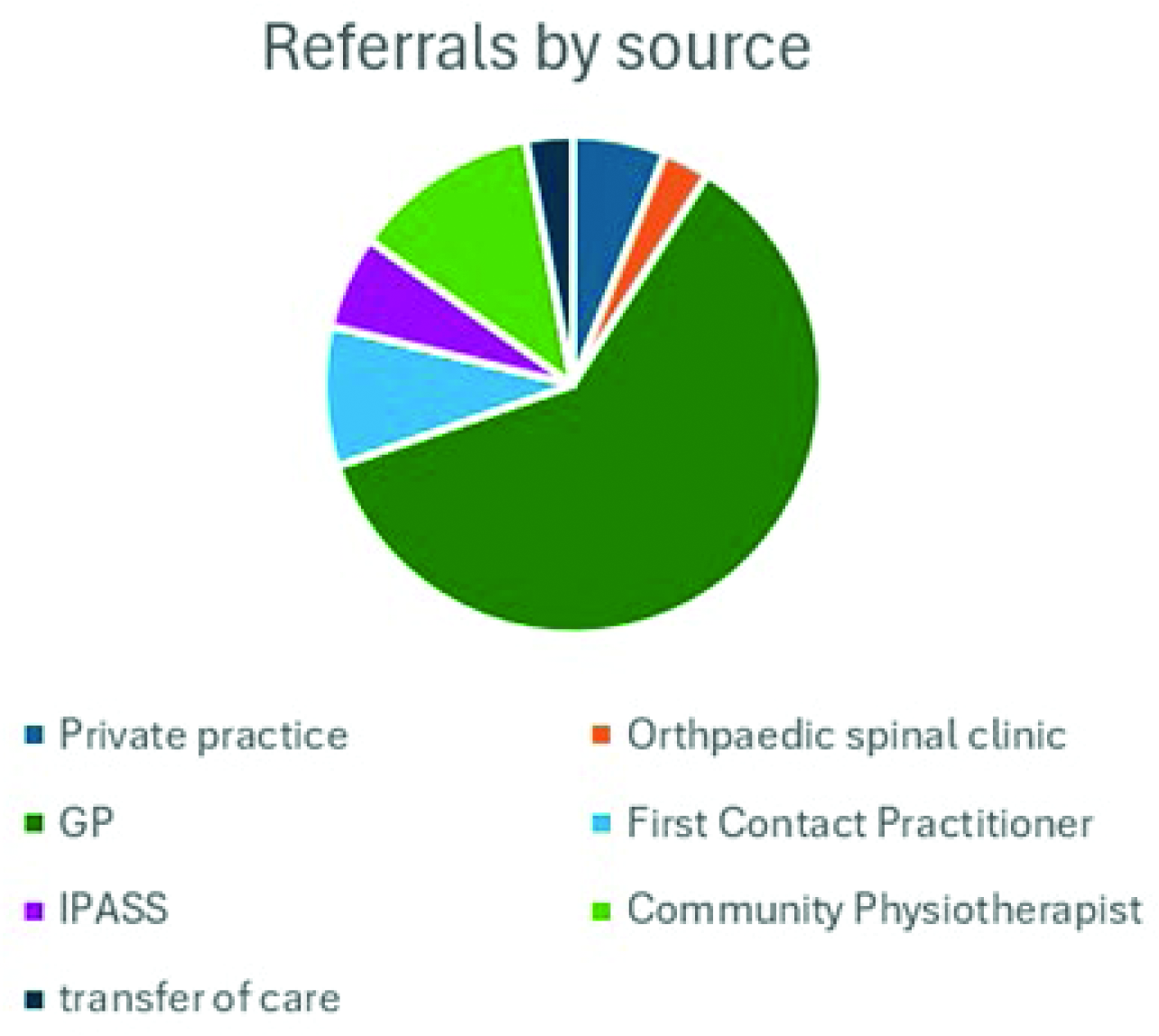
Results: During the period reviewed, thirty-three new patients were assessed within the APP-led IBP clinic (63.6% female; median age 39 years). The majority of referrals originated from general practice doctors (GP 60.6%), followed by Community physiotherapy (12.1%), First Contact Practitioners (9.1%), Integrated Pain and Spinal Service - IPASS (6.1%), private practice (6.1%), Orthopaedic Spinal Clinic (3.0%) and transfer of care from another hospital (3.0%). AxSpA was diagnosed in 39.4% (13/33) overall. The APP clinically suspected axSpA in 45.5% (15/33) of patients referred - in this cohort diagnostic yield was markedly higher at 86.7% (13/15). Among diagnosed cases, MRI evidence supportive of axSpA was present in 84.6%, while HLA-B27 positivity (66.7% and elevated CRP (45.5%) were more frequent than in non-axSpA. Clinical pathway outcomes differed by diagnosis: all axSpA patients remained under rheumatology follow-up, whereas 83.3% of non-axSpA patients were discharged. Diagnostic yield varied by referral source, GP 25.0% (5/20), Community Physiotherapist 75.0% (3/4), FCP 33.3% (1/3), IPASS 0% (0/2), private practice 100% (2/2), spinal clinic 100% (1/1), and transfer of care 100% (1/1). The APP independently managed all 33 assessments, equivalent to 33 consultant new-patient slots saved, increasing to an estimated 60 slots or 30 hours when time associated with clinical adminstrative tasks such as reviewing and actioning investigations and results were included.
Conclusions: An APP-led IBP clinic delivered robust diagnostic performance, with axSpA conversion rates from referral (39.4%) aligning with or exceeding benchmarks from early axSpA referral studies such as SPACE [5] and RADAR [6]. This may reflect previous work at the Royal Berkshire Hospital to improve referral and triage pathways [7]. The substantially higher diagnostic yield where APP clinical suspected aXSpA (86.7%) highlights the diagnostic value of APP assessment and suggests that, as confidence in the pathway grows, diagnostic costs may fall through more selective MRI use. Continued education of community referrers remains essential to support appropriate referral and maximise diagnostic yield. The APP-led model produced substantial resource savings, avoiding 33 consultant new-patient appointments and an estimated 30 hours including administrative workload, demonstrating capacity gains and efficiency in early axSpA assessment. This capacity will allow earlier access to Rheumatology services for patients with other suspected conditions. As the APP progresses into a prescribing role, pathway efficiency should improve further.
Referrals in to the APP-led IBP clinic by source
REFERENCES: [1] Zhao SS., Pittam B., Harrison NL., Ahmed AE., Goodson NJ., Hughes DM. Diagnostic delay in axial spondyloarthritis: a systematic review and meta-analysis. Rheumatology (Oxford). 2021;60(4):1620-8
[2] British Society for Rheumatology (2021) *Rheumatology Workforce: A Crisis in Numbers*. London: BSR.
[3] GIRFT (2021) *Rheumatology: GIRFT Programme National Specialty Report*. London: NHS Getting It Right First Time
[4] Ramiro S., Nikiphorou E., Sepriano A., Ortolan, A., Webers, C., Baraliakos, X., et al . ASAS-EULAR recommendations for the management of axial spondyloarthritis: 2022 update. Annals of the Rheumatic Diseases. 2023;82(1):19-34.
[5] Abawi, O., van der Heijde, D., van den Berg, R., Ramonda, R., Marchesoni, A., Landewé, R., et al . (2017) ‘Evaluation of referral strategies for axial spondyloarthritis in the SPACE cohort’, Annals of the Rheumatic Diseases, 76(9), pp. 1633–1639
[6] Sieper, J., Srinivasan, S., Zamani, O., Mielants, H., Choquette, D., Pavelka, K., et al.(2013) ‘Comparison of two referral strategies for diagnosis of axial spondyloarthritis: the Recognising and Diagnosing Ankylosing Spondylitis Reliably (RADAR) study’, Annals of the Rheumatic Diseases, 72(10), pp. 1621–1627.
[7] Chan, A., Rigler, K., Ahmad, N. and Lafont, T. (2024) ‘Progressive improvement in time to diagnosis in axial spondyloarthritis through an integrated referral and education system’, Rheumatology Advances in Practice, 8(4), rkae102
Acknowledgments: NIL.
Disclosure of Interests: Kathryn Rigler: None declared, Ignacio MedinaMarchant: None declared, Antoni Chan Novartis, UCB, Abbvie, Medac