fetching data ... 
Background: Haemophagocytic lymphohistiocytosis/Macrophage Activation Syndrome (HLH/MAS) is a hyperinflammatory condition associated with autoimmune diseases such as Adult-Onset Still’s Disease (AOSD) and Systemic Lupus Erythematosus (SLE). The pathogenesis involves excessive activation of macrophages, leading to cytokine storm, tissue damage, and high mortality. However, the upstream molecular drivers that mediate inflammasome activation in HLH/MAS remain incompletely understood.
Objectives: This study aims to identify the role of Macrophage Scavenger Receptor 1 (MSR1) in MAS pathogenesis and to determine its potential as a diagnostic biomarker and therapeutic target.
Methods: The study employed single-cell RNA sequencing, flow cytometry, qPCR, and ELISA to assess MSR1 expression in peripheral blood mononuclear cells (PBMCs) from patients with AOSD, SLE, and healthy controls. Soluble MSR1 (sMSR1) levels in plasma were quantified via ELISA and correlated with clinical features. MAS murine model was induced via repeated CpG stimulation in wild-type (WT) and MSR1-deficient (global and myeloid-specific knockout) mice. Transcriptomic profiling and Gene Set Enrichment Analysis (GSEA) were used to characterize downstream signaling. Functional assays including mitochondrial ROS quantification, inflammasome activation assays, and pharmacologic inhibition (Fucoidan, Mito-TEMPO) were performed to dissect the MSR1–mtROS–NLRP3 axis.
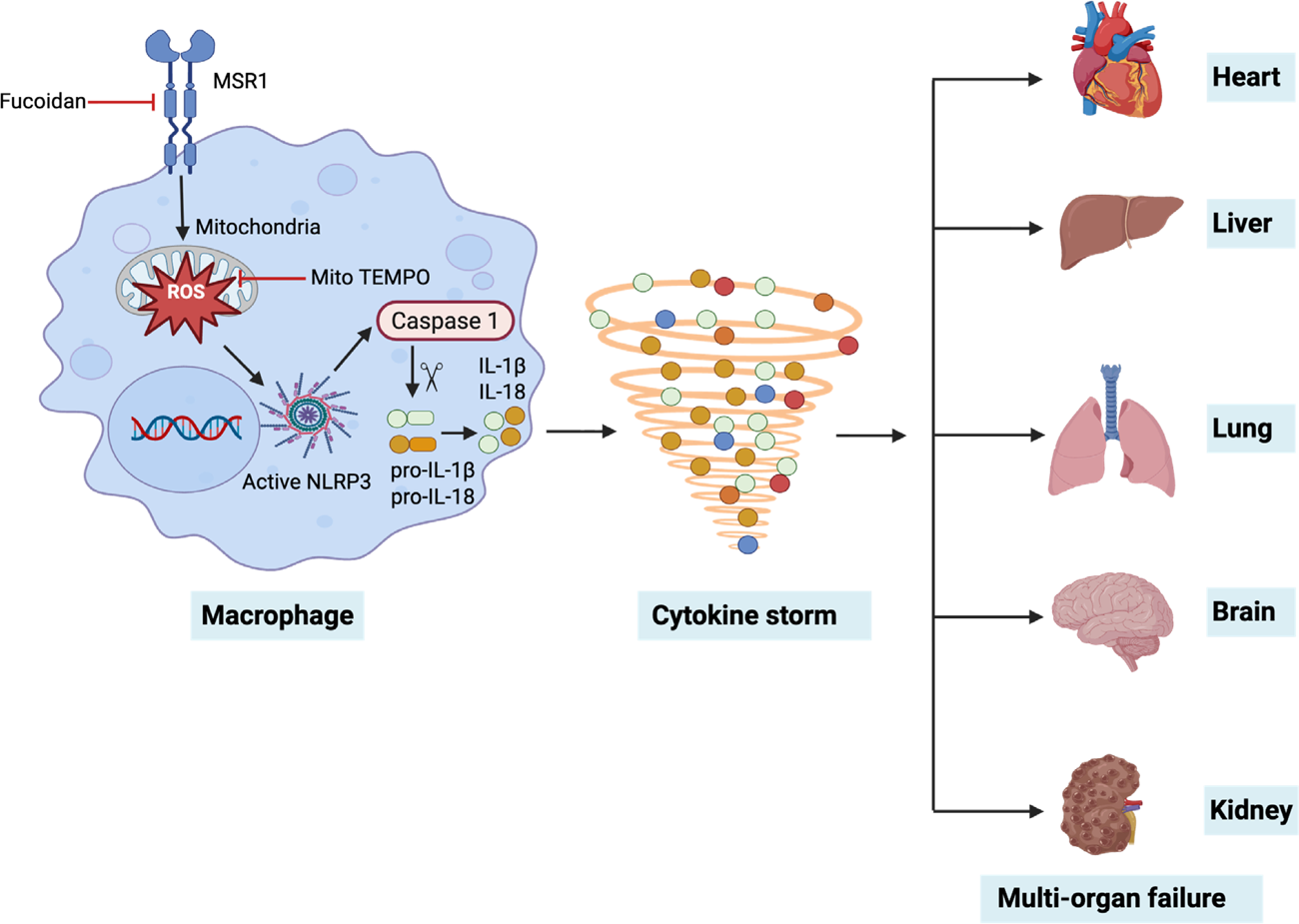
Results: MSR1 was significantly upregulated in a subset of circulating monocytes in AOSD and SLE patients, accompanying with elevated soluble MSR1 (sMSR1) levels correlating with disease activity, therapeutic response, and HLH onset of AOSD. In CpG-induced MAS mouse models, MSR1 expression increased in liver macrophages. MSR1-deficient mice showed reduced systemic inflammation, cytokine production, hepatosplenomegaly, and hemophagocytosis. Mechanistically, MSR1 promoted mitochondrial ROS production, which activated the NLRP3 inflammasome, leading to IL-1β and IL-18 release. MSR1 knockout or pharmacologic inhibition suppressed these pathways. Myeloid-specific deletion of MSR1 recapitulated protective effects seen in global knockout mice.
Conclusions: MSR1 serves as a novel biomarker and functional regulator of HLH/MAS, functioning through a mtROS–NLRP3 inflammasome axis. Its expression correlates with disease severity and response to treatment, suggesting both diagnostic and therapeutic potential. Targeting MSR1 could represent a novel strategy for managing HLH, particularly in autoimmune-related forms.
This diagram illustrates the mechanism by which MSR1 facilitates NLRP3 inflammasome activation via promoting mitochondrial ROS (mtROS) production in macrophage, ultimately leading to cytokine storm and multi-organ failure in macrophage activation syndrome/haemophagocytic lymphohistiocytosis.
REFERENCES: NIL.
Acknowledgments: NIL.
Disclosure of Interests: None declared.