fetching data ... 
Background: Approximately 40% of rheumatoid arthritis (RA) patients show inadequate responses to first-line DMARDs despite therapeutic advances. The established RF/ACPA serological classification and current clinical tools suffer from limitation in reliably predicting treatment response and risk of joint erosion. Addressing this significant challenge to precision medicine requires novel biomarkers that can provide insights forecasting disease outcomes and guiding therapeutic decisions. Risk stratification of several diseases, including rheumatic diseases, may be enhanced through integration of serum protein signatures with clinical features [1].
Objectives: This study aimed to identify serum biomarkers predictive of RA disease activity and progression through comprehensive longitudinal proteomic analysis using data-independent acquisition mass spectrometry (DIA-MS).
Methods: Serum samples were obtained from DMARD- and steroid-free RA patients enrolled in the EUPA cohort (NCT00512239) from 2005 to 2019, at the CIUSSS de l’Estrie-CHUS, Québec, Canada [2]. Serial sera collected at baseline and at the 12-month follow-up visit from 48 seronegative and 59 seropositive patients were analyzed by DIA-MS. DIA-NN software was used to perform peptides and proteins identification and label-free quantification from mass spectrometry data. R software was used to conduct all statistical analyses: Differentially abundant proteins (DAPs) across clusters were identified by Mann–Whitney U test with Bonferroni correction. The PathfindR R package was used to perform KEGG pathway enrichment analyses, with Benjamini-Hochberg correction. Longitudinal (baseline and 12-month) serum proteome was analyzed using Generalized estimating equations (GEE) models, which were adjusted for age, sex, serology, and symptom duration, with binomial disease activity (DA) outcome defined as DAS28-CRP ≤2.6 (remission) or ≥3.2 (Active). False discovery rate (FDR) correction was applied to GEE results using Storey’s q-value.
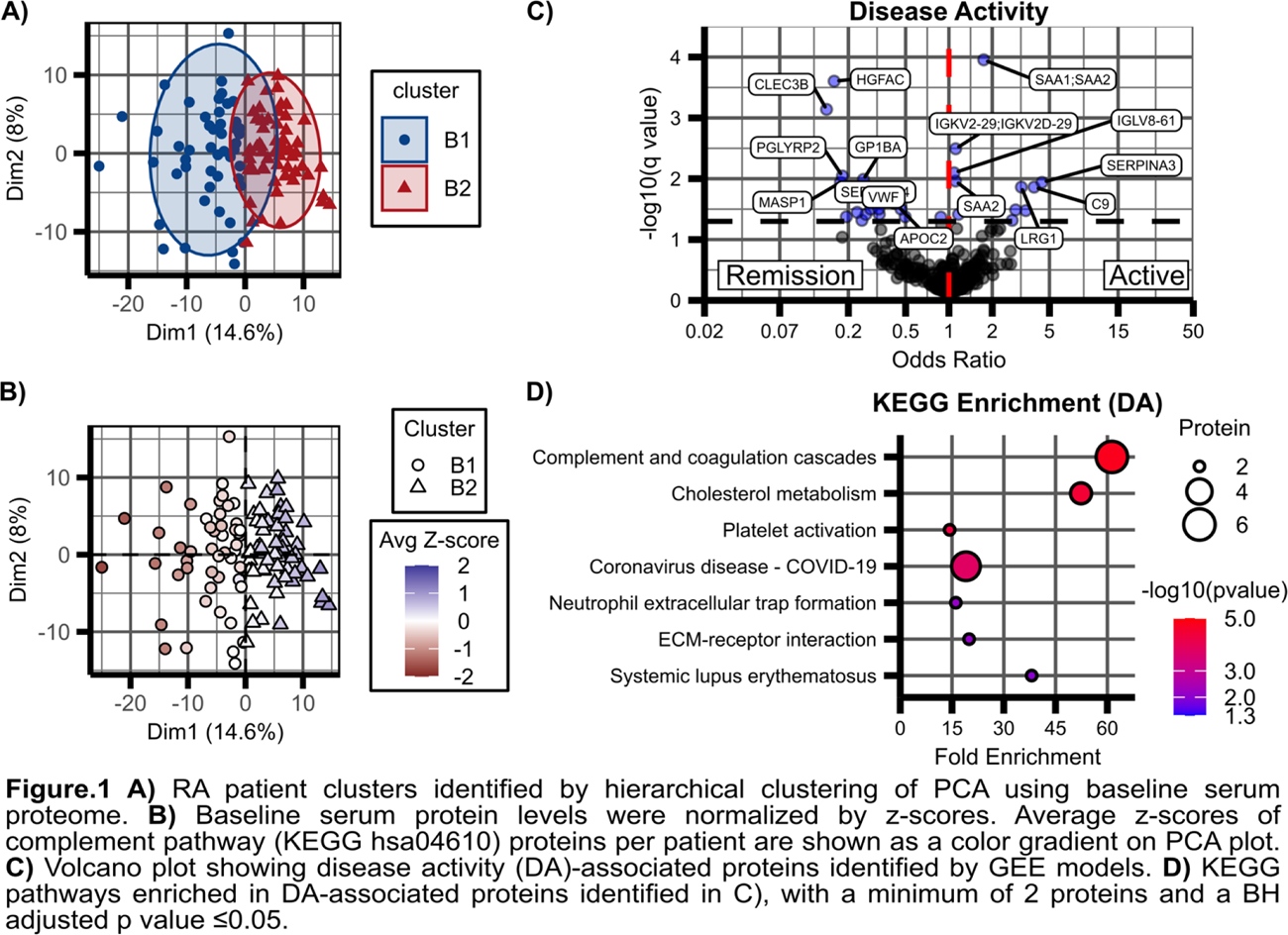
Results: DIA-MS analysis of RA serum proteome allowed quantification of 869 proteins, from which 368 passed our quality control and filtering thresholds prior to downstream statistical analyses. We first performed hierarchical clustering on principal component analysis (PCA) of baseline (Figure 1A) and 12-month proteomic data. Patients could be grouped into two clusters, an optimal number of clusters that was determined by silhouette score. Serum DAPs were identified between patient clusters and KEGG pathway analyses revealed significant enrichment of proteins related to complement and coagulation cascades pathway. Distinct serum levels of complement-related proteins were observed between patient clusters, as visualized by their average normalized z-scores (Figure 1B). The trajectories between baseline and 12-month serum-based clusters was assessed and transitions between clusters were associated with significant changes of complement-related protein levels. Longitudinal serum proteome analyses by GEE models identified 29 proteins (q-value ≤0.05) associated with 12-month DA (Figure 1C), including previously reported proteins (SAA1, SAA2 and LRG1). Furthermore, these proteins were significantly enriched for complement and coagulation cascades KEGG pathway (Figure 1D). Notably, several individual protein components of complement pathway showed divergent association with DA outcome: C9 and SERPINA1 with active disease, and C1QB, F13B, MASP1, VWF with remission.
Conclusions: Longitudinal serum proteomic profiling reveals heterogeneity in circulating complement components among early RA patients. Complement protein signatures may reflect underlying disease mechanisms beyond general inflammation. Given that complement-targeting therapies are clinically approved, these findings underscore the potential for biomarker-driven approaches to RA management and warrant further investigation.
REFERENCES: [1] Carrasco-Zanini J. Nat Med 2024; 30:2489-2498
[2] Carrier N. J Rheumatol 2024; 52: 119-127
Acknowledgments: NIL.
Disclosure of Interests: Benoit Marchand: None declared, Nathalie Carrier: None declared, Elizabeth Beaulieu: None declared, Dominique Lévesque: None declared, Barath Ramanathan: None declared, François-Michel Boisvert: None declared, Sophie Roux Kyowa Kirin, Amgen, Kyowa Kirin, Apotex, Kyowa Kirin, Insmed, Javier Marrugo: None declared, Gilles Boire Biocon Biologics, Biocon Biologics, Hugues Allard-Chamard Abbvie, Amgen, AstraZeneca, BMS, Celltrion, Eli Lilly, Hoffmann-La Roche, Fresenius Kabi, GSK, Janssen, Novartis, Otsuka, Mantra Pharma, Pfizer, Sandoz, Sobi., Abbvie, Amgen, AstraZeneca, Celltrion, Eli Lilly, GSK, Hoffmann-La Roche, Janssen, Fresenius Kabi, Novartis, Pfizer, Sandoz, Sobi., AstraZeneca, Eli Lilly, Fresenius Kabi, Pfizer.