fetching data ... 
Background: Autoimmune diseases such as rheumatoid arthritis and psoriatic arthritis affect millions globally, leading to chronic inflammation, tissue damage, and considerable morbidity. Therapeutic arsenal remains limited, with most interventions targeting downstream, symptom-focused pathways—often unable to halt progression or reverse tissue injury. Cytokine-mediated pathways are central to the pathogenic process, involving proinflammatory cytokine secretion by cells from the innate and adaptive immune compartments as well as from fibroblast-like synoviocytes, eventually leading to articular destruction. These proinflammatory cytokines are postulated to be key in initiating and maintaining the pathogenic process. Importantly, the immune attack goes unnoticed during several years and, when clinical disease is apparent, joints are already affected. Disease-Modifying Antirheumatic Drugs (DMARDs) mainly act by blocking cytokine binding to its receptor, blocking the receptor itself, or inhibiting the JAK/STAT intracellular signalling. These are all late inflammation phases, when proinflammatory cytokines have already been secreted, and the extracellular milieu is highly pathogenic. There is an urgent need for innovative therapies capable of intercepting pathogenic immune signalling at upstream molecular checkpoints, thereby restoring immune homeostasis prior to extensive cytokine-mediated damage.
Objectives: We postulate that targeting the earliest inflammation stages, by limiting the production and/or secretion of proinflammatory cytokines, would lead to a less proinflammatory microenvironment capable of controlling inflammation and autoimmunity.
Methods: We performed a target-agnostic, high-throughput screening of a chemically diverse library, including both repurposing drugs and novel molecules, in primary peripheral blood mononuclear cells (PBMCs) stimulated with PAMPs and/or DAMPs. After a biophysical and a phenotypic screening, several candidates were identified for their ability to suppress proinflammatory cytokine secretion (TNF, IL-1β, IFN-γ). Cell viability was confirmed by flow cytometry, and cytokine production was quantified by ELISA or Luminex in culture supernatants. Compound #11 exhibited pronounced efficacy, particularly under PAMP+DAMP challenge. Its activity was validated in PBMCs from healthy donors as well as RA and PsA patients. The mechanism of action was investigated using THP-1 reporter cells via advanced fluorescence-based kinetic microscopy. Gene expression profiles were evaluated via qPCR and RNA-seq following RNA isolation. Phospho-flow cytometry is underway to evaluate the functional effects of the compound.
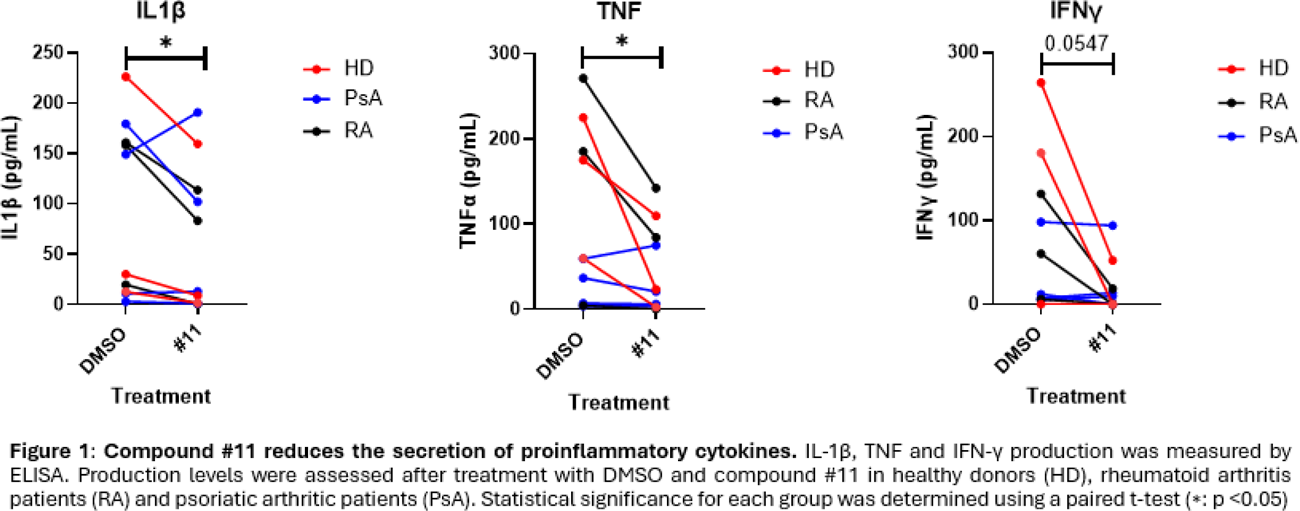
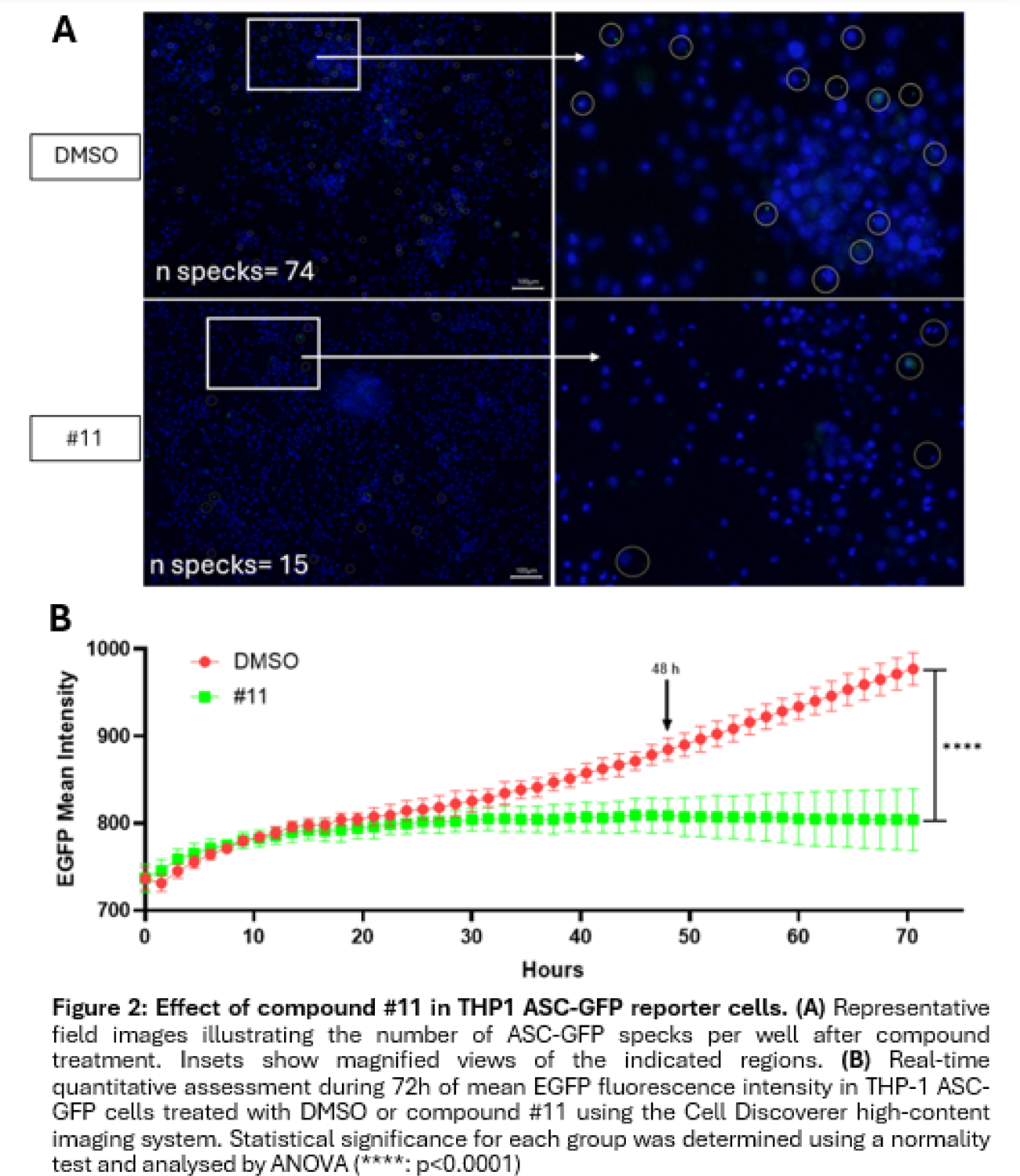
Results: Compound #11 exhibited pronounced efficacy in reducing the secretion of proinflammatory cytokines (IL-1β, TNF and IFN-γ) by PAMP+DAMP treated PBMCs from healthy donors, and patients with RA and PsA ( Figure 1 ). Mechanistic insights were gained with THP-1 reporter cells for NFκB and IRF3, showing significant downregulation of both pathways. Subsequent characterization in THP-1 ASC-GFP reporter monocytic cells revealed robust inhibition of inflammasome assembly by Compound #11, visualized by flow cytometry and in real time during 72h using advanced fluorescence-based kinetic microscopy, which showed a significant decrease in mean fluorescence intensity in treated cells. Real-time high-content imaging enabled dynamic quantification of ASC speck formation and inflammasome kinetics, providing mechanistic insights into compound activity at a subcellular level and indicating reduced cellular activation ( Figure 2 ). Gene expression profiling (qPCR) in PBMCs revealed a significant reduction in the expression of IL1B , TNF and NLRP3, highlighting a mechanistic axis targeting both canonical signalling and inflammasome machinery. Ongoing phospho-flow cytometry aims to complement these findings by analysing key proteins involved in proinflammatory signalling pathways, such as STAT5 , p65, Akt and ERK1/2 . Transcriptomic (RNA-seq) analysis revealed robust downregulation of cell cycle and inflammatory gene sets (MYC targets V1/V2, E2F, G2M checkpoint, interferon responses, oxidative phosphorylation, IL6/JAK/STAT3 signalling), with selective upregulation of myogenesis, cholesterol homeostasis, coagulation and inflammatory pathways (PIK3IP1) These data support a global anti-inflammatory and cell cycle modulatory signature.
Conclusions: In summary, compound #11 demonstrates upstream immunomodulatory capacity across several autoimmune backgrounds by targeting both NFκB/IRF3 axes and the inflammasome pathway, providing a promising candidate for broad-spectrum therapeutic intervention.
REFERENCES: NIL.
Acknowledgments: NIL.
Disclosure of Interests: None declared.