fetching data ... 
Background: The prevalence of autoimmune diseases is higher in women than in men, with notable gender-related differences observed in clinical manifestations, symptomatology, pharmacokinetics, and the incidence of adverse drug reactions across various conditions. Rheumatoid arthritis (RA) occurs with a higher prevalence in women, whereas a comparable prevalence between women and men applies to psoriatic arthritis (PsA), and men have a higher prevalence of axial spondyloarthritis (axSpA) than women. However, treatment responses to TNFi and treatment persistence have been shown to differ in favor of men in both RA, PsA, and axSpA, although some studies show no significant difference by sex or gender [1,2].
Women have higher immunoglobulin levels and stronger antibody responses than men, which may increase anti-drug antibody (ADAs) formation. Higher body fat, proinflammatory sex hormones, and psychological factors such as coping and adherence may further reduce TNFi response [3].
Infliximab and adalimumab, immunogenic monoclonal antibodies targeting TNF receptors, can induce ADAs formation, leading to reduced efficacy and infusion reactions in some patients.
Objectives: The aim of the study was to investigate whether gender effects the response to adalimumab and infliximab in patients with RA, PsA, and axSpA and if this was related to different drug concentration and development of anti-drug antibodies
Methods: In this prospective cohort study, adult patients with RA, PsA, or axSpA, who started treatment with adalimumab or infliximab, were followed for 12 months. The proportion of good-responders and disease activity at 4 and 12 months, and drug levels and development of anti-drug antibodies at 2, 4, and 12 months were analyzed and compared between men and women. Further the hazards of treatment termination due to informative drop out (no-effect or adverse events) were compared.
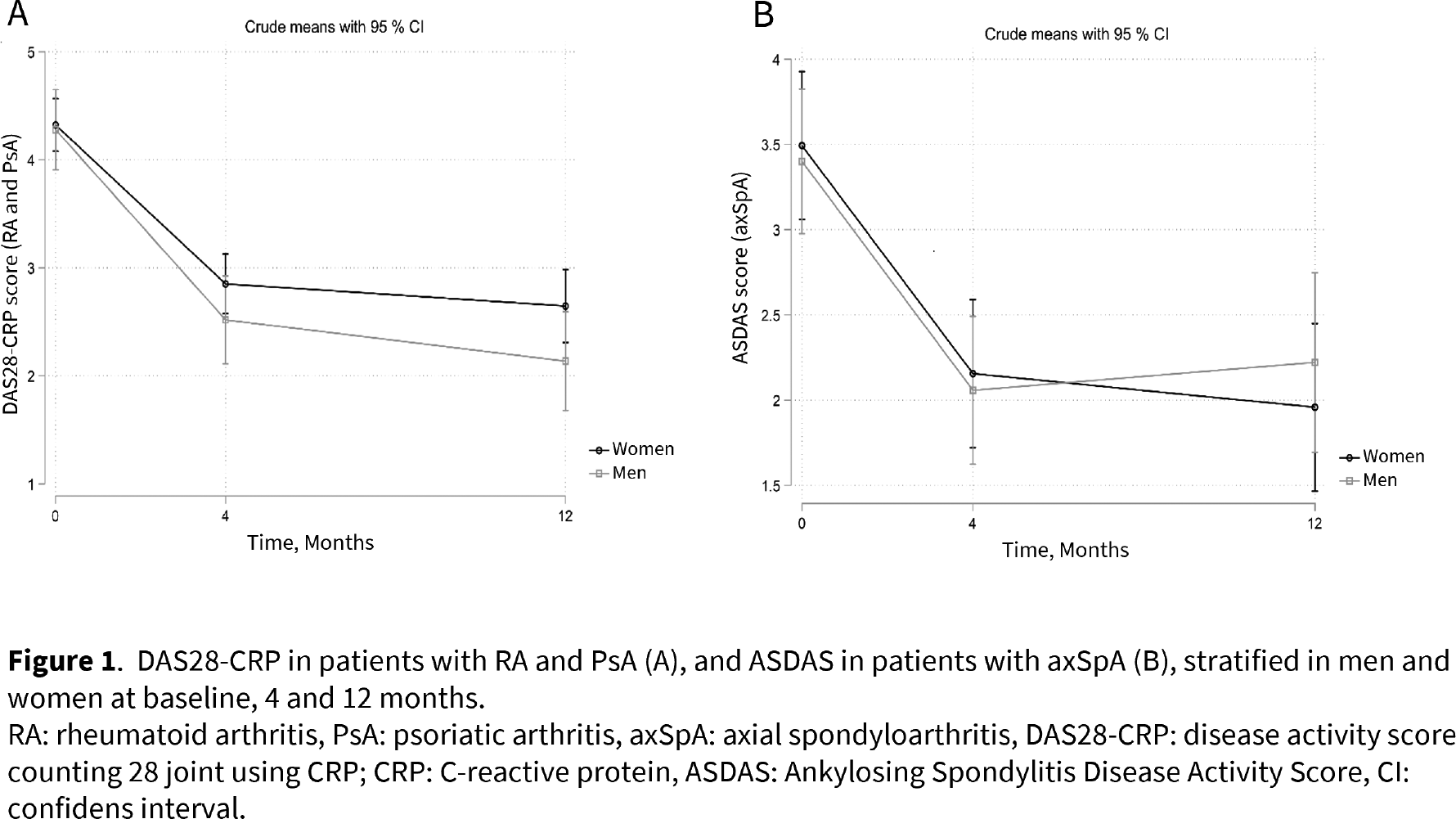
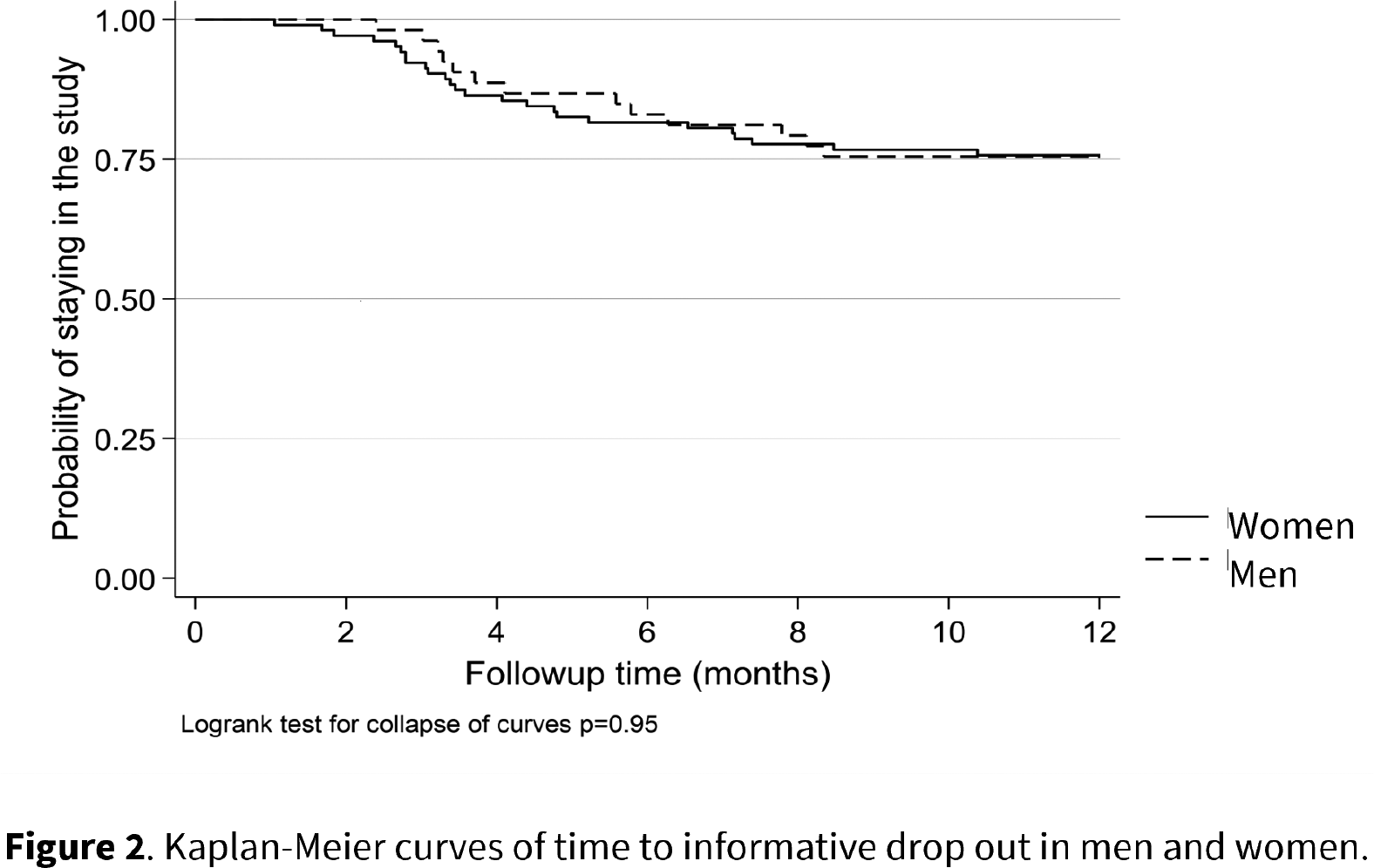
Results: In total 160 patients were included, of which 105 (66%) were women. Among them 150 patients were treated with adalimumab. Of both men and women 46% had a good response at 4 months with a risk ratio (RR m/w ) 1.00 (95% CI 0.66; 1.53). Likewise, no difference between genders was seen at 12 months; RR m/w 0.97 (95% CI 0.60; 1.56). Women had slightly higher, but non-significant, DAS28-CRP score compared to men at 4 months and 12 months, respectively mean difference (MD m-w ) -0.33 (95%CI -0.83; 0.16) and -0.51 (95% CI -1.10; 0.06). ASDAS in patients with axSpA was similar between men and women, MD m-w was -0.10 (95% CI -0.71; 0.52) at 4 months and 0.26 (95% CI -0.46; 0.98) at 12 months. There was no difference between men and women in median adalimumab drug levels at 2 and 4 months. At 12 months women had median adalimumab levels similar to 4 months level (7.0 (95% CI 5.78; 8.47) mg/L); whereas men had lower levels of adalimumab (4.8 (95% CI 3.65; 6.17) mg/L). No statistically significant difference was seen in the proportion of patients who developed anti-adalimumab antibodies, but a tendency of higher proportion among men was seen at 12 months, RR m/w 1.77 (95% CI 0.95; 3.31). Treatment persistence was the same for men and women, but whereas men terminated treatment due to no effect (71%), adverse events was the most frequent reason among women (61%). The median adalimumab drug level in the last blood sample in patients, who terminated treatment before 12 months, was 5.59 (95% CI 4.06; 7.69) mg/L in women and 5.40 (95% CI 3.67; 7.94) mg/L in men. The fraction of anti-adalimumab antibodies was 0.32 and 0.31, respectively.
Conclusions: Gender did not have a significant impact on treatment response or treatment termination but did influence the reason for termination. No difference by gender in initial drug level or immunogenicity was seen and results of adalimumab level and anti-adalimumab antibodies could not explain the difference seen in reasons of treatment termination.
REFERENCES: [1] Klein SL, Morgan R. The impact of sex and gender on immunotherapy outcomes. Biol Sex Differ . 2020;11: 24. doi:10.1186/s13293-020-00301-y
[2] Lauridsen KB, Duch KS, Mortensen AS, et al. Sex differences in treatment response in patients with rheumatoid arthritis treated with tumour necrosis factor inhibitor: a cohort study from the DANBIO registry. Scand J Rheumatol . Published online 2025. doi:10.1080/03009742.2025.2471713
[3] Mauvais-Jarvis F, Berthold HK, Campesi I, et al. Sex-and gender-based pharmacological response to drugss. Pharmacol Rev . 2021;73(2):730-762. doi:10.1124/pharmrev.120.000206
Acknowledgments: NIL.
Disclosure of Interests: Karen Buch Lauridsen Speakers fee from Thermo Fisher Scientific outside the presents work. 2022, Lene Wohlfahrt Dreyer speakers bureau: MSD, UCB, Eli Lilly, Grant/research support: AbbVie and BMS outside the present study (payment to institution), Kaspar Rene Nielsen: None declared, Anne Vingaard Olesen: None declared, Asta Linauskas: None declared, Claus Henrik Nielsen: None declared, Salome Kristensen: None declared.