fetching data ... 
Background: Interleukin-6 (IL-6) is a pro-inflammatory cytokine involved in the pathophysiology of immune-mediated inflammatory diseases, for example, rheumatoid arthritis. Therapies inhibiting the IL-6 receptor (IL-6Ri), such as tocilizumab and sarilumab, are licensed for these conditions. In pregnancy IL-6 plays critical roles in implantation, placental development, and foetal tolerance. However, elevated levels of this cytokine in individuals with inflammatory diseases were associated with miscarriage, preeclampsia, and preterm delivery. There is a paucity of data assessing the safety of IL-6Ri. However, data from small studies using tocalizumab and sarilumab in pregnant women with COVID-19 suggested reassuring maternal and neonatal outcomes [1].
Objectives: Given the challenges of studying disease-modifying anti-rheumatic drugs in pregnancy, alternative approaches, such as Mendelian randomization (MR), can offer valuable insights. MR leverages natural genetic variation in drug target genes to infer potential therapeutic effects. As genetic variants are randomly allocated at conception, MR is less prone to biases than traditional pharmacoepidemiologic designs. We employed MR to investigate whether genetically proxied IL6-Ri impacts maternal and neonatal outcomes.
Methods: Single-nucleotide polymorphisms within or near the IL6 and IL6R gene associated with C-reactive protein at genome-wide significance among 343,524 individuals were selected to genetically proxy IL-6Ri. Genetic association data for the female infertility (cases = 16720, controls = 119468), pre-eclampsia (cases = 8185, controls = 234147), eclampsia (cases = 80, controls = 234147), pre-eclampsia or eclampsia (cases = 8818, controls = 234034), gestational diabetes (cases = 16802, controls = 237816), gestational hypertension (cases = 10739, controls 234147), ectopic pregnancy (cases = 6818, controls = 180063), spontaneous abortion (cases = 20775, controls = 180063), hyperemesis gravidarum (cases = 2961, controls = 215354), congenital deformities of musculoskeletal system (cases = 3233, controls = 450500), congenital malformations of genital organs (cases = 3580, controls = 450153), congenital malformations of circulatory system (cases = 5282, controls = 448451) were obtained from the Finngen database. The Wald ratio or inverse variance weighted methods estimated causal effects, scaled to per standard deviation reduction in C-reactive protein.
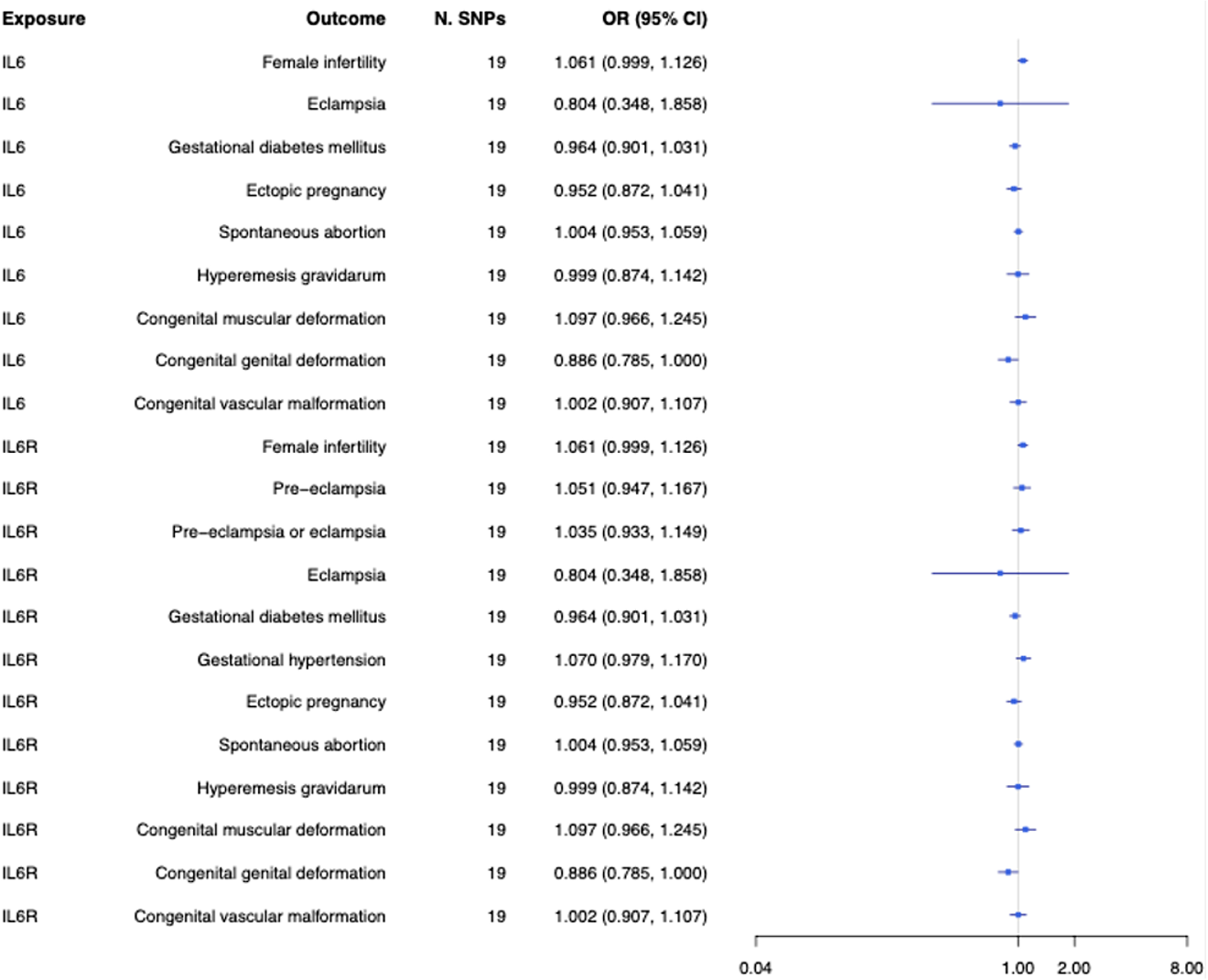
Results: Nineteen single-nucleotide polymorphisms were identified to mimic IL-6Ri. We demonstrated that genetically proxied IL-6Ri was not associated with any maternal or neonatal outcomes selected for study ( Figure 1 ).
Conclusions: Our results suggest that inhibition of the IL-6 pathway is not associated with adverse pregnancy outcomes related to the mother or child. We suggest continued study of the use of IL-6Ri in pregnancy through further work using MR and standard epidemiological analysis of clinical data where appropriate.
Forest plot demonstrating the odds ratio with 95% confidence interval for the mendelian randomization assessment of the association between genetically proxied interleukin-6 and interleukin-6 receptor inhibition across a variety of maternal and neonatal outcomes.
REFERENCES: [1] Nana M, Gregori M, Chandler E, Powell H, Goulden B, Watts T, Dhanjal MK, Nelson-Piercy C. Use of interleukin-6 receptor antibodies in the second and third trimester of pregnancy: a retrospective cohort study. Lancet Rheumatol. 2024 Sep;6(9):e625-e635. doi: 10.1016/S2665-9913(24)00124-3. Epub 2024 Aug 5. PMID: 39116898.
Acknowledgments: NIL.
Disclosure of Interests: None declared.