fetching data ... 
Background: Peer-reviewed journals are central to the dissemination of scientific knowledge worldwide. Likewise, editorial roles are prestigious positions that are frequently occupied by academic researchers with a strong publication record and a history of collaborations with scientific journals. Being positions of power, editorial positions should be equitable and diverse to expand and provide novel knowledge beyond the context of a specific group.
However, researchers from low- and middle-income countries often face structural barriers, including limited infrastructure, funding reductions, and elevated article processing charges (APCs) that hinder their participation in academic publishing. Paradoxically, the global burden of rheumatic diseases is disproportionately borne by low-income countries (LICs) [1, 2]. Similarly, women have been historically underrepresented in rheumatology editorial boards [3]. To account for diversity, equity and inclusion in our field, we evaluated global and gender representation of rheumatology journals and their editorial boards.
Objectives: To assess the diversity of rheumatology journals and editorial boards in terms of global representation and gender equity.
Methods: We systematically identified and extracted rheumatology journals indexed in Scimago (SJR), Scopus, Journal Citation Reports (JCR), and the Directory of Open Access Journals (DOAJ). To capture regional journals from Latin America and the Caribbean, we additionally included Redalyc and Dialnet.
Journals were classified by country of publication according to the World Bank Group (WBG) income categories. We extracted journal metrics from 2024: Quartile, APCs, impact factor, H index, Scimago journal rank (SJR), and citations/document. Leadership and executive/senior roles were extracted from the editorial board using Manan’s proposed hierarchy [4]. Gender was determined according to the pronouns on professional profiles (LinkedIn, ResearchGate, institutional sites) and then validated with Gender API. Descriptive statistics and non-parametric tests (Spearman’s ρ, Mann–Whitney U) were applied for analysis.
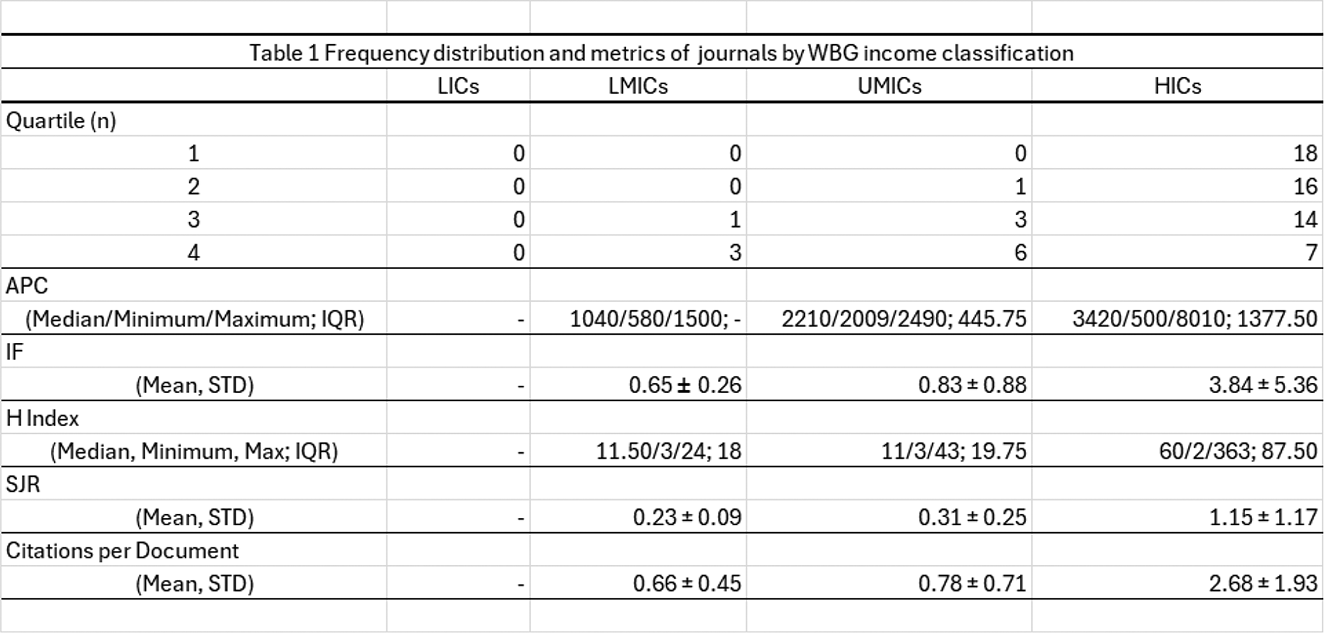
Results: Of 84 analyzed rheumatology journals, only 4 (4.8%) were based in lower-middle-income countries (LMICs), 14 (16.7%) in upper-middle-income countries (UMICs), and 66 (78.6%) in high-income countries (HICs). None originated from LICs (Table 1). Median APC for open access/hybrid journals was $3,250 (IQR: $2,080; range: $500–$8,010) and correlated positively with national income (ρ = 0.349, p = 0.007). Journals based on HICs have significantly higher impact factors (3.83 vs. 0.84, p = 0.033), H-index (80.8 vs. 15.1, p < 0.001), SJR (1.13 vs. 0.29, p < 0.001), and citations/document (2.64 vs. 0.75, p = 0.001) compared to middle LMICs and UMICs.
Among 1,219 editorial positions, 64.4% (n = 785) were held by men and 35.6% (n = 434) by women. In leadership roles, women held only 24.7% (27/106) of editorial positions. Geographically, 81.1% (n = 989) of editors were from HICs, 10.9% (n = 134) from UMICs, 7.8% from LMICs (n = 95), and just 0.1% (n = 1) from a LIC.
Conclusions: Journals based in LMICs represent barely 5% of rheumatology publishing, while LICs remain virtually underrepresented. Furthermore, editors from LMICs and LICs represent less than 10% of decision-making editorial positions, despite the high burden of disease in these regions. Conversely, APCs were highest in HICs and correlated positively with the country’s income, posing an economical barrier for researchers in LICs to publish their work in high impact journals.
Women are still underrepresented in decision-making positions, as they account only for 35% in executive/senior roles, with a shrinking 25% in leadership positions. The shortage of editors from LICs is a serious concern which underscores the need for equitable representation. The current global distribution of academic rheumatology journals and editorial boards is not equitable, nor does it correlate with the global burden of disease. Urgent action to diversify editorial boards and reduce financial and structural barriers to ensure parity in rheumatology publishing is needed.
REFERENCES: [1] Su, Qin-Yi et al. “Global, regional, and national burdens of rheumatoid arthritis among people aged 60 years and older from 1990 to 2021: a trend analysis for the Global Burden of Disease Study 2021.” Frontiers in public health vol. 13 1527680. 26 May. 2025, doi:10.3389/fpubh.2025.1527680
[2] Hasan, Bilal et al. “Health disparities in systemic lupus erythematosus-a narrative review.” Clinical rheumatology vol. 41,11 (2022): 3299-3311. doi:10.1007/s10067-022-06268-y
[3] Ovseiko, Pavel V et al. “Gender representation on editorial boards of rheumatology journals.” The Lancet. Rheumatology vol. 4,10 (2022): e663-e664. doi:10.1016/S2665-9913(22)00157-6
[4] Manan, Muhammad Romail et al. “Diversity, Equity, and Inclusion on Editorial Boards of Global Health Journals.” Asian bioethics review vol. 15,3 209-239. 16 Mar. 2023, doi:10.1007/s41649-023-00243-8
Acknowledgments: NIL.
Disclosure of Interests: None declared.