fetching data ... 
Background: Subclinical gut involvement is a recognized feature of spondyloarthritis (SpA) and is associated with elevated serum secretory IgA (sSIgA) levels. We have previously demonstrated apical expression of CD71 in the ileal epithelium of patients with SpA, supporting reverse transcytosis of SIgA as a mechanism contributing to increased sSIgA, which may link subclinical intestinal inflammation with systemic disease activity in SpA. However, whether CD71/SIgA complexes can also trigger additional immune activation pathways relevant to the gut–enthesis axis remains unknown.
Objectives: To characterize the intracellular trafficking of CD71/SIgA complexes in the ileal mucosa of patients with SpA without IBD, and to explore whether this process supports pathways beyond classical reverse transcytosis that may be relevant to the gut–enthesis axis
Methods: A total of 180 patients with SpA (ASAS criteria) were clinically assessed; From the patients who met selection criteria, 41 underwent digital chromoendoscopy with magnification of the colon and ileum, including histological analysis. Patients with concomitant IBD were excluded. CD71 expression was evaluated by in-house indirect immunofluorescence. In patients showing apical CD71 expression, proximity ligation assay (PLA) was used to confirm CD71/SIgA interactions. The intracellular routing of CD71/SIgA complexes was assessed by co-localization with early endosomal (Rab5, EEA-1), recycling endosomal (Rab11A), and lysosomal (Rab7, LAMP-2) markers using confocal microscopy. The analysis were made using the Chi-square or Fisher’s exact test and a multiple correspondence discriminant analysis (MCDA).
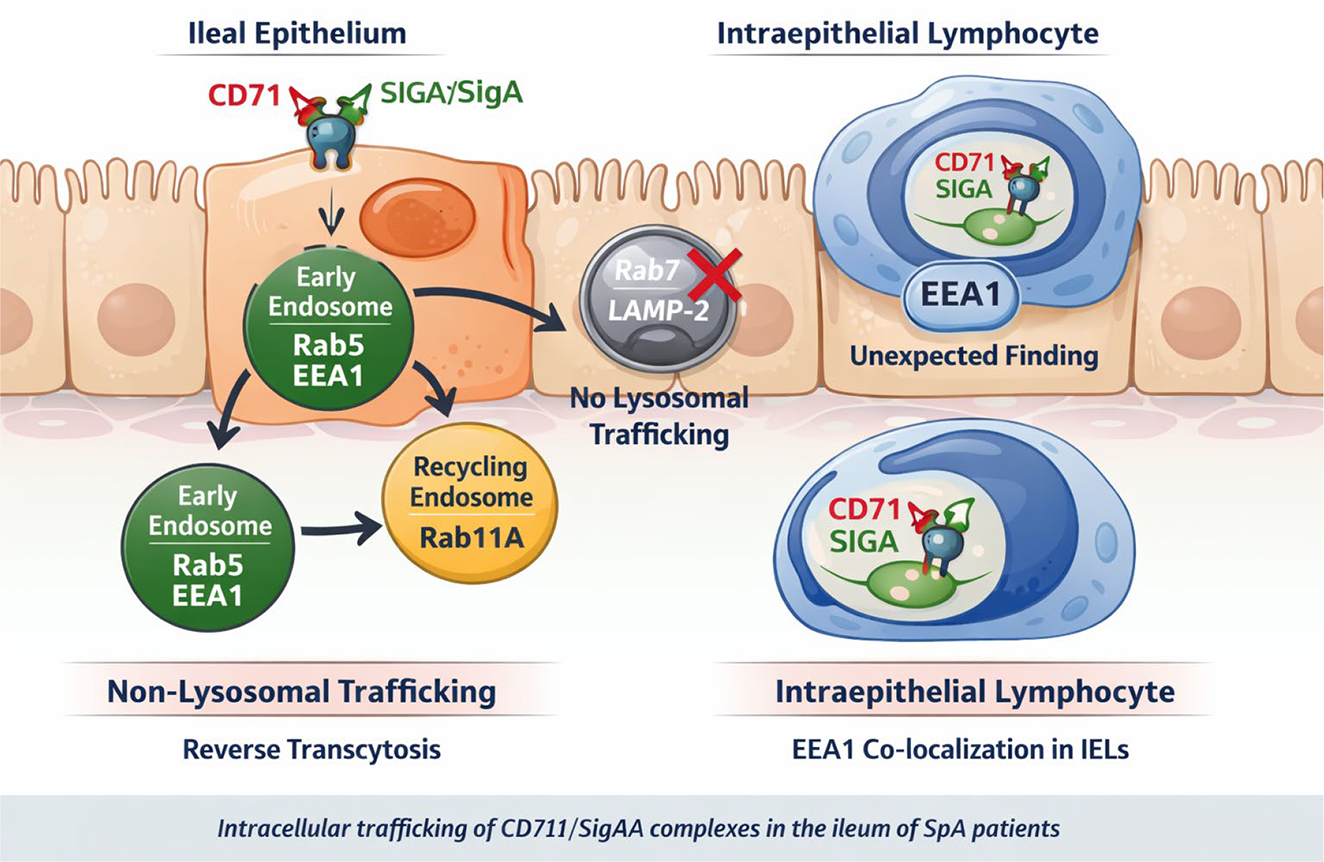
Results: Apical expression of CD71 was observed in 48.8% of ileal biopsies and was associated with elevated serum sSIgA levels. CD71–SIgA interactions at the apical epithelial surface were confirmed by proximity ligation assay. Intracellular trafficking analysis revealed that CD71/SIgA complexes consistently co-localized with Rab5 and Rab11A, indicating progression through early and recycling endosomal compartments. In contrast, no co-localization was observed with lysosomal markers, including Rab7 and LAMP-2, supporting a non-lysosomal, non-degradative trafficking pathway.
Importantly, and as an unexpected finding, CD71/SIgA complexes also co-localized with the early endosomal marker EEA-1 within intraepithelial mononuclear cells. These cells displayed a morphology and localization compatible with mucosa-restricted intraepithelial immune cells, suggestive of intestinal intraepithelial lymphocytes.
Conclusions: CD71/SIgA complexes undergo a non-lysosomal intracellular trafficking pathway in the ileal mucosa of patients with spondyloarthritis, as demonstrated by their co-localization with Rab5- and Rab11A-positive compartments and the absence of lysosomal routing. Beyond confirming reverse transcytosis, the unexpected detection of CD71/SIgA–EEA-1 co-localization within intraepithelial mononuclear cells suggests the involvement of additional epithelial–immune interfaces in the handling of SIgA. Together, these findings support a mechanistic framework in which CD71/SIgA complexes may participate in gut–enthesis communication through pathways that extend beyond classical reverse transcytosis, providing new insight into the immunobiology of subclinical intestinal inflammation in spondyloarthritis.
“De Avila J. Figure generated with AI assistance (visual model), based on conceptual material derived from the original document.”
REFERENCES: [1] Mauro, Daniele et al. “The gut-enthesis axis and the pathogenesis of Spondyloarthritis.” Seminars in immunology vol. 58 (2021): 101607. doi:10.1016/j.smim.2022.101607
[2] De Ávila, Juliette et al. “Gut expression of CD71 and co-localisation with Dec-1 associated with high levels of serum SIgA and disease activity in SpA.” Scientific reports vol. 15,1 19517. 4 Jun. 2025, doi:10.1038/s41598-025-03532-4
Acknowledgments: NIL.
Disclosure of Interests: None declared.