fetching data ... 
Background: Inflammatory arthritis encompasses a group of chronic immune-mediated disorders that affect joints and extra-articular tissues. Rheumatoid arthritis (RA), psoriatic arthritis (PsA), and ankylosing spondylitis (AS) are among the most prevalent subtypes [1]. Accumulating evidence indicates that patients with inflammatory arthritis often exhibit an elevated triglyceride-glucose index (TyG) [2, 3],a metabolic marker that may influence disease activity by modulating lymphocyte subsets and cytokine profiles. However, the relationship between the TyG index and inflammatory arthritis remains to be fully elucidated.
Objectives: To investigate the associations between the TyG index and disease activity as well as peripheral lymphocyte-subset profiles in patients with RA, PsA, and AS.
Methods: Clinical data were retrospectively collected from patients with various forms of inflammatory arthritis who attended the Second Hospital of Shanxi Medical University between 2015 and 2024. The TyG index was calculated and used to stratify participants into high, intermediate, and low tertiles. Inter-group comparisons were performed for disease-activity indices (DAS28 for RA, PASI for PsA, and BASDAI for AS), systemic inflammatory markers (erythrocyte sedimentation rate, C-reactive protein), and peripheral-blood lymphocyte subsets (Th1, Th2, Th17, and Treg cells). For multiple-group comparisons, one-way analysis of variance (ANOVA) was used when data met both normality and homogeneity of variance assumptions; otherwise, the Kruskal-Wallis test was applied, with post-hoc analyses performed as appropriate.
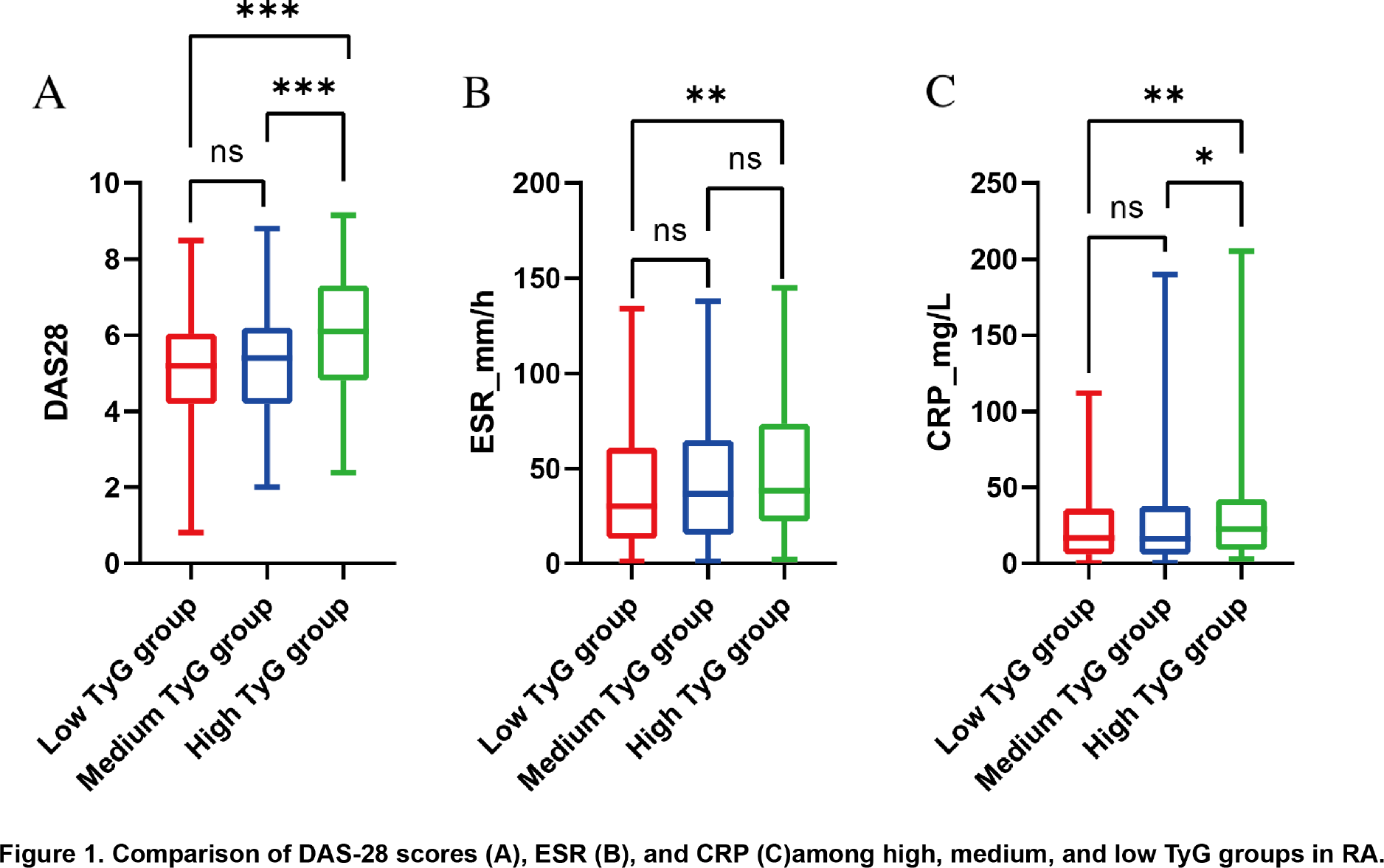
Results: Patients in the high TyG-index tertile exhibited significantly higher disease-activity scores and partial inflammatory markers than those in the intermediate and low tertiles (RA: P<0.001; PsA: P<0.001; AS: P<0.001). Lymphocyte-subset analysis revealed a positive correlation between the TyG index and absolute Th17 counts (RA: P<0.001; PsA: P = 0.002; AS: P<0.001) and an inverse correlation with absolute Treg counts in RA (P<0.001). In PsA and AS, inter-group differences in Treg counts across TyG tertiles were not statistically significant (P >0.05), possibly attributable to limited sample size.
Conclusions: The TyG index is significantly associated with heightened disease activity and a shift in specific lymphocyte-subset homeostasis (elevated Th17 and reduced Treg) across multiple rheumatic diseases, suggesting the potential utility of the TyG index as an accessible biomarker for assessing both inflammatory burden and metabolic risk in this patient population.
| Basic characteristics | RA group(n=738) | PsA group(n=296) | AS group(n=278) |
|---|---|---|---|
| Age (years ) | 59.05±12.1 | 48.2±13.6 | 38.9±14.7 |
| Gender (Male ) | 220 (29.81 ) | 140 (47.30 ) | 221 (79.50 ) |
| BMI | 22.88 (20.62,24.77 ) | 24.6±3.44 | 23.4 (21,25.7 ) |
| Glu (mmol/L ) | 4.88 (4.22,5.72 ) | 4.95 (4.65,5.36 ) | 5.03±0.63 |
| TG (mmol/L ) | 1.15 (0.83,1.53 ) | 1.11 (0.84,1.59 ) | 0.98 (0.77,1.41 ) |
| TC (mmol/L ) | 4.32±1.03 | 3.72±1.02 | 4.02±0.97 |
| HDL-C (mmol/L ) | 1.18 (0.97,1.43 ) | 1.07 (0.92,1.32 ) | 1.04 (0.9,1.26 ) |
| LDL-C (mmol/L ) | 2.38±0.68 | 2.17±0.55 | 2.28 (1.81,2.74 ) |
REFERENCES: [1] Ramiro S, Radner H, van der Heijde D, van Tubergen A, Buchbinder R, Aletaha D, Landewé RB. Combination therapy for pain management in inflammatory arthritis (rheumatoid arthritis, ankylosing spondylitis, psoriatic arthritis, other spondyloarthritis). Cochrane Database Syst Rev. 2011 Oct 5;2011(10):CD008886. doi: 10.1002/14651858.CD008886.pub2.
[2] Zhang X, Tang H, Chen J, Chen J, Zhou H, Qi T, Wang D, Zeng H, Yu F. Association between different triglyceride-glucose index combinations with obesity indicators and arthritis: results from two nationally representative population-based study. Eur J Med Res. 2024 Jul 27;29(1):389. doi: 10.1186/s40001-024-01992-4.
[3] Peng Y, Liu C, Gan R, Liu W. Association Between T2DM, TyG Index, Multiple Sclerosis, and Rheumatoid Arthritis: Insights into Potential Mechanisms. Mol Neurobiol. 2025 Sep;62(9):11297-11316. doi: 10.1007/s12035-025-04961-y.
Acknowledgments: NIL.
Disclosure of Interests: None declared.