fetching data ... 
Background: Axia is a CE-certified therapeutic app providing patient-tailored, guideline-based exercise therapy, patient education, and disease management for axial spondyloarthritis (axSpA). In phase I of a three-phase randomised controlled trial (RCT) including 200 patients with axSpA receiving stable pharmacotherapy, Axia significantly improved patient-reported disease activity, functional status, and quality of life after 12 weeks (Figure 1A) [1]. However, data on long-term sustainability and reproducibility of these effects are needed.
Objectives: To evaluate (1) the sustainability of Axia’s effects observed in phase I over an additional 14-week extension phase and (2) the reproducibility of app-related effects in the former control group (CG) after crossover to the Axia intervention.
Methods: In this nationwide RCT, 200 patients with axSpA on stable pharmacotherapy were randomized 1:1 to either the Axia intervention group (IG) or to the CG for 12 weeks (Phase I) (Figure 1A displays the study design). In Phase II (weeks 12-26), the CG crossed over to use Axia. The original IG was subdivided into a continued-use group (c-IG) and a discontinued-use group (d-IG) based on app usage and patient preference. Primary outcomes were disease activity (Bath Ankylosing Spondylitis Disease Activity Index [BASDAI]), functional status (Bath Ankylosing Spondylitis Functional Index [BASFI]), and quality of life (Ankylosing Spondylitis Quality of Life [ASQoL]). Assessment of SpondyloArthritis international Society (ASAS)20 and ASAS40 response rates were assessed as secondary outcomes. Assessments were conducted at baseline (BL), week 12 (W12), and week 26 (W26). The trial was registered at the German registry of clinical trials (DRKS-ID: DRKS00033783).
Results: Of the 186 participants entering phase II, 180 completed the follow-up (BL characteristics: mean age 50.5 years, 66% females, b/tsDMARD therapy: 58%) (Figure 1A). 92 participants from the former CG crossed over to the Axia intervention in phase II, while 85 patients from the original IG continued the use (c-IG). Ten participants discontinued the use of Axia (d-IG) due to infrequent app-usage frequency during phase I (n=9) and personal preference (n=1).
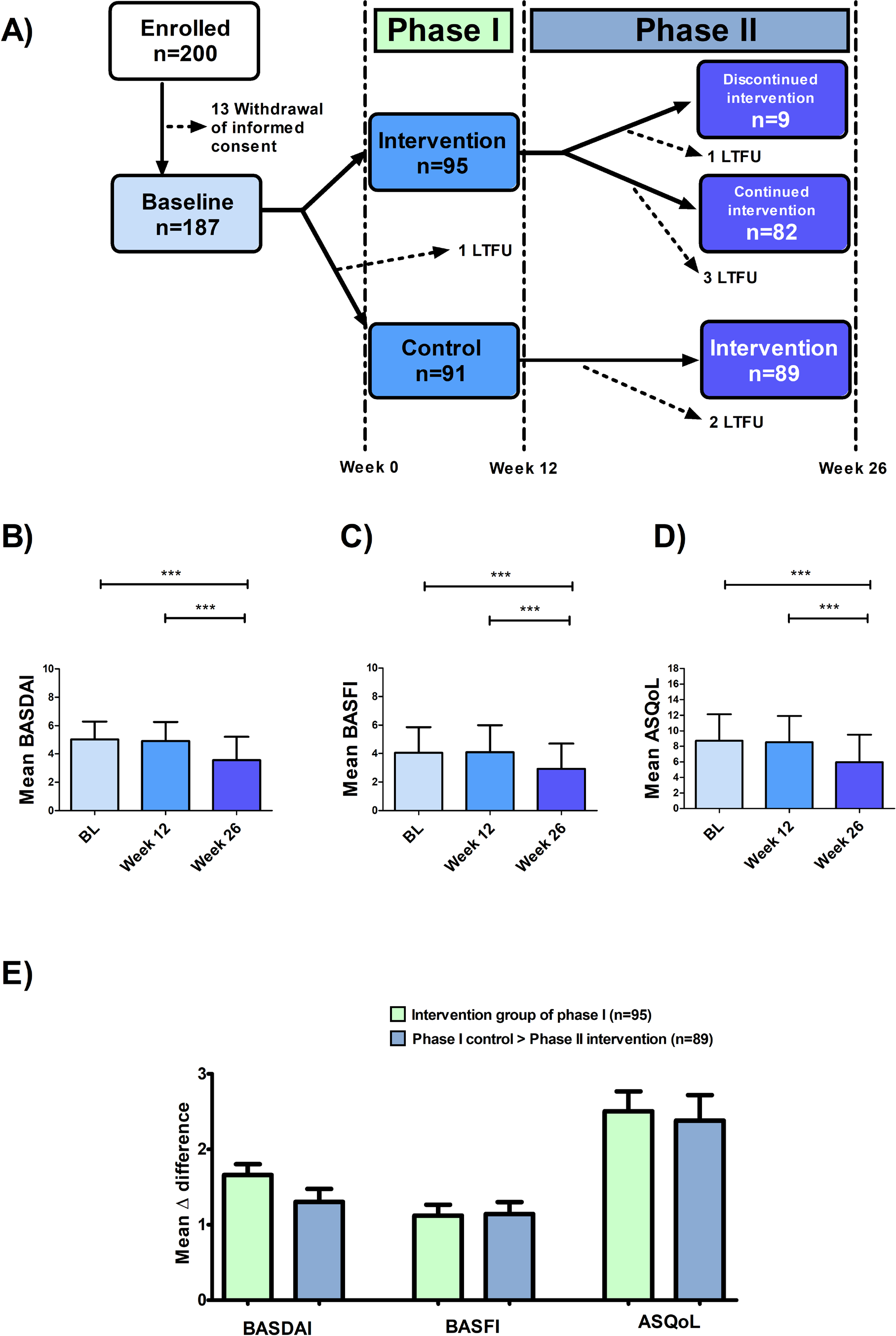
Initiation of Axia in the crossover CG resulted in significant and clinically meaningful improvements in BASDAI, BASFI, and ASQoL by W26 (all p<0.001) (Figure 1B-D). ASAS20 and ASAS40 response rates after crossover were 40.5% and 20.2%, respectively (Figure 2D-E). The magnitude of improvement did not differ from that observed during phase I in the former IG (Δ mean BASDAI IG: -1.66 vs. crossed over CG: -1.30; Δ mean BASFI IG: -1.12 vs. CG: -1.14; Δ mean ASQoL IG: -2.51 vs. CG: -2.38; each p>0.05) (Figure 1E), demonstrating reproducibility of treatment effects.
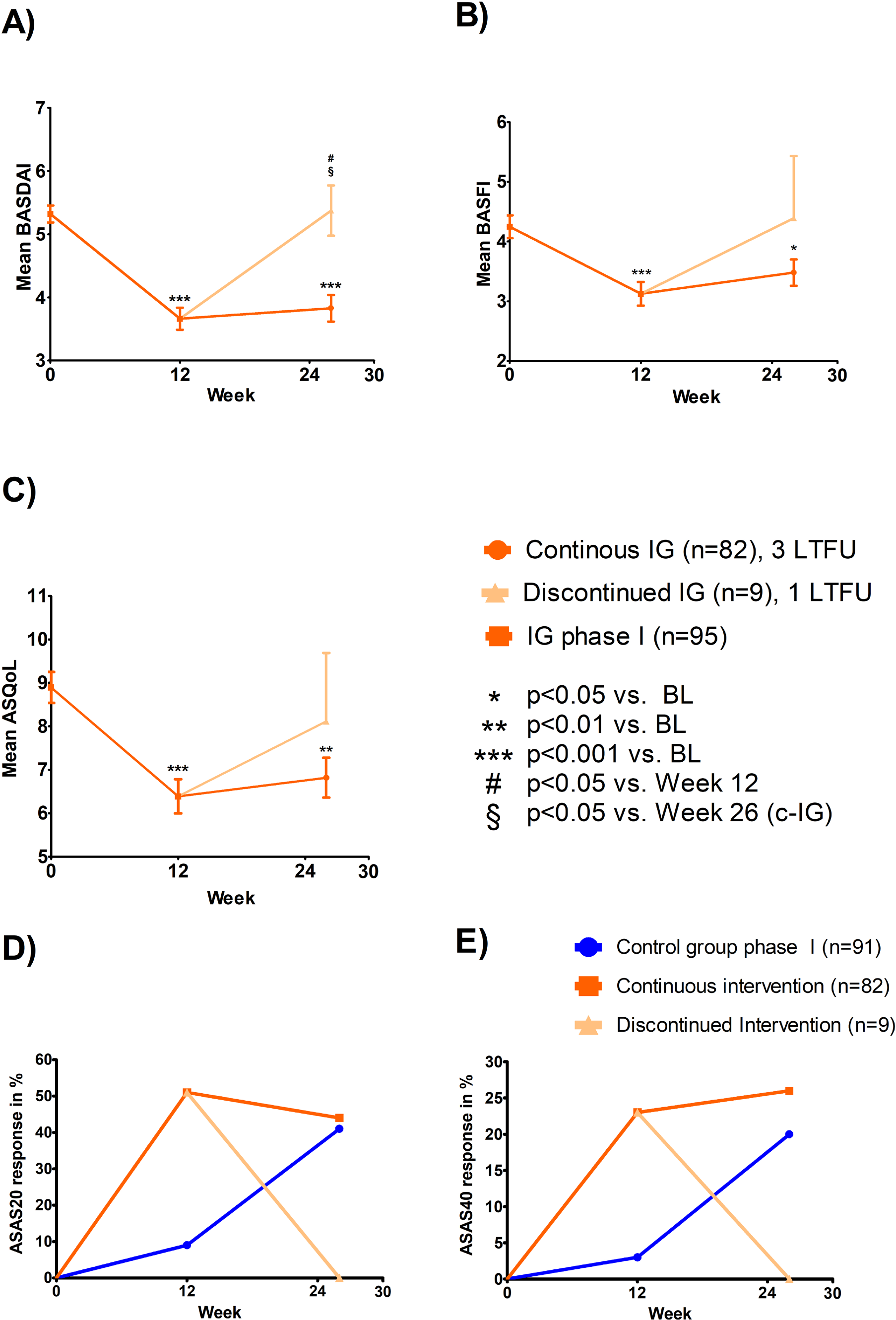
In the original IG, improvements in BASDAI, BASFI, and ASQoL as well as ASAS20 and ASAS40 response rates observed during phase I were sustained in the c-IG throughout the subsequent 14 weeks of phase II (Figure 2A-E). In contrast, mean BASDAI, BASFI, and ASQoL values in the d-IG returned to baseline levels (Figure 2A-E). No ASAS20 or ASAS40 responses were observed in the d-IG (Figure 2D-E).
Conclusions: This RCT demonstrates that the effects of Axia are consistent and sustained over 26 weeks of continued app use. Accordingly, Axia represents an effective and scalable new approach to improving non-pharmacological care for patients with axSpA.
Improvement of the primary outcomes in the (crossed-over) control group and comparison to the results of the intervention group in phase I
The study design is shown in figure 1A. LTFU, Lost to follow-up.
The figures 1B-D display the results of the primary outcomes in the control group at baseline (BL), after phase I at week 12, and after the cross-over with the intervention at week 26/ end of phase II. The mean values of BASDAI (B), BASFI (C), and ASQoL (D) were significantly lower at week 26 compared to week 12 and BL. The mean difference exceeded the minimally clinically important difference (MCID) threshold (Figure 1E).
1E) The mean improvement of BASDAI, BASFI, and ASQoL in the intervention group in phase I is similar to the mean improvement of the control group after cross-over in phase II, indicating reproducibility of the effect.
Results are presented as means with standard deviations (SD) (1B-D) and means with standard error of the mean (SEM) (1E); One-way ANOVA was used as statistical test; ***: p< 0.001.
Sustainability of the effects induced by Axia over 26 weeks
The figures 2A-C display the development of the mean values of the primary outcomes in the intervention group (IG) over 26 weeks. The mean BASDAI (A), BASFI (B), and ASQoL (C) were significantly lower at week 12 (primary endpoint, n=95) compared to baseline (BL). After week 12, the intervention group was split in a group with discontinued intervention (n=9) and with continuous intervention (n=82). The effect of phase I remained stable in the continued IG, while the mean values returned to the extent at BL in the discontinued IG indicating a sustained effect in the c-IG. One-way ANOVA was used to test for statistical differences.
The figures 2D-E show the development of the ASAS20 and ASAS40 response rates in the intervention group compared to the control group. A remarkable ASAS20 and ASAS40 response rate was observed in the intervention group of phase I. After cross-over, the former control group achieved a similar ASAS20 and ASAS40 response rate comparable to the intervention group in phase I. The ASAS20 and ASAS40 response remained stable in the c-IG, while the group with discontinued intervention showed no ASAS20 and ASAS40 response at week 26.
REFERENCES: [1] Strunz PP et al. LB0002 The novel digital therapeutic AXIA improves disease activity, functionality, and quality of life in axial spondyloarthritis patients: results from a randomized controlled crossover trial (Bechterew-App trial) (abstract). Ann Rheum Dis 84(Suppl 1):LB2.
Acknowledgments: NIL.
Disclosure of Interests: Patrick-Pascal Strunz Research funding from Chugai, Novartis, and Abbvie, Maxime le Maire Shareholder of Applimeda, CEO of Applimeda, Tobias Heusinger Shareholder of Applimeda, Technical and medical officer of Applimeda, Anna Fleischer: None declared, Karsten Sebastian Luetkens: None declared, Patricia Possler: None declared, Michael Gernert Research funding from Novartis, Hannah Labinsky: None declared, Ottar Gadeholt: None declared, Robert Leppich Shareholder of Applimeda, Chief technology officer of applimeda, Astrid Schmieder: None declared, Ludwig Hammel: None declared, Billy Sperlich: None declared, Hermann Einsele: None declared, Marc Schmalzing Research funding from Novartis, Matthias Fröhlich: None declared.