fetching data ... 
Background: MRI-detected bone marrow oedema (BMO) in the spine and sacroiliac joints (SIJs) is a key imaging biomarker in clinical trials of axial spondyloarthritis (axSpA). Quantifying BMO provides an objective measure of active inflammation that complements clinical, laboratory and patient-reported outcomes. Multiple MRI scoring systems have been developed and validated over the past two decades, enabling standardised assessment of inflammatory lesions and supporting evaluation of therapeutic efficacy across trials. However, current manual scoring methods are labour-intensive, costly, and subject to reader variability. To address these limitations, we developed a fully automated machine-learning (ML) platform capable of detecting inflammatory spinal and SIJ lesions in axSpA, which has been independently validated in phase 3 trial datasets [1].
Objectives: To longitudinally assess the sensitivity to change of a ML-derived BMO scoring system for the sacroiliac joints and spine in axSpA
Methods: MRI scans from three phase 3 biologic therapy clinical trial datasets (MEASURE 1, PREVENT, and SURPASS) were analysed using a previously validated ML BMO detection [1]. ML spinal BMO lesions were detected at the vertebral unit (VU) level, with each VU defined by the upper half of one vertebra and the lower half of the adjacent vertebra; lesion outputs were aggregated to generate a whole-spine BMO score ranging from 0 to 23 (reflecting the 23 assessable VUs). ML SIJ BMO lesions were detected at the quadrant level (upper ilium, lower ilium, upper sacrum, and lower sacrum) for each SIJ, yielding a total SIJ BMO score ranging from 0 to 8. Change in BMO scores for both the SIJs and the whole spine was evaluated from baseline to all available timepoints (up to week 104 or 208). Sensitivity to change was summarised using means, SD, and the standardised response mean (SRM), calculated as the mean change divided by the SD of the change. SRM values were interpreted as follows: >0.8 large, 0.5–0.8 moderate, and 0.2–<0.5 low responsiveness. Analyses were conducted using all available patient pairs (irrespective of treatment allocation), including participants with paired scans at specific timepoints even if they did not attend every scheduled visit.
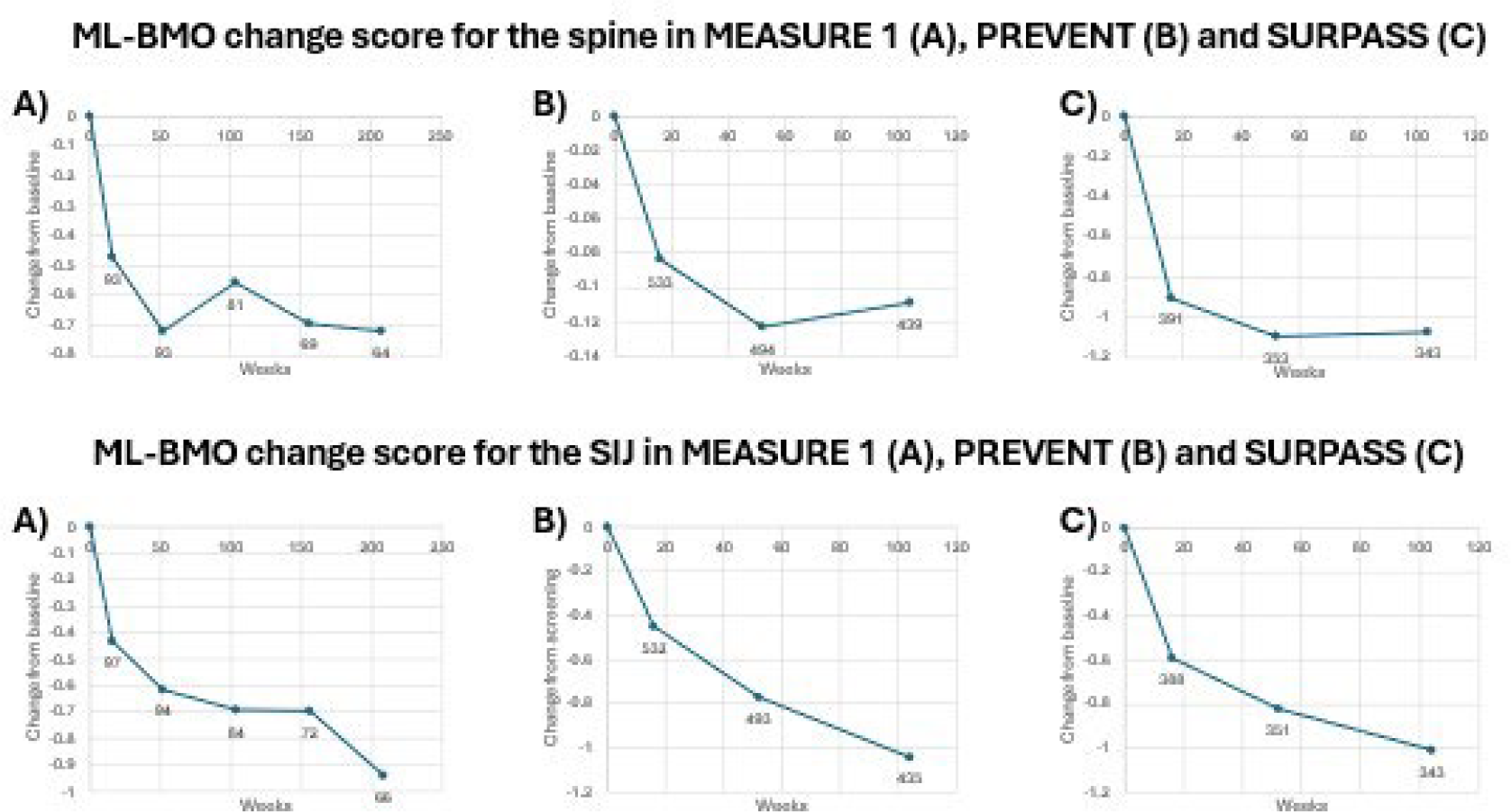
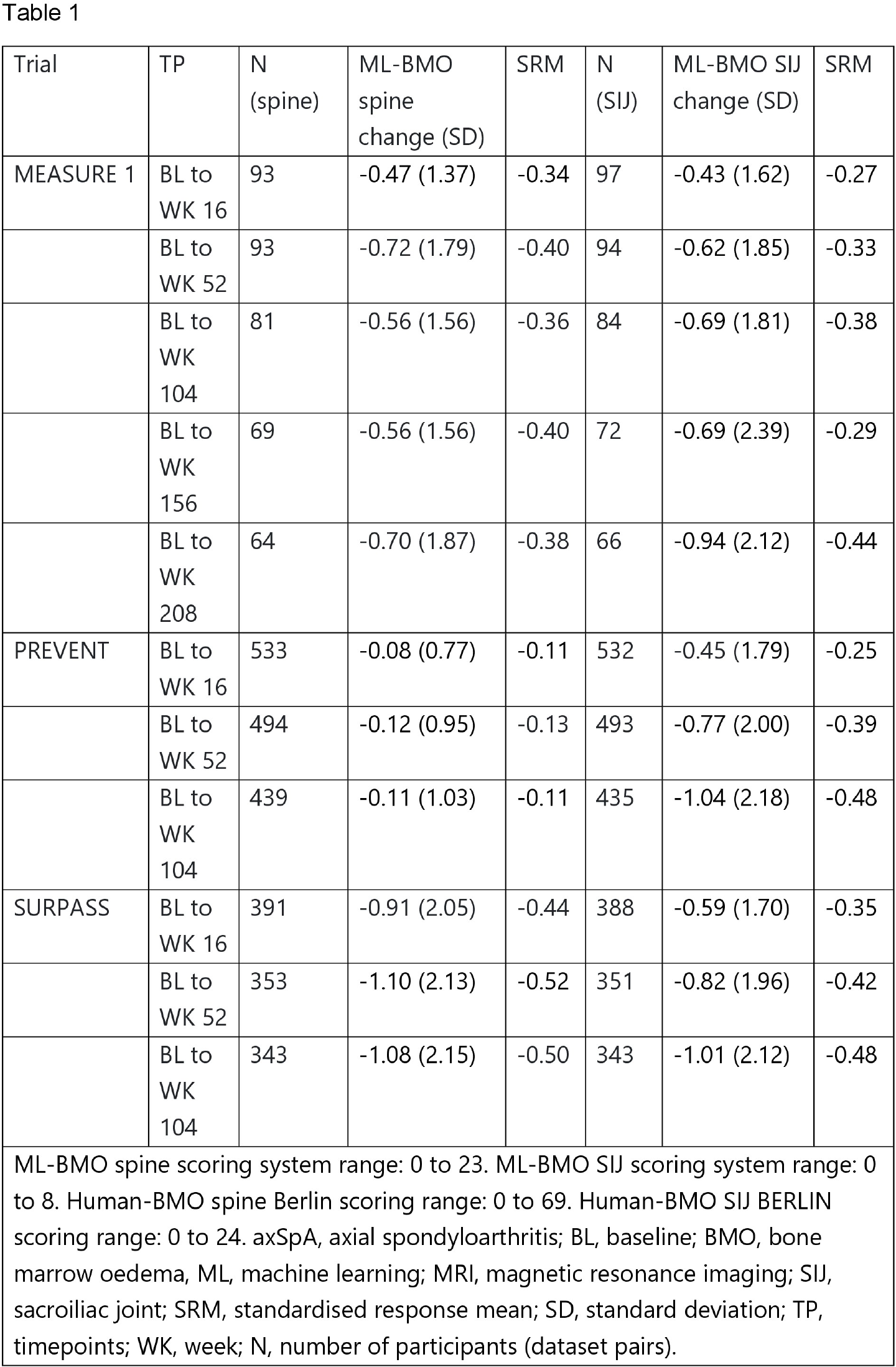
Results: Data from 64-97, 435-533 and 343-391 patients were analysed from the MEASURE 1, PREVENT, and SURPASS trials, respectively (Table 1). Across all studies, ML-derived BMO scores for both the SIJs and spine showed a progressive reduction over time (Figure 1), reflecting decreasing inflammatory burden as more patients were established on secukinumab (anti-interleukin 17A monoclonal antibody) treatment through to the end of follow-up. ML effect sizes across timepoints, expressed as SRMs, were low to moderate, ranging from -0.27 to -0.44, -0.11 to -0.48, and -0.35 to -0.52 for MEASURE 1, PREVENT, and SURPASS, respectively (Table 1).
Conclusions: ML software applied to raw MRI images can reliably detect longitudinal changes in inflammatory lesions across the whole spine and SIJs, demonstrating sensitivity to improvement at multiple timepoints throughout follow-up. Automated scoring effectively tracks treatment-related reductions in BMO aligning closely with established clinical trial expectations. Next steps will involve comparing performance with human scores and evaluating the ability of the ML scoring system to discriminate between active and placebo groups.
REFERENCES: [1] Jamaludin A, et al. Rheumatology (Oxford). 2025 Oct 1;64(10):5446-5454.
Acknowledgments: NIL.
Disclosure of Interests: Saad Ahmed: None declared, Amir Jamaludin: None declared, Timor Kadir: None declared, Jerome Declerck: None declared, Rhydian Windsor: None declared, Sarim Ather: None declared, Robin Park: None declared, Andrew Zisserman: None declared, Juergen Braun: None declared, Lianne S Gensler: None declared, Mikkel Østergaard: None declared, Denis Poddubnyy: None declared, Thibaud Coroller Novartis, Brian Porter novartis, Novartis, Gregory Ligozio novartis, Aimee Readie novartis, novartis, Pedro M Machado PMM has received consulting/speaker’s fees from Abbvie, BMS, Celgene, Eli Lilly, Galapagos, Janssen, MSD, Novartis, Orphazyme, Pfizer, Roche and UCB.