fetching data ... 
Background: In axial spondyloarthritis (axSpA), skeletal damage and ankylosis are at least partly genetically determined, but the individual contributing factors remain poorly defined. Better understanding of the genes involved should help to clarify the underlying biology and identify potential therapeutic targets. However, previous studies investigating genetic determinants of radiographic damage have failed to identify loci at the level of genome-wide significance.
Objectives: To identify genetic variants associated with radiographic progression in axSpA across European and East Asian populations, and to identify proteins with evidence of a causal effect on progression
Methods: We analysed genetic and radiographic data from the Australo-Anglo-American Spondyloarthritis Consortium (TASC) and a Korean cohort comprising radiographic axSpA cases fulfilling the modified New York criteria with ≥2 sets of spinal radiograph.
Radiographs were scored using a modified mSASSS (original non-zero scores recoded as score minus 1) to reduce ambiguity between scores 0 and 1 [1]. For cervical or lumbar spine, missing vertebral scores were imputed using the within-region mean if <4 were vertebral scores missing; total mSASSS was set to missing if ≥4 vertebral scores were missing in either region.
TASC participants were genotyped on Illumina HumHap370, Human660W-Quad, or Immunochip platforms and imputed using 1000 Genomes and UK Biobank reference panels; Korean participants were genotyped on KoreanChip (~833,000 markers) [2]. Analyses included unrelated individuals (kinship coefficient <0.0884) with sample call rate ≥95%. In TASC, European ancestry was defined by PCs 1 and 2 within 3 SD of the European 1000 Genomes reference. SNPs were excluded for call rate <99%, minor allele frequency (MAF) <5%, or Hardy–Weinberg equilibrium p<1×10 -6 and (in TASC) imputation INFO<0.8.
Primary association testing used PLINK with final mSASSS (last time point after which mSASSS no longer increased) as the outcome, adjusted for baseline mSASSS, radiograph interval (years), age, sex, symptom duration, smoking status (never/previous/current), and the first 5 principal components (ANCOVA-type approach, less susceptible to measurement error than change scores). Analyses were performed within each ancestry and combined using fixed-effects meta-analysis in METAL.
To prioritise putative therapeutic targets, we performed proteome-wide cis-pQTL Mendelian randomisation (MR) using up to 4,672 SomaScan plasma proteins in deCODE (n=35,559) with replication in Fenland (n=10,708) studies [3,4]. Instruments were independent (r 2 <0.1), region-wide significant (p<5×10 -6 ) variants within ±200 kb of the encoding gene, excluding the MHC. Protein–progression effects were estimated using Wald ratio or inverse-variance weighted methods, with Bonferroni correction. Posterior probability of a shared causal variant >80% was considered evidence of colocalisation.
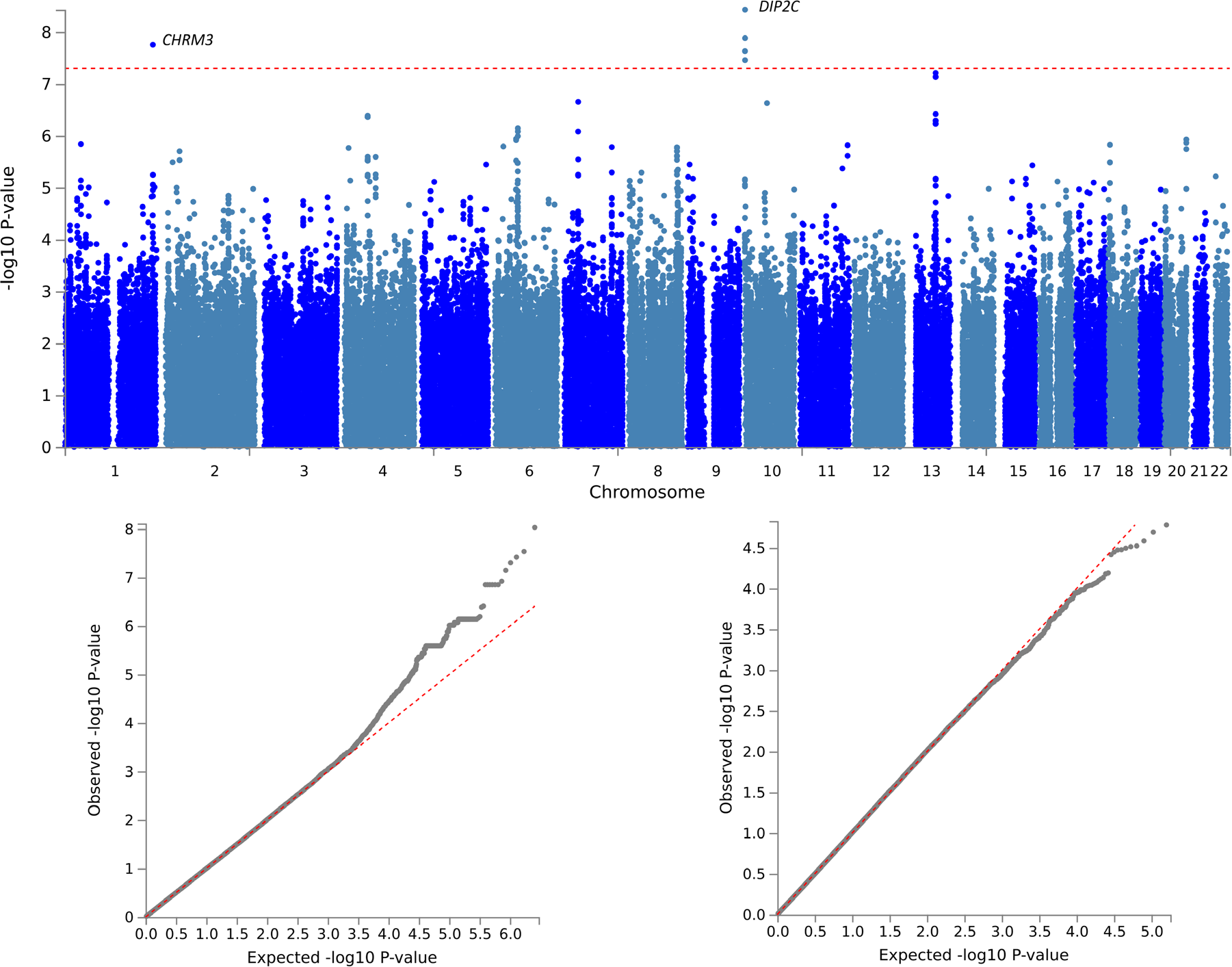
Results: After QC, analysis included 339 TASC participants (mean age 49 [SD 14], 75% male, symptom duration 23 [SD 14] years) and 5,122,352 SNPs, and 735 Korean participants (mean age 41 [SD 9] years, 90% male, symptom duration 18 [SD 8] years) and 317,267 SNPs. Genomic inflation was minimal (λ=1.01 TASC; λ=0.99 Korean; λ=1.01 meta-analysis).
In TASC, 4 SNPs reached genome-wide significance (p<5×10 −8 ); none in the Korean cohort. Meta-analysis identified 5 genome-wide significant SNPs representing two novel loci and several suggestive loci (Table 1). The lead signals included: rs4881486 (chr10; p=3.72×10 −9 ), intronic in DIP2C (disco interacting protein 2 homolog C) which is a conserved cytoplasmic protein of unknown function; and rs6676664 (chr1; p=1.76×10 −8 ), intronic in CHRM3 (cholinergic receptor muscarinic 3) which is involved in parasympathetic cholinergic signalling and a regulator of bone mass accrual in mice [5]. No variants in the MHC (including tagging SNPs for HLA-B27) reached p<0.05.
Cis-pQTL MR identified circulating carboxypeptidase A4 (CPA4) as inversely associated with mSASSS in both proteomic datasets (β=-1.2; p=2.72x10 -5 in deCODE; p=3.84×10 -5 in Fenland), with strong evidence of colocalisation (posterior probability of shared causal variant >97% in both datasets).
Conclusions: In the largest GWAS of radiographic progression in axSpA to date, we identified two genome-wide significant loci, including one with a plausible link to bone biology [5], although further functional studies are needed. Statistical power was limited and replication was limited by differences in SNP coverage between the discovery and validation datasets. We did not confirm prior candidate signals at RANK or PTGS1 [1]. Proteome-wide MR implicated circulating CPA4 as causally associated with radiographic progression. Together, these findings highlight bone-related mechanisms alongside inflammation-focused pathways and may inform therapeutic target discovery.
Loci associated with radiographic progression.
| rsID | Chr:position | Beta | P | Consequence | Nearest gene | |
|---|---|---|---|---|---|---|
| rs4881486 | 10: 616309 | -4.0 | 3.72x10 -9 | intronic | DIP2C | disco interacting protein 2 homolog C |
| rs6676664 | 1: 239601307 | -4.1 | 1.76x10 -8 | intronic | CHRM3 | cholinergic receptor muscarinic 3 |
| rs9573207 | 13: 74022447 | 3.9 | 6.15x10 -8 | intergenic | KLF12 | KLF transcription factor 12 |
| rs17416951 | 7: 38725157 | -3.2 | 2.22x10 -7 | exonic | CFAP144P1 | CFAP144 pseudogene 1 |
| rs56356712 | 10: 60211412 | -4.1 | 2.35x10 -7 | intergenic | TFAM | transcription factor A, mitochondrial |
Manhattan plot of GWAS meta-analysis of radiographic progression (top) and QQ plots for TASC (bottom left) and Korean (right) analyses.
REFERENCES: [1] Cortes A, et al. Ann Rheum Dis. 2015;74:1387–93.
[2] Nam B, et al. Ann Rheum Dis. 2023;82:527–32.
[3] Ferkingstad E, et al. Nat Genet. 2021;53:1712–21.
[4] Pietzner M, et al. Science. 2021;374:eabj1541.
[5] Shi Y, et al. Cell Metab. 2010;11:231–8.
Acknowledgments: NIL.
Disclosure of Interests: None declared.