fetching data ... 
Background: HLA-B27 is the strongest known hereditary risk factor for ankylosing spondylitis and anterior uveitis. Genome-wide association studies (GWAS) have identified several additional loci statistically associated with disease risk, but their individual effects are modest.
Objectives: The aim of this study is to identify interactions between HLA-B27 and non-HLA genetic risk factors that modify the lifetime risk of developing ankylosing spondylitis.
Methods: The study cohort consisted of 520 000 biobank participants whose genomic data were linked to health information obtained from national healthcare registers. HLA phenotypes were genetically determined for all participants. Interaction analyses between HLA-B27 and loci identified in genome-wide association studies (GWAS) were performed. Lifetime cumulative incidence of disease was estimated using the Kaplan–Meier method.
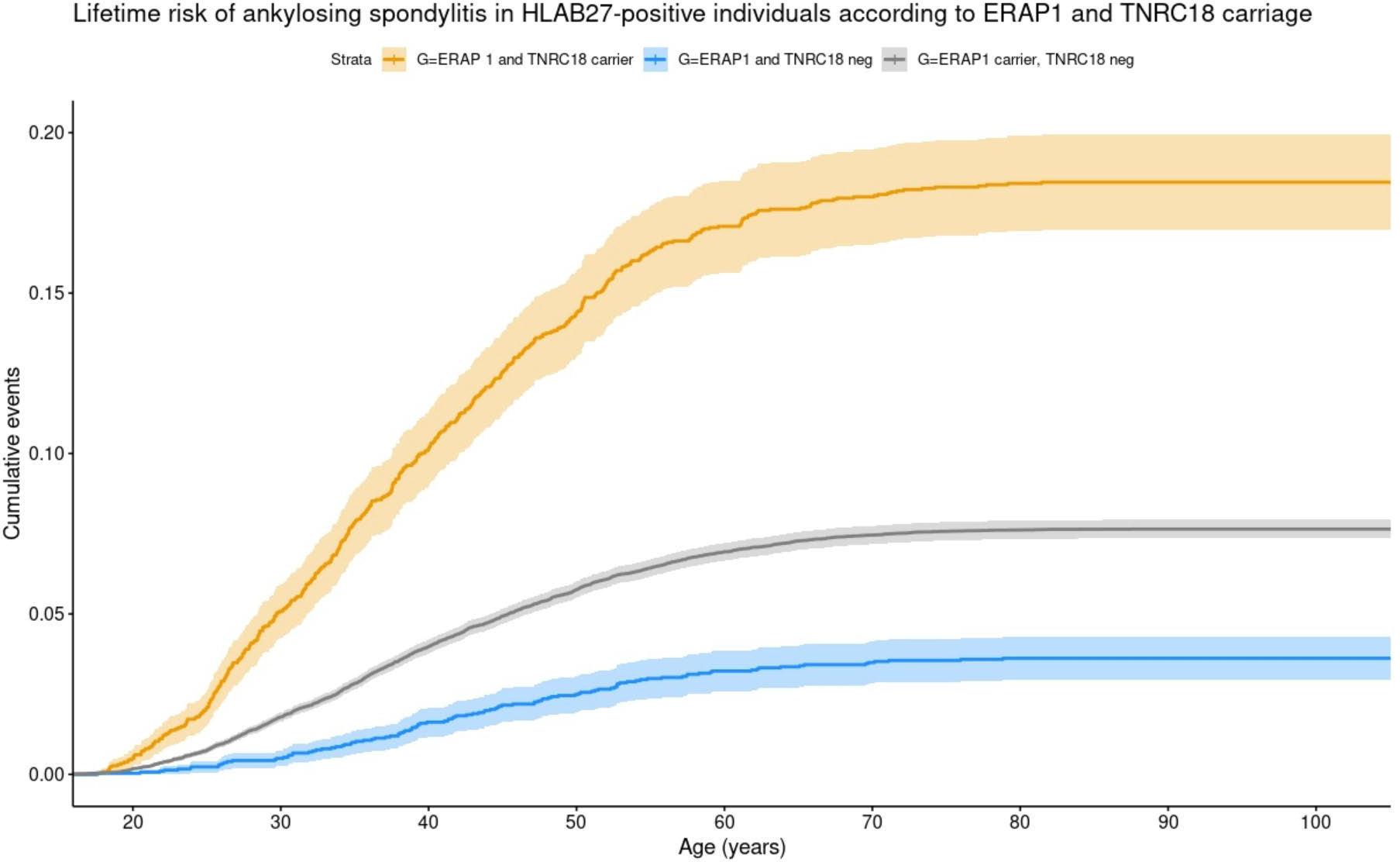
Results: The study replicated the previously reported interaction between HLA-B27 and the ERAP1 gene: Among HLA-B27–negative individuals, the ERAP1 variant did not increase disease risk at all (0.4 vs. 0.4%), whereas among HLA-B27–positive individuals, carriage of the ERAP1 variant markedly increased lifetime disease risk (ERAP1 negative 3.7%, heterozygous 7.5%, homozygous 9.2%). As a novel finding, we identified a Finnish-enriched variant in the TNRC18 gene, whose risk-increasing effect in combination with HLA-B27 was even stronger (negative 7.3%, heterozygous 16.9%, homozygous 36.5%). Co-carriage of both the TNRC18 and ERAP1 risk variants also substantially increased lifetime disease risk among HLA-B27–positive individuals (both negative 3.6%, only ERAP1-positive 7.6%, both positive 18.5%, Figure 1). The effect was minimal among HLA-B27–negative individuals (0.4, 0.4% vs. 0.7%).
ERAP1 and TNRC18 variants also had a substantial impact on the risk of anterior uveitis among HLA-B27–positive individuals with ankylosing spondylitis (both negative 20.2%, only ERAP1 positive 34.6%, both positive 45.5%).
Conclusions: Both ERAP1 and TNRC18 gene variants have a substantial impact on the lifetime risk of developing ankylosing spondylitis among HLA-B27–positive individuals, whereas their effect among HLA-B27–negative individuals is minimal. These variants have also a substantial impact on the risk uveitis in these patients.
REFERENCES: NIL.
Acknowledgments: NIL.
Disclosure of Interests: Johanna Paltta Sub-investigator in clinical drug trials (Boehringer-Ingelheim, Glaxo-Smith-Kline, Abbvie, BMS), all unrelated to this work, Eeva Sliz: None declared, Elisa Lahtela: None declared, Ville Salo: None declared, Johannes Kettunen: None declared, Finngen FinnGen: None declared, Antti Palomäki Boehringer-Ingelheim, Pfizer, Abbvie, Lilly, Johnson&Johnson, UCB, all unrelated to this work, Boehringer-Ingelheim, Abbvie, Johson&Johnson, all unrelated to this work.