fetching data ... 
Background: Inflammatory myopathies (IM) are autoimmune diseases characterized by chronic skeletal muscle inflammation and weakness. In many patients, disability persists despite low disease activity under immunosuppressants. This condition, referred to as “damage”, is frequent and is associated with increased disability and mortality.
Currently, no pharmacological treatment is available for the management of IM-related damage. However, combined intensive resistance and endurance training has been shown to improve patient-reported outcomes (PRO), muscle strength and aerobic capacity [1]. The molecular mechanisms underlying these beneficial effects remain poorly understood, and no validated biomarkers are currently available to assess or monitor IM-related damage. We recently demonstrated that elevated serum fatty-acid binding protein 3 (FABP3) levels correlate with International Myositis Assessment & Clinical Studies Group (IMACS) muscle damage scores in IM patients with low disease activity [2], suggesting a role for FABP3 in the pathophysiology of IM-related damage and its potential utility as a biomarker.
Objectives: This study aimed to investigate whether combined resistance and endurance training in IM patients with damage modifies circulating FABP3 levels.
Methods: Fifty IM patients (2017 EULAR/ACR criteria) with disease duration >12 months, creatine kinase levels <500 IU/L, and stable medication for ≥6 months, were prospectively enrolled in a 12-week intensive combined resistance and endurance training protocol consisting of 3 sessions/week. Each session was composed by 30 min of aerobic exercise at 70% of VO2max, followed by 20 min of resistance exercise at 30–40% of maximal strength [1]. Serum FABP3 levels, measured by enzyme-linked immunosorbent assay (ELISA), were assessed at inclusion in the protocol (baseline) and after completion of the training program, along with PRO, exercise capacity, muscle strength, and myositis-related damage indices. Exercise capacity was assessed by VO 2 max during an incremental ramp cycling exercise on an ergometer and by walking distance during the 6-minute walk test. A hand-held dynamometer was used to evaluate muscle strength in the muscles included in the MMT8, as well as grip strength. Myositis-related damage was assessed using the Myositis Damage Index (MDI), including severity and extent scores validated by IMACS. PRO included perceived fatigue (PROMIS-7 questionnaire), perceived physical disability (PROMIS-20 questionnaire), and disability (Health Assessment Questionnaire, HAQ).
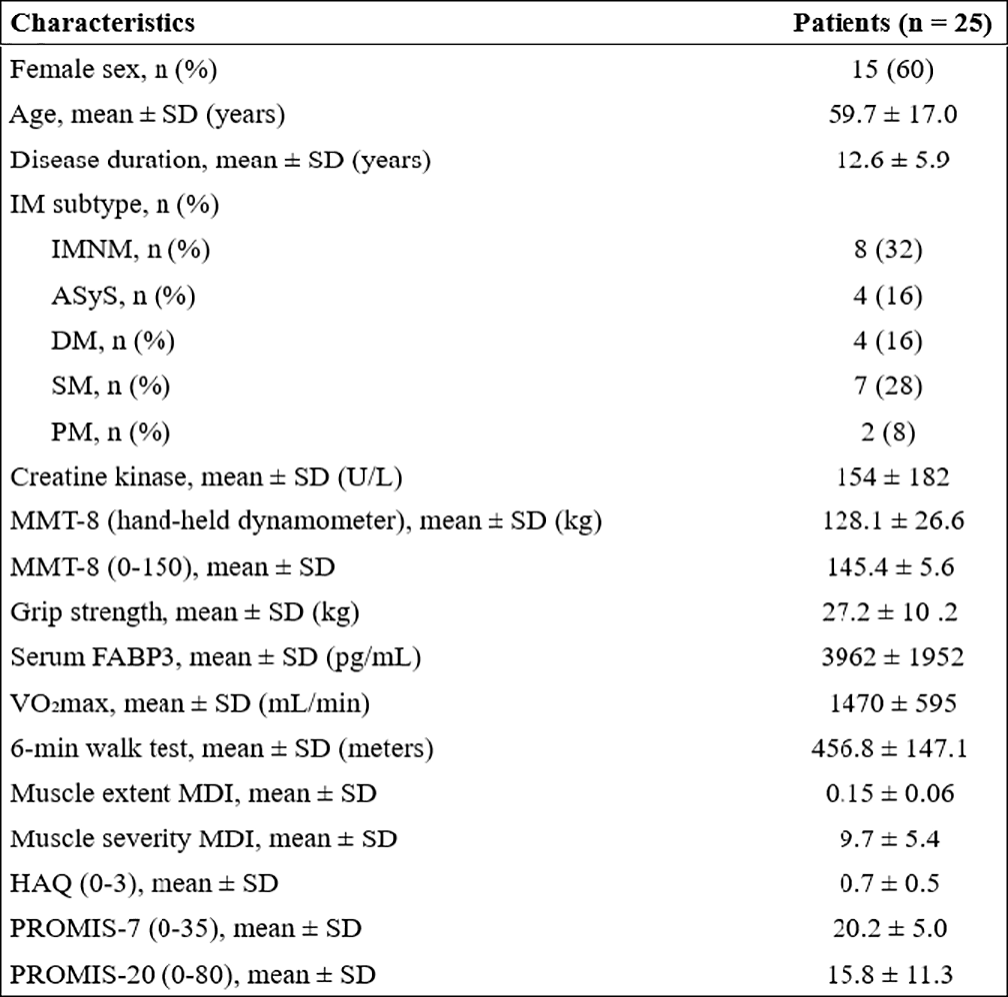
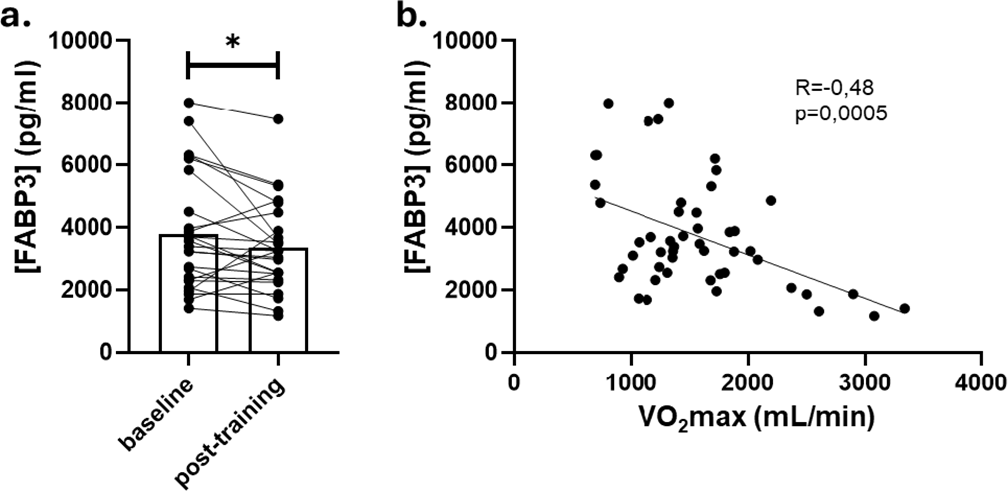
Results: Twenty-five patients already completed the protocol; cohort characteristics are presented in Table 1. At baseline, FABP3 serum levels did not differ by sex. Training significantly improved PROMIS-7 score, exercise capacity, and muscle strength, while reducing FABP3 serum levels (Δ= -425.6 ± 829.3 pg/mL, p= 0.025) (Figure 1a). MDI severity and extent scores did not change after training. At baseline, FABP3 levels correlated with i) exercise capacity (VO2max: R= -0.46, p=0.021 (Figure 1b); 6-min walk test R=-0.41, p=0.034), ii) muscle strength (MMT-8: R=-0.42, p= 0.038; grip strength: R= -0.38, p= 0.069), and iii) muscle extent and severity MDI (both R= 0.52, p= 0.022), but not with PRO (HAQ: R= 0.17, p= 0.40; PROMIS-20: R= 0.28, p= 0.16; PROMIS-7: R=-0.005, p=0.98). After training, FABP3 levels remained correlated with i) exercise capacity (VO2max: R= -0.49, p= 0.017; 6-min walk test: R= -0.67, p= 0.0005), ii) muscle strength (MMT-8: R= -0.49, p= 0.018; grip strength: R= -0.50, p= 0.015), and iii) muscle extent and severity MDI (respectively: R= 0.53, p= 0.03; R= 0.64, p= 0.005). Post-training FABP3 levels were also correlated with HAQ score (R= 0.57, p= 0.006).
Conclusions: FABP3 serum levels is a biomarker of muscle damage in IM, and its reduction is associated with the response to a combined resistance and endurance training program. Knowing the role of FABP3 in the transport of fatty acids to mitochondria [3], this myokine might contribute to damage pathophysiology in IM.
Table 1. Characteristics of patients with inflammatory myopathies (IM) at inclusion in a 12-week combined resistance and endurance training protocol.ASyS: Antisynthetase syndrome; DM: Dermatomyositis; FABP3: fatty-acid binding protein 3; HAQ: Health assessment questionnaire; IMNM: Immune-mediated necrotizing myopathy; MDI: Myositis damage index; MMT-8: Manual muscle test 8; n: number of patients; PM: Polymyositis; PROMIS-7: Patient-reported outcomes measurement information system 7-item short form; PROMIS-20: Patient-reported outcomes measurement information system 20-item short form; SD: standard deviation; SM: Scleromyositis; VO 2 max: Maximal oxygen uptake.
Fatty-acid binding protein 3 (FABP3) serum level before (baseline) and after (post-training) the intensive combined exercise program (a). Correlation between FABP3 serum level and maximum oxygen uptake (VO 2 max). p: p-value; R: Pearson correlation coefficient; *: p=0,0255.
REFERENCES: [1] Alemo Munters L. Arthritis Res Ther. 2013;15(4):R83.
[2] Giannini M. Ann Rheum Dis. 2025;84(537-538)
[3] Lee SM, et al. Nat Commun. 2020 Nov 9;11(1):5661.
Acknowledgments: NIL.
Disclosure of Interests: None declared.