fetching data ... 
Background: Despite advancements in diagnosis and treatment of rheumatoid arthritis (RA), up to 50% of patients still fail to achieve remission even with conventional synthetic disease-modifying anti-rheumatic drugs (csDMARDs); even of those that do, many experience debilitating disease flares [1]. The biological mechanisms underlying RA flare are not fully understood, although factors such as female sex, methotrexate use, rheumatoid factor and anti-citrullinated peptide autoantibody levels were reported as associated with flare following csDMARDs discontinuation [2]. The BIOlogical Factors that Limit sustAined Remission in rhEumatoid arthritis (BIO-FLARE) study is a multicentre, prospective single-arm study in which participants with established RA in sustained drug-induced remission stopped their treatment and underwent serial peripheral blood immune profiling for 6 months or until they flared [2].
Objectives: Leveraging serially obtained peripheral blood CD4+ T cell gene expression and paired serum proteome data from BIO-FLARE participants, we sought to identify a hierarchy of pathobiological pathways implicated in flare by employing joint modelling and network-based approaches.
Methods: After stopping csDMARDs at baseline, participants were followed for 24 weeks or until time of incident flare (defined as DAS28-CRP≥3.2 or DAS28-CRP≥2.4 confirmed twice within 2 weeks) [2]. Longitudinal biomarker measurements were collected at baseline, pre-flare or a matched time point, and flare/end-of-study. CD4+ T cell RNA was sequenced (NovoSeq), and serum mediators measured using the NULISAseq™ Inflammation Panel 250 [3]. Measurements were log-normalized; missing intermediate values were imputed by averaging baseline and last measurements. Analyses were focused on biomarkers with temporal changes. Associations between biomarker trajectories and the hazard of flare were assessed in joint longitudinal and survival models [4]. Biomarkers that showed significant associations with flare were subsequently advanced for network-based causal inference analyses, using the temporal Peter Clark (tPC) algorithm [5]. We additionally drew 100 bootstrap samples from the BIO-FLARE data and repeated the analyses using these samples. Gene functional analyses were carried out with clusterProfiler and enrichplot R packages [6].
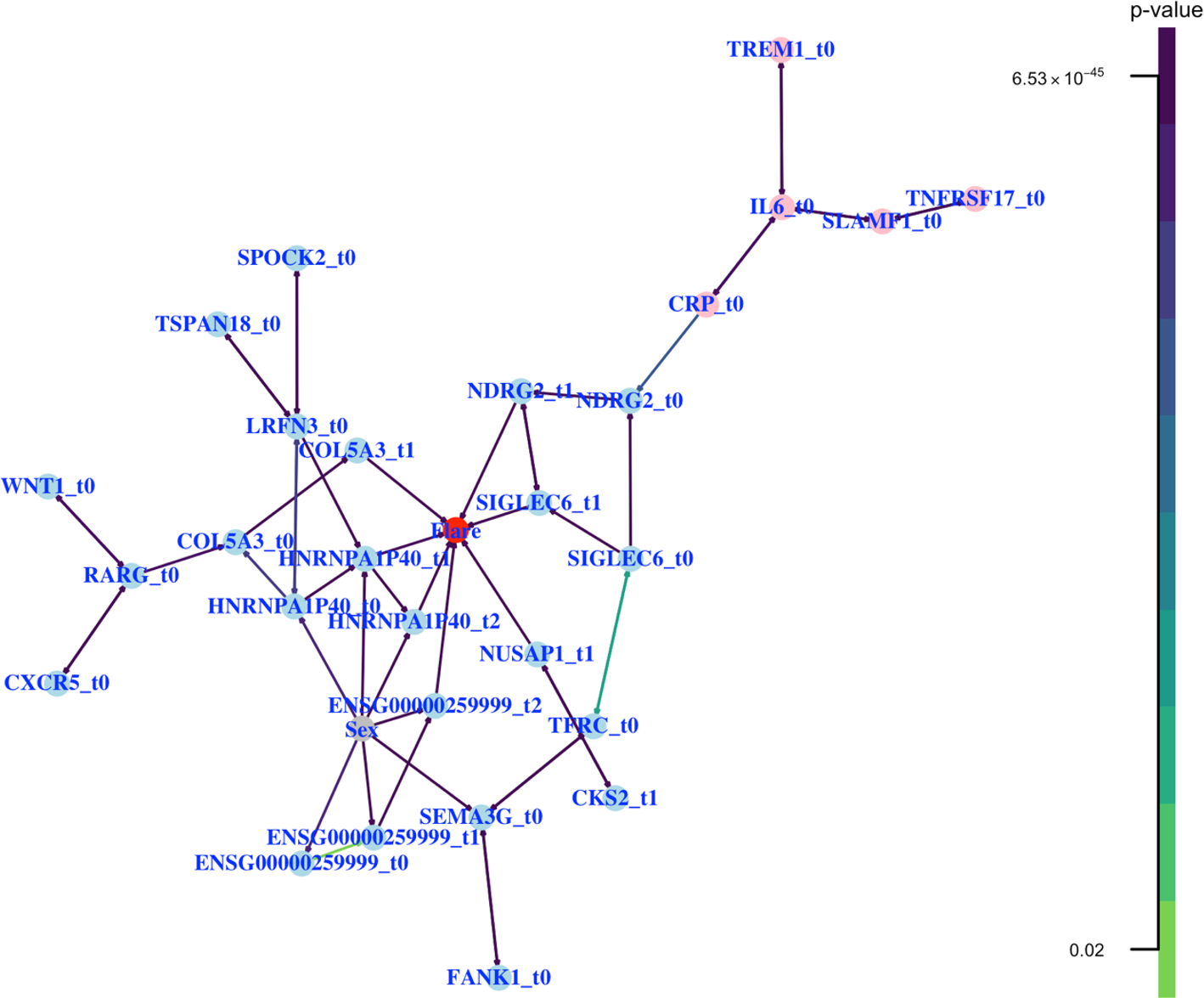
Results: Of 85 BIO-FLARE participants included, 42 (49%) experienced flare during the course of follow-up. The joint longitudinal and survival analyses identified 22 serum proteins and 17 T cell gene transcripts associated with flare. Across analysed transcripts, hazard ratios (HRs) varied between 0.11 and 1.38, whereas the HR of associated proteins ranged between 1.68-4.28. Twenty-one different genes, represented by 17 gene transcripts and 4 proteins, were part of a pathway leading to flare (Figure 1). A serum protein component of the flare-associated pathway implicated CRP/IL-6 mediated systemic inflammation and its association with soluble B-cell maturation antigen ( BCMA ) via signalling lymphocyte activation molecule-1 ( SLAM1 ), as well as the soluble triggering receptor expressed on myeloid sTREM1. This protein sub-network was in turn apparently linked to nascent flare via up-regulation of key tumour suppressor N‐myc downstream‐regulated gene 2 ( NDGR2 ) which, among other functions, inhibits PD-L1, leading to T cell proliferation.
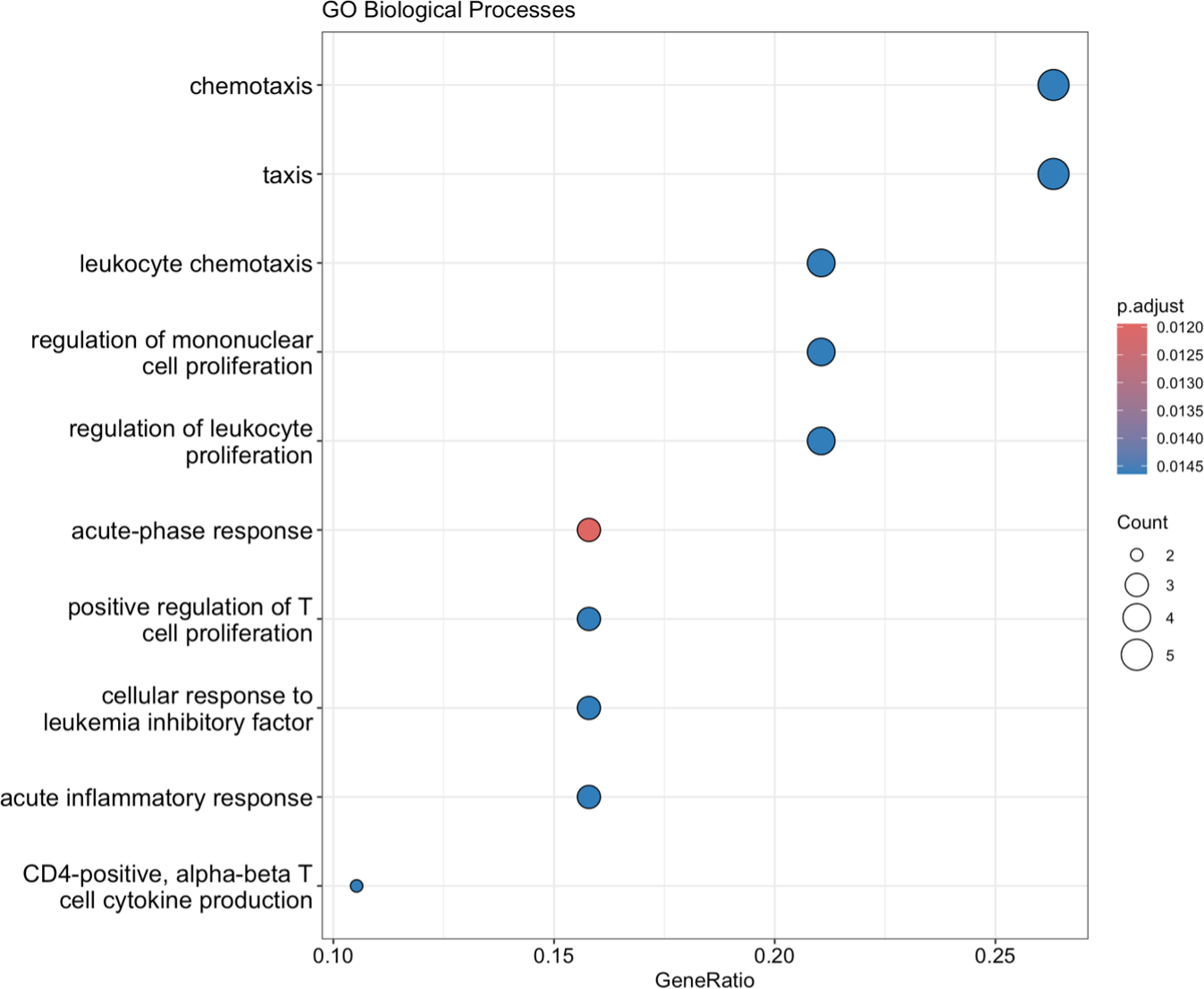
Seven RNA-seq transcripts that directly connected to flare each formed distinct molecular pathways that also interacted with one another. Whilst transcripts with previously well-characterised T-cell-specific functions were not prominent amongst these, functional analysis of the global flare-associated network pointed to the relevance of pathways associated with T-cell activation, proliferation and chemotaxis during the transition from remission to flare. (Figure 2). The NDGR2 -axis exemplified this, with NDGR2 expression influenced by Sialic acid-binding Ig-like Lectin 6 ( SIGLEC6 ), which has itself been associated with resistance to RA treatment [7]; interaction of SIGLE6 with Transferrin receptor ( TFRC ) may in turn mediate T-cell proliferation, synapse formation and cytokine signalling Amongst other genes in the NDGR2 -axis distally connected to flare through TFRC was Semaphorin 3G ( SEMA3G ), upregulation of which may exacerbate joint inflammation and increase synovial T cell numbers in RA [8]. Notably, bootstrap analysis confirmed edges between flare and analysed biomarkers in our network were somewhat unstable, likely reflecting the modest sample size.
Conclusions: Our findings should be considered exploratory in nature. They nonetheless illustrate the value of joint modelling and network-based approaches for prioritising potential mechanisms of disease in longitudinal studies for functional interrogation in future work. Given IL-6 mediated T-cell activation is a known feature of early RA pathogenesis [9], our current observations hint at biological parallels between the initiation of arthritis and subsequent relapse.
Gene network leading to flare. Gene transcripts (in blue) and encoded proteins (in pink) were represented by nodes in the network.
Gene Ontology biological processes enriched among genes that were in the causal pathway leading to flare. The figure shows top ten enriched pathways based on lowest p-values.
REFERENCES: [1] Bykerk VP. et al. J Rheumatol. 2014.
[2] Rayner F et al. BMJ Open. 2025.
[3] Feng W et al. Nat Commun. 2023.
[4] Rizopoulos D, et al. Stat Methods Med Res. 2024.
[5] Andrews RM et al. Int J Epidemiol. 2024.
[6] Yu G. Innov Life. 2025.
[7] Yamada S et al. Ann Rheum Dis. 2023.
[8] Shoda J et al. Arthritis Res Ther. 2022.
[9] Pratt AG et al. Ann Rheum Dis. 2012.
Acknowledgments: NIL.
Disclosure of Interests: Karina Patasova: None declared, Jasmine Sim: None declared, Graham Smith: None declared, Fiona Rayner: None declared, Najib Naamane: None declared, Bernard Dyke: None declared, Andrew Melville: None declared, Sean Kerrigan: None declared, Andrew McGucken: None declared, Christopher D Buckley: None declared, Andrew Filer: None declared, Iain B. McInnes: None declared, Karim Raza: None declared, Stefan Siebert Amgen, Johnson & Johnson, Novartis, Pfizer and UCB, AbbVie, AstraZeneca, Johnson & Johnson, Syncona, Shattuck Labs, Teijin Pharma, and UCB, Eli Lilly, GlaxoSmithKline, Johnson & Johnson, Pfizer and UCB, Wan-Fai Ng: None declared, Kenneth F Baker: None declared, Amy E Anderson: None declared, John Isaacs: None declared, Heather Cordell: None declared, Arthur Pratt GSK grant.