fetching data ... 
Background: Sjögren’s disease (SjD) is a systemic autoimmune disease occurring in 0.3-0.8% of the population. SjD has a complex genetic architecture and shares genetic risk factors with other rheumatic diseases. Despite this, SjD remains one of the least genetically characterized rheumatic diseases with only 22 genome-wide significant (GWS) SjD risk loci identified thus far [1].
Objectives: Perform a genome-wide association study (GWAS) with 1,802,895 samples (from which 13,114 were SjD cases) to identify novel GWS SjD risk loci.
Methods: IRB/EC approval was obtained. Genotypes from SjD patients meeting 2016 ACR-EULAR criteria were from the Sjögren’s Genetic Network. GWAS were performed separately using PLINK2 on European (EUR) genotype data (5,150 cases, 30,618 controls) imputed with TOPMed reference panel. ImmunoChip data from additional EUR (281 cases, 6,133 controls) and East Asian (EAS) (561 cases, 1,760 controls) samples were analyzed separately. Data were meta-analyzed using inverse variance-weighted fixed-effect models in METAL with biobank GWAS summary statistics for SjD cases and controls (excluded SjD and other rheumatic diseases). Biobanks data included Japanese (303 EAS cases, 175,599 controls), Estonian (464 EUR cases, 204,701 controls), MGI (952 EUR cases, 18,594 controls), meta-analysis of UK Biobank, MVP and FinnGen (5,399 EUR cases, 1,352,375 controls). In total, meta-analysis was performed on 13,114 cases and 1,789,781 controls. Heterogeneity criteria of I 2 <0.75, p HET <1x10 -6 were applied. GWAS catalog was used to determine if loci were previously reported in related autoimmune diseases. FUMA was used for variant-to-gene analysis. Chromatin interaction (CI) for GM12878 cell line and eQTLs from immune cells and salivary gland were used to predict affected genes. TensorQTL was used to calculate salivary gland eQTLs (n=43 genotyped subjects with matched single nuclei RNA-seq (snRNA-seq) from minor salivary gland).
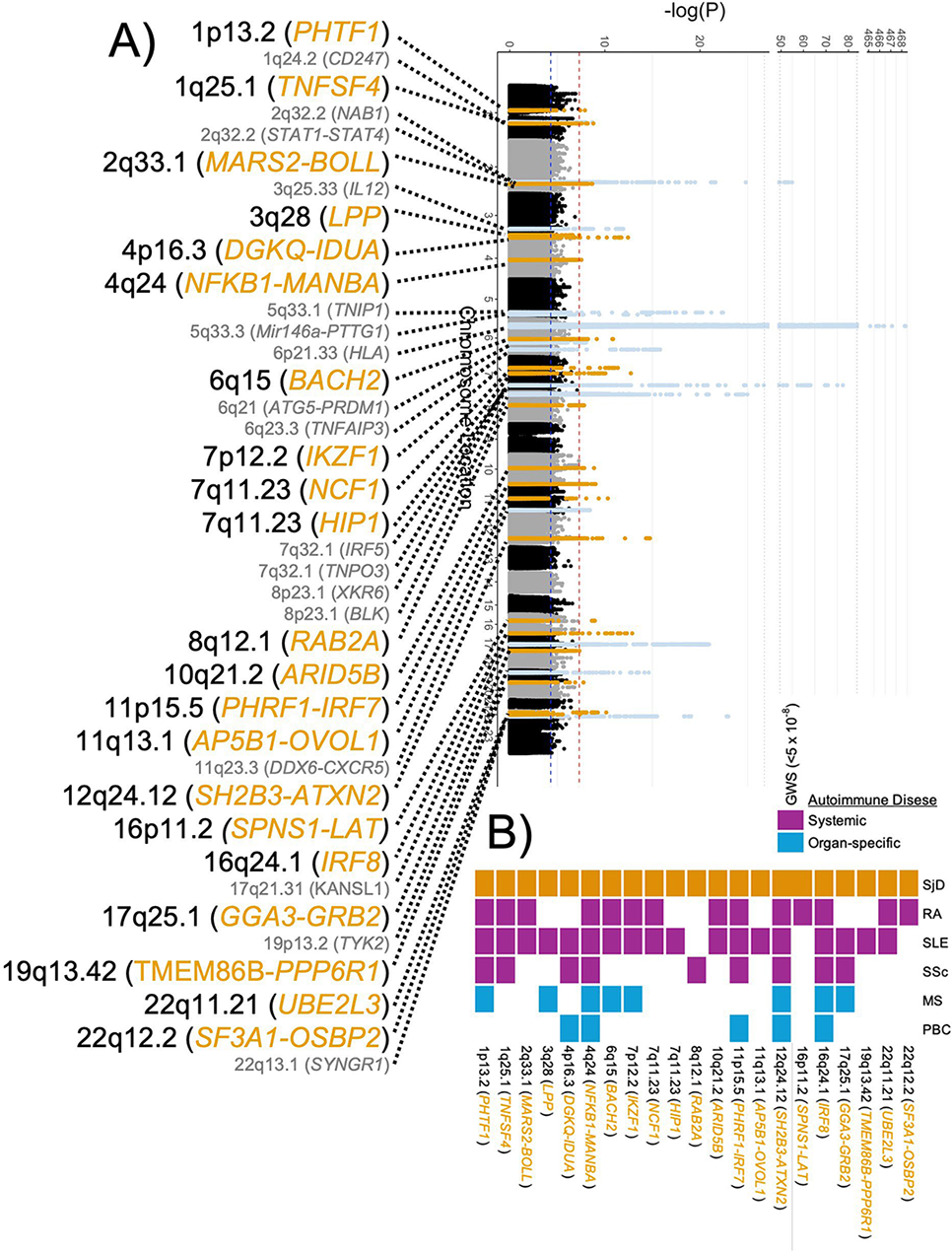
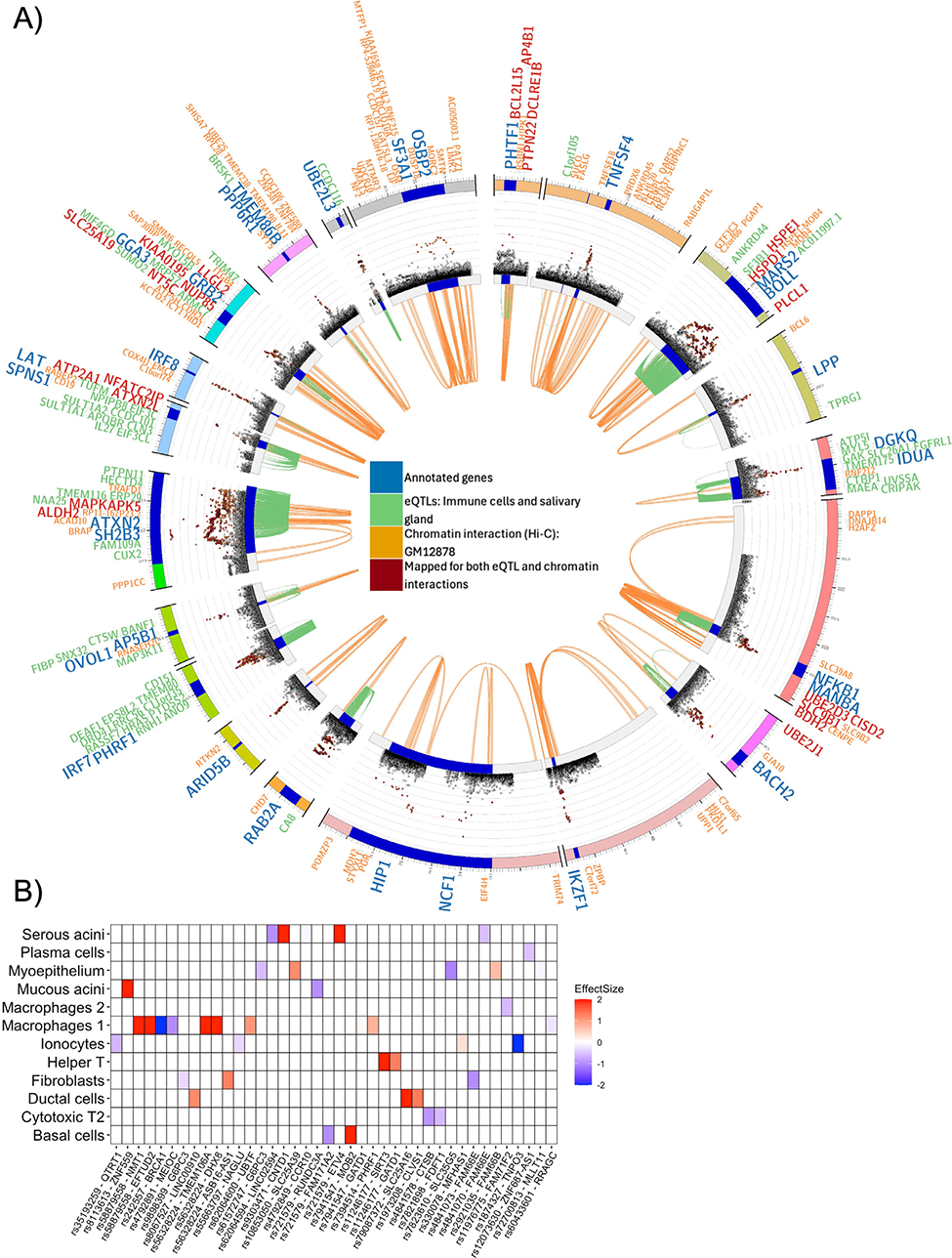
Results: Total of 21 novel GWS risk loci were identified: 1p13.2 ( PHTF1 ), 1q25.1 ( TNFSF4 ), 2q33.1 ( MARS2-BOLL ), 3q28 ( LPP ), 4p16.3 ( DGKQ-IDUA ), 4q24 ( NFKB1-MANBA ), 6q15 ( BACH2 ), 7p12.2 ( IKZF1 ), 7q11.23 ( NCF1 ), 7q11.23 ( HIP1 ), 8q12.1 ( RAB2A ), 10q21.2 ( ARID5B ), 11p15.5 ( PHRF1-IRF7 ), 11q13.1 ( AP5B1-OVOL1 ), 12q24.12 ( SH2B3-ATXN2 ), 16p11.2 (SPNS1-LAT ), 16q24.1 ( IRF8 ), 17q25.1 ( GGA3-GRB2 ), 19q13.42 (TMEM86B- PPP6R1 ), 22q11.21 ( UBE2L3 ), 22q12.2 ( SF3A1-OSBP2 ) (Figure 1A). All were previously reported in a related autoimmune disease (Figure 1B). Risk loci 4q24 ( NFKB1-MANBA ), 12q24.12 ( SH2B3-ATXN2 ), and 16q24.1 ( IRF8 ) were shared by all related autoimmune diseases with annotated genes previously implicated in immune response regulation. Further investigation of novel GWS SjD loci using open-source FUMA data, including GM12878 Hi-C and reported immune cell and salivary gland eQTLs, revealed variants with predicted effects on 279 genes: 86 showed only eQTLs, 151 showed only CIs, and 42 showed both eQTLs and CIs (Figure 2A). Several genes have known functions in SjD pathogenic pathways: phagocytosis ( GRB2 , IRF8 , LAT , NCF1 , TMEM175 ), germinal center formation ( CD19 , IRF8 , RC3H1 ), and inflammation related fibrosis ( BACH2 , FASLG , NFKB1 , SH2B3 ). Open-source salivary gland eQTLs were from bulk tissue. To assess cell type-specific eQTLs in salivary gland, in-house snRNA-seq data from minor salivary gland were used (Figure 2B). Forty cell type-specific eQTLs were observed among 12 salivary gland resident cell types; 34 of which were not found in open-source data. One eQTL shared between open-source (Macrophages, Monocytes and B cells) and in-house data (Macrophages 2) was PHRF1 – involved in TGF-β signaling and genome integrity and reported in many rheumatic diseases.
Conclusions: By increasing the GWAS sample size and performing meta-analysis, this study nearly doubled the number of identified GWS SjD risk loci. Importantly, common genetic associations between SjD and related autoimmune diseases may indicate shared mechanisms of disease. Further, while loci are annotated by the gene closest to the index variant, this study demonstrated that epigenomic annotations, such as CIs and cell type-specific eQTLs, can identify a wider network of genes at each locus that may be regulated by SjD risk variants. Data herein identified a network of almost 300 genes with implicated functional significance beyond the annotated genes. These findings also highlight the limited availability of open-source salivary gland data and demonstrate how improved cell type-specific eQTL reporting in the salivary gland can enhance the functional interpretation of GWS risk loci in the context of disease target tissues. Additional datasets from SjD clinical partners and biobanks are needed to further increase discovery power of novel loci.
(A ) Summary statistics of meta-analysis: 13,114 EUR+EAS cases (orange - novel GWS SjD risk loci; light blue - previously established). The -log 10 ( P ) for each variant is plotted against genomic locations (red line - GWS (5x10 -8 ) threshold; blue line - suggestive (1x10 -5 ) threshold. (B ) Novel SjD associations established in other systemic (violet) and organ-specific (blue) autoimmune diseases. Data from GWAS catalogue. Rheumatoid arthritis (RA), Systemic Lupus Erythematosus (SLE), Systemic Scleroderma (SSc), Multiple Sclerosis (MS), Primary Biliary Cirrhosis (PBC).
(A ) Regional maps of genetic risk loci: outside layer - gene names (annotated genes – dark blue, chromatin-chromatin interaction – orange, eQTLs – green, both - red); middle layer - genetic risk locus (top variant annotated; LD to the index SNP: red - r 2 >0.8, orange – 0.8> r 2 >0.6, gray - r 2 <0.6); Inside layer –chromatin interactions (orange loop), eQTLs (green loop). Data generated with FUMA. (B ) Heatmap of significant (p-value<0.001) eQTLs for suggestive variants (x axis - variant and affected gene, y-axis - cell type; effect size - z-score of slope).
REFERENCES: [1] Khatri, et al. Nat Commun . 2022.
Acknowledgments: NIL.
Disclosure of Interests: Marcin Radziszewski: None declared, Bhuwan Khatri: None declared, Philip E. Stuart: None declared, Astrid Rasmussen Current affiliation: Boston Children’s Hospital., Received consulting fees from Immunovant Clinical Outcomes Solutions., Kandice L Tessneer: None declared, Cherilyn Pritchett Frazee: None declared, Matthew T. Patrick: None declared, Elena Pontarini: None declared, Michele Bombardieri: None declared, Maureen Rischmueller Speaker honorariums from Novartis., Received funding for clinical trials from Amgen, Argenx, AstraZeneca, Brystol Myers Squibb (BMS), Horizon Therapeutics, Novartis, and Servier., Marika Kvarnström: None declared, Torsten Witte Received speaker honorariums from previous plus Amgen, AstraZeneca, Ghugai, GSK, Medac, Nordic, Sanofi, UCB; Received travel support from AbbVie, Janssen, Lilly, UCB., Received consulting fees from Abbvie, Boehringer Ingelheim, Fresenius Kabi, Galapagos, Janssen, Lilly, and Novartis., Hendrika Bootsma: None declared, Gwenny M. Verstappen: None declared, Frans G.M. Kroese Received consulting fees from Novartis., Arjan Vissink: None declared, Sarah Pringle: None declared, Athanasios Tzioufas: None declared, Clio Mavragani: None declared, Alan Baer Received consulting fees from BMS., Marta Alarcon-Riquelme Received consulting fees from GSK., Javier Martin: None declared, Xavier Mariette Received consulting fees from BMS, GSK, Janssen, Novartis, Otsuka, Pfizer., Gaetane Nocturne Member, Boehringer Ingelheim Advisory Board, Received consulting fees from Abbvie, Novartis, Galapagos, Amgen. Received travel support from Amgen, UCB., Jacques-Olivier Pers: None declared, Jacques-Eric Gottenberg: None declared, Wan-Fai Ng Received consulting fees for Novartis, BMS, Janssen, Sanofi, Abbvie, IQVIA, Argenx, Resolve Therapeutics., Erik Abner: None declared, Kanwal Batool: None declared, Benjamin A. Fisher Speaker honorarium from Novartis, Servier, Otsuka., Received consulting fees from Novartis, BMS, Servier, Galapagos, Roche, UCB, Sanofi, Johnson & Johnson, AstraZeneca, Otsuka, Amgen, Kiniksa, Cullinan, Quell Therapeutics, OneFour Bio., Research funding from Johnson & Johnson, Servier, Galapagos, Novartis, Cullinan., Rachael Gordon Received consulting fees from Novartis, Vor, Totus Medicine, Receiving funding from Rheumatology Research Foundation Scientific Development Award, 5 K12AR084218, Gabriela Hernandez-Molina: None declared, Adrian Y S Lee Received speaker honorarium from Novartis., Received speaker honorarium from Novartis., Caroline Shiboski Received consulting fees from BMS., Kimberly E Taylor: None declared, Lindsey Criswell: None declared, Blake M Warner Active research agreements with Astellas Bio, Pfizer., A. Darise Farris Grant/research support from Johnson and Johnson Innovative Medicine (formerly Janssen; ended 12/31/2023)., Judith A. James Received consulting fees from GSK., Received research support from Progentec Biosciences., R Hal Scofield Advisory Board Member for Janssen Pharmaceuticals, IQVIA., Received consulting fees from Johnson and Johnson Innovative Medicine (formerly Janssen) and Merk Pharmaceuticals., Joel M Guthridge: None declared, Daniel J Wallace M.D.: None declared, Swamy Venuturupali ACR Board of Governors Member, Received research funding from Navidea Biopharmaceuticals Inc, ARGENX, Mallinckrodt, Janssen, Kiniksa Pharmaceuticals., Michael T Brennan Received consulting fees and research funding from MeiraGTx, Lipella, and SUN pharmaceuticals; Received travel support from North Carolina Dental Society, Juliana Imgenberg-Kreuz: None declared, Lars Ronnblom Received consulting fees and speaker honorarium from AstraZeneca, Eva Baecklund: None declared, Maija-leena Eloranta: None declared, Svein Joar Auglænd Johnsen: None declared, Roald Omdal: None declared, Lara A Aqrawi: None declared, Øyvind Palm: None declared, Johan G Brun: None declared, Daniel Hammenfors: None declared, Malin V Jonsson: None declared, Silke Appel: None declared, Sara Magnusson Bucher: None declared, Helena Forsblad-d’Elia: None declared, Thomas Mandl Employee of UCB, Per Eriksson Johnson & Johnson Advisory Board Member, Received research funding from BMS, Novartis, Servier, Marie Wahren-Herlenius Received research funding from Merck KGaA and Janssen, Johann E Gudjonsson: None declared, Lam Tsoi: None declared, Gunnel Nordmark: None declared, Christopher J Lessard Consulting fees from Johnson and Johnson Innovative Medicine Research Alliance Sjögren’s Disease Advisory Board., Received research support from Johnson and Johnson Innovative Medicine (formerly Janssen; ended 12/31/2023).