fetching data ... 
Background: CD45RC is an isoform of CD45, a transmembrane tyrosine phosphatase that plays a critical role in regulating antigen receptor signalling in T and B cells. CD45RC is expressed on most circulating B cells, while in T cells its high expression is restricted to helper 1 T (Th1) precursors, Th1 cells, and T effector memory CD45RA+ (TEMRA) subsets. In preclinical models of transplant rejection [4], graft-versus-host disease (GvHD)[2], Duchenne muscular dystrophy, Autoimmune Polyendocrinopathy-Candidiasis-Ectodermal Dystrophy (APECED)[3], Rheumatoid Arthritis (RA) and Inflammatory Bowel Disease (IBD), administration of an anti-CD45RC monoclonal antibody (mAb) has demonstrated robust disease control [1]. The anti-CD45RC mAb ABO21009 (Aboleris Pharma) is currently being evaluated in a placebo-controlled, single-blind, phase I clinical trial in healthy volunteers and patients with RA.
Objectives: The study aimed to evaluate the presence and expression of CD45RC in salivary gland tissue of patients diagnosed with Sjögren’s Disease (SjD) based on presence of anti-SSA antibodies and/or focus score (FS) (≥50 lymphocytes/4 mm 2 ). Tissue sections from various patient and control groups were analysed to assess the degree of SjD related to lymphocytic infiltration and the co-expression of CD45RC within and adjacent to lymphocytic foci.
Methods: Samples from patients (n=99) were stratified into six groups based on clinical, serological and histological features: pre-SjD (anti-SSA-positive, asymptomatic; n=9), SjD-1 (anti-SSA-positive with FS; n=27), SjD-2 (anti-SSA-positive with sicca symptoms only; n=18), SjD-3 (anti-SSA-negative with sicca symptoms and FS; n=9), Sicca controls (objective dryness without anti-SSA; n=29), and Sicca-Complaint controls (subjective dryness only; n=7). Salivary gland biopsies were formalin-fixed, paraffin-embedded, sectioned (4 μm), haematoxylin and eosin (H&E) stained, and immunohistochemistry was performed for CD3, CD20, CD21, CD138, CD45, and CD45RC. Sections were digitally scanned, and tissue areas quantified (≥4 mm 2 per definition FS). Lymphocytic foci (≥50 cells), FS, T/B cell ratios, and follicular dendritic cells were assessed; biopsies were classified as positive if FS ≥1 or FS <1 with lymphoepithelial lesions (LELs). CD45/CD45RC expression was analysed to evaluate autoreactive lymphocytes across disease groups.
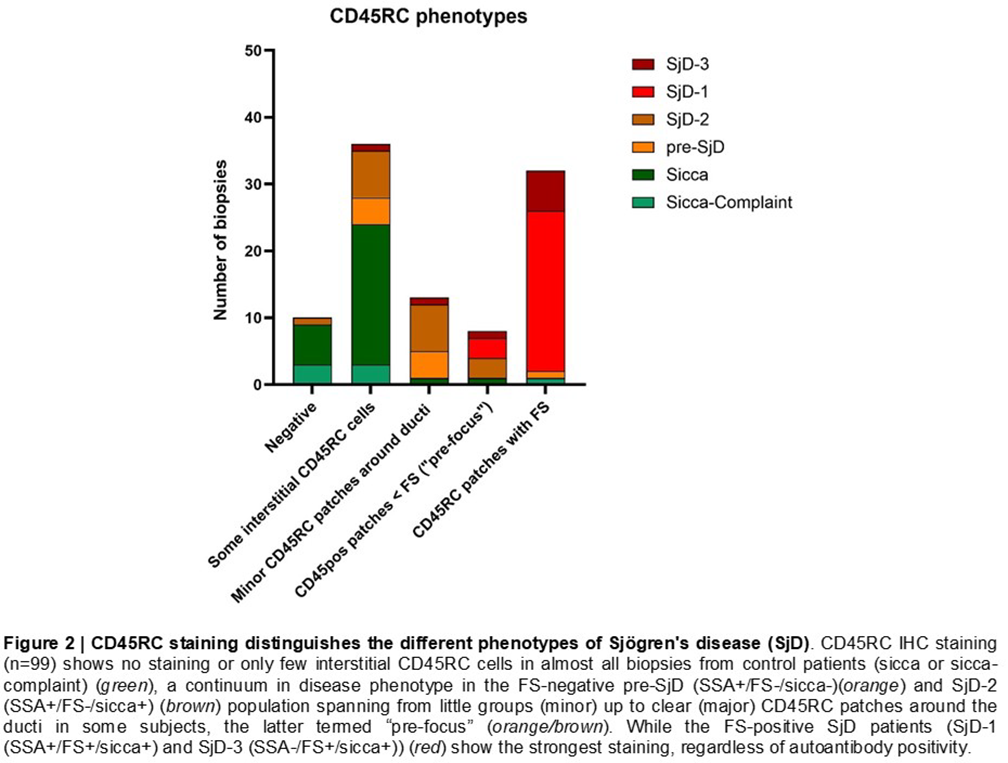
Results: CD45RC expression in salivary gland tissue demonstrates a strong correlation with FS, indicating that CD45RC-positive cells constitute the primary components of focal lymphocytic infiltrates in SjD ( Figure 1, left panel ). Absence of CD45RC staining ( Figure 1, right panel ) allowed clear discrimination from biopsies that lack any lymphocytic infiltration. This suggests CD45RC as a potential therapeutic target, given its association with degree of inflammation and expression restricted to affected glands within pre-SjD and SjD patients groups ( Figure 2 ). Importantly, comparative analysis across classification groups revealed a continuum in CD45RC staining that correlated with disease phenotypes; negligible CD45RC staining in control cohorts (sicca and sicca complaint) ( Figure 2, green ), whereas pre-SjD and SjD-2 groups exhibited minimal to moderate positivity ( Figure 3, orange/brown ), occasionally forming focal aggregates primarily localized around the ducti without meeting FS criteria - named “pre-focus”. In contrast, the FS-positive groups SjD-1 and SjD-3 groups displayed pronounced CD45RC expression ( Figure 1, left and Figure 3, red ), corresponding to severe lymphocytic infiltration. Furthermore, CD45RC staining facilitated the identification of LELs, a hallmark of SjD, and demonstrated spatial overlap with pan-CD45 staining, albeit more restricted to the center of the (developing) focus lesions ( Figure 1, left and middle panel ). Interestingly in these groups, CD45RC expression was equally abundant irrespective of anti-SSA status. Thus, CD45RC expression in SjD is localized in the salivary glands, associated to the infiltration severity, and spans across the entire glandular disease spectrum ( Figure 1 and 2 ) even allowing capture of early and ‘pre-focus’ lesions within salivary gland biopsies from patients who do not yet fulfil the criteria for a positive FS.
Conclusions: CD45RC is highly expressed within lymphocytic infiltrates in the salivary glands of SjD patients, with expression levels directly correlating with degree of lymphocytic infiltration. Its absence in control groups and localized expression in disease-affected areas support CD45RC as a promising therapeutic target for SjD treatment, including phenotypic manifestations at early stages of the disease prior to the development of a positive FS. Importantly, CD45RC expression in inflamed salivary gland is shown to be irrespective of autoantibody status. Altogether, our findings demonstrate the potential of CD45RC therapy in SjD and underscores its potential as a biomarker.
CD45RC expression in salivary gland tissue of patients with Sjögren’s Disease (SjD)
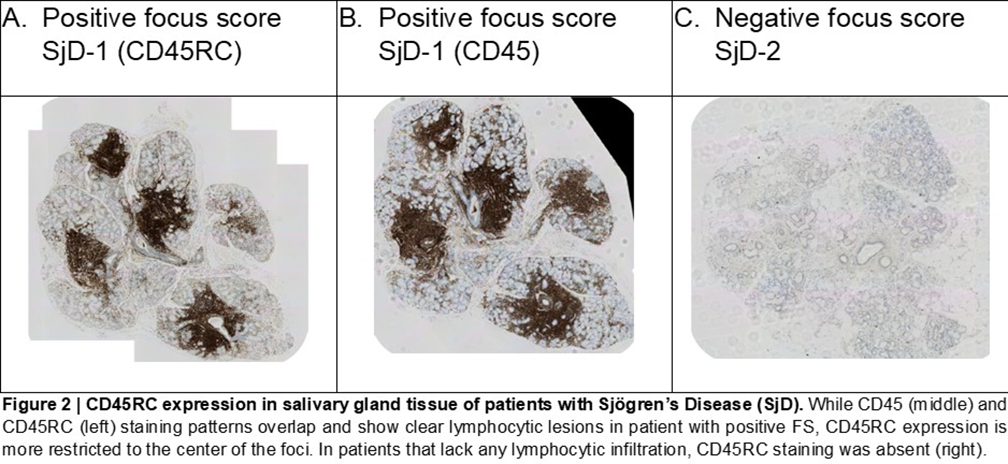
CD45RC Immunohistochemistry staining distinguishes different phenotypes of Sjögren’s disease (SjD)
REFERENCES: [1] Bergua et al., First-in-class anti-human CD45RC antibody targets CD45RC high T and B cells to mitigate pathogenic immune responses, Molecular Therapy (2025),
[2] Boucault et al., Transient antibody targeting of CD45RC inhibits the development of graft-versus-host disease. Blood Adv. 2020 Jun 9;4(11):2501-2515. doi: 10.1182/bloodadvances.2020001688.
[3] Besnard et al., Anti-CD45RC antibody immunotherapy prevents and treats experimental autoimmune polyendocrinopathy-candidiasis-ectodermal dystrophy syndrome. J Clin Invest. 2022 Apr 1;132(7):e156507. doi: 10.1172/JCI156507.
[4] Picarda et al., Transient antibody targeting of CD45RC induces transplant tolerance and potent antigen-specific regulatory T cells. JCI Insight. 2017 Feb 9;2(3):e90088. doi: 10.1172/jci.insight.90088.
Acknowledgments: NIL.
Disclosure of Interests: Joke Deprez: None declared, David Creytens: None declared, Katleen Swinnen Aboleris, Sophie Vanhoof: None declared, Helena Achten: None declared, Laure-Helene Ouisse: None declared, Nadege Vimond Aboleris, Carole Guillonneau Aboleris, Aboleris, Aboleris, Ronald Van Brempt Aboleris, Isabelle Peene Argenx, Dirk Elewaut Argenx, Aboleris, BMS, Argenx, Aboleris.