fetching data ... 
Background: Interstitial lung disease (ILD) is a frequent and prognostically important extra-glandular manifestation in Sjögren’s disease (SjD), associated with heterogeneous disease trajectories and increased mortality. Recent recognition of progressive pulmonary fibrosis (PPF) as a treatable phenotype across ILDs has reframed therapeutic strategies. However, how this paradigm applies to SjD-ILD remains uncertain, as highlighted in the 2025 European Respiratory Society (ERS) and European Alliance of Associations for Rheumatology (EULAR) clinical practice guidelines for connective tissue diseases associated-ILD. Noteworthy, these guidelines were based almost exclusively on indirect evidence, given the absence of randomised trials and limited longitudinal real-world data in SjD-ILD. Consequently, treatment strategies remain largely empirical, and contemporary data on treatment implementation, timing, and pulmonary outcomes are scarce.
Objectives: To characterise real-world treatment frequency and therapeutic patterns in SjD-ILD across European expert centres, to identify clinical factors associated with treatment initiation, and to evaluate temporal trends in pulmonary function and survival under current clinical care.
Methods: We performed a post-hoc analysis of prospectively collected data from a multicentre European observational cohort including patients with SjD-ILD diagnosed between 1997 and 2025 at three European centres (Oslo, Zurich, Vienna). All patients fulfilled the 2016 ACR/EULAR classification criteria and had presence of ILD on high-resolution computed tomography (HRCT) and ILD pattern confirmed by local expert thoracic radiologists. Longitudinal data on clinical characteristics, pulmonary function, imaging, and treatment exposure were analysed. Respiratory symptoms were assessed by using the modified Medical Research Council (mMRC) dyspnoea scale. Treatment patterns (treatment initiation, drug class and compound description, sequencing across treatment lines, and treatment modification) and pulmonary outcomes were assessed across four predefined calendar periods reflecting key eras of CTD-ILD management (≤2006, 2007-2011, 2012-2016, ≥2017). Pulmonary outcomes were defined by absolute changes in forced vital capacity (FVC ≥5% at 12±3 months or ≥10% at 24±3 months) and by 5-year all-cause mortality. Patients were followed from baseline until last clinical encounter or death, with follow-up censored at the end of the observation period. Temporal trends were analysed using trend tests, and univariable logistic regression was applied to identify factors associated with treatment initiation.
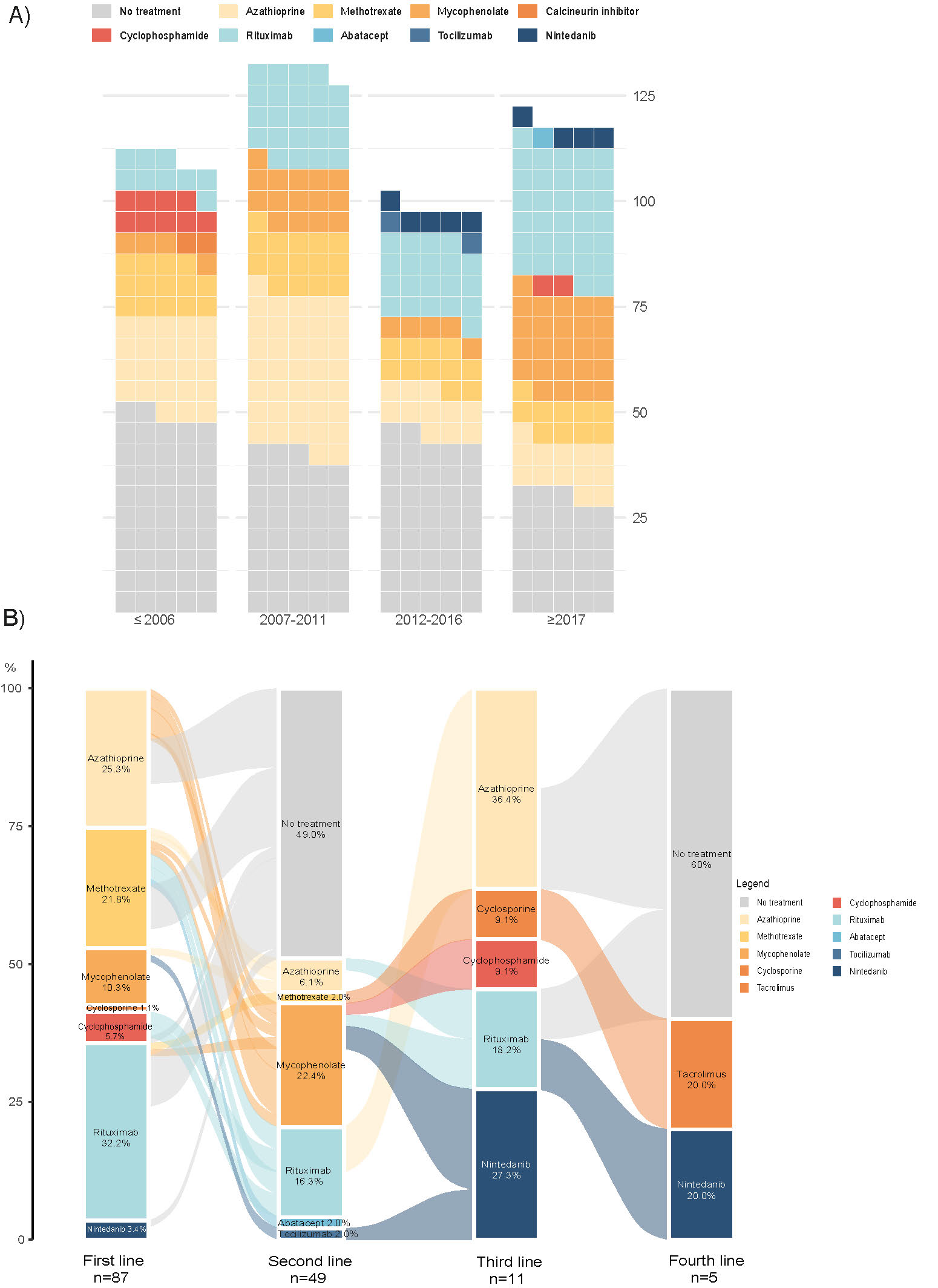
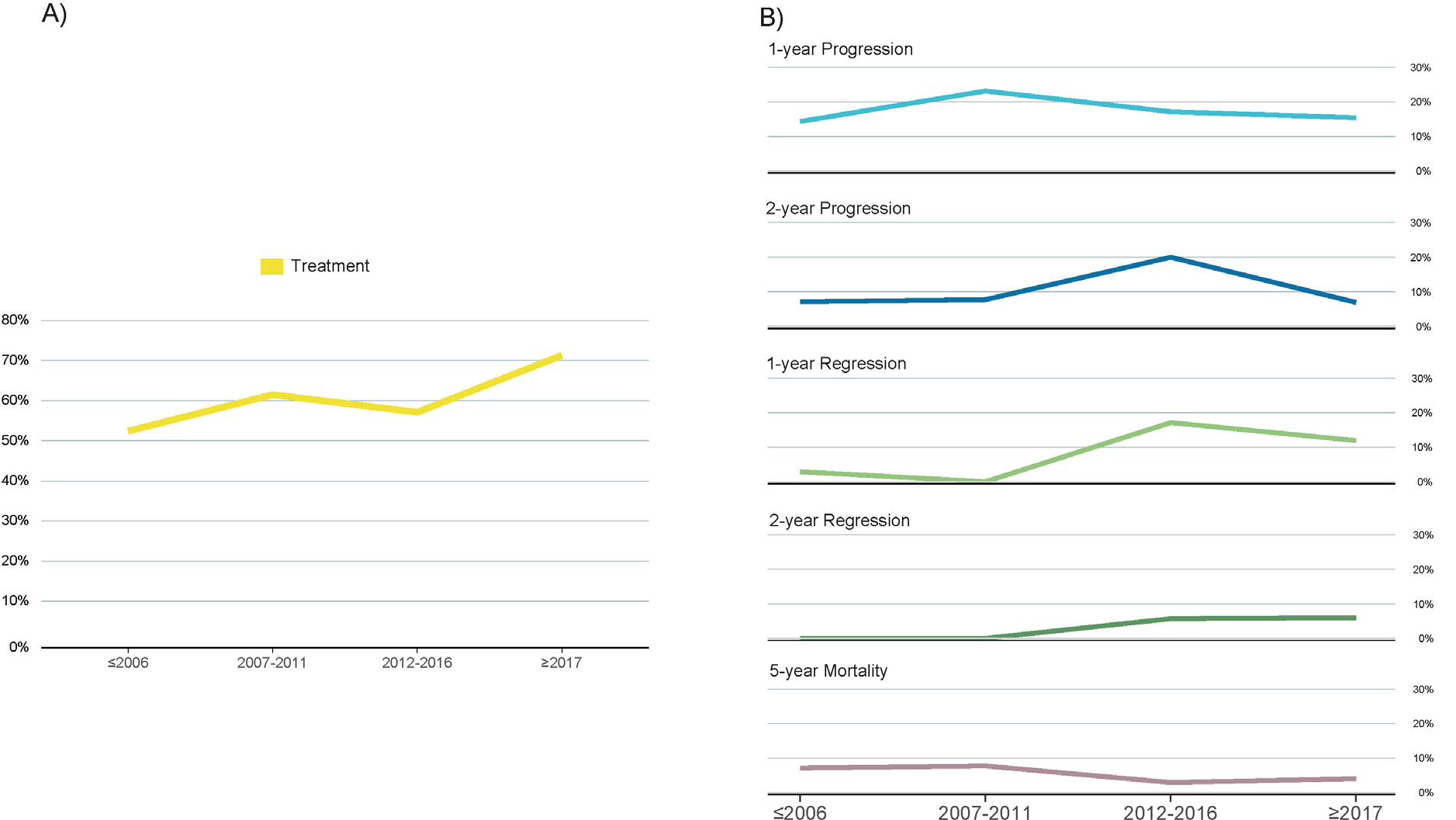
Results: Among 191 patients with SjD-ILD (mean age 59.9 ± 13.6 years, 81% female), lymphocytic interstitial pneumonia (LIP) was the most frequent HRCT pattern (39.8%), followed by non-specific interstitial pneumonia (NSIP, 20.4%) and usual interstitial pneumonia (UIP, 8.9%). Overall, 122 patients (63.9%) received any immunosuppressive therapy, with treatment rates increasing from 52.4% before 2006 to 71.3% after 2017 (p=0.03, Figure 2A). Glucocorticoids were prescribed in 81 patients (42.4%), rituximab in 48 (25.1%), azathioprine in 33 (17.3%) and mycophenolate in 32 (16.8%). Nintedanib was introduced after 2016 and prescribed in 3.7% (Figure 1A). When we evaluated therapeutic patterns, we found that first-line drug persistence-defined as continuous use of a single regimen without modification-was highest for mycophenolate (77.8%) followed by rituximab (64.3%), azathioprine (31.8%) and methotrexate (15.8%) (Figure 1B). When we assessed clinical factors associated with treatment initiation, our data revealed that patients with higher mMRC dyspnoea class (OR 3.34, 95% CI 1.43-7.80) and FVC <70% predicted (OR 3.48, 95% CI 1.54-7.90) were more likely to receive treatment, and that LIP was treated less frequently than NSIP (OR 0.40, 95% CI 0.18-0.90). Lastly, we evaluated pulmonary outcomes using absolute FVC changes at 1 and 2 years, classifying patients as progressors or improvers and compared these across calendar periods (Figure 2B). At 1 year, 25 of 191 patients (13.1%) had ILD progression (absolute FVC decline ≥ 5%) with similar proportions across periods (≤2006: 14.3%; 2007-2011: 23.1%; 2012-2016: 11.4%; ≥2017: 11.9%; p=0.53). One-year improvement (absolute FVC increase ≥ 5%) was observed in 19 patients (9.9%) and significantly increased over time, from 2.4% in ≤2006 to 11.9% in ≥2017 (p=0.03). At 2 years, 17 of 191 patients (8.9%) had ILD progression (absolute FVC decline ≥ 10%) without a consistent temporal trend (Figure 2B). Two-year improvement (absolute FVC increase ≥ 10%) was less frequent overall (4.2%) and showed a numerical increase in later periods (from 0% ≤2006 to 6% ≥2017; p=0.06). Over mean five years, 9 patients (4.8%) died without significant differences between time periods.
Conclusions: Management of SjD-ILD has evolved towards broader and more consistent use of immunosuppressive therapy. However, in routine practice, treatment is still predominantly initiated in the presence of advanced symptoms or functional impairment, while progression rates and survival remain unchanged. These findings highlight persistent gaps in evidence-based management and emphasise the need for earlier risk stratification, timely intervention, and prospective studies to define optimal treatment strategies and outcomes in SjD-ILD.
Temporal evolution of treatment patterns and treatment lines in Sjögren’s disease-associated ILD. (A) Proportional use of individual immunosuppressive and antifibrotic agents across four periods (waffle chart, each square representing 1%). (B) Sankey diagram displays compound-level transitions across lines of therapy.
Pulmonary outcomes and mortality in Sjögren’s disease-associated ILD. (A) Temporal rate of immunosuppressive treatment use across four calendar periods. (B) Rates of 1-year and 2-year progression and improvement, as well as 5-year all-cause mortality, across the same periods.
REFERENCES: NIL.
Acknowledgments: NIL.
Disclosure of Interests: Kastriot Kastrati reports honoraria for lectures and presentations from Boehringer Ingelheim, Novartis, UCB Pharma, Sandos, Eli Lilly and AbbVie, Marco Sprecher: None declared, Florine Weber: None declared, Emily Langballe reports honoraria for lectures and presentations from Boehringer Ingelheim, Daniel Molnar: None declared, Lena-Theresa Göthans: None declared, Karolina Anderle: None declared, Håvard Fretheim: None declared, Hilde Jenssen Bjørkekjær reports research grant from Janssen, Phuong Phuong Diep received honoraria for lectures from Boehringer-Ingelheim, participated in advisory boards for Boehringer-Ingelheim and NordicInfu Care AB, financial research grants from Boehringer Ingelheim, Boehringer-Ingelheim and NordicInfu Care AB, Boehringer-Ingelheim, Marthe Mæhlen: None declared, Daniel Mrak: None declared, Nadège Rempp: None declared, Bojana Müller: None declared, Cathrine Brunborg: None declared, Cosimo Bruni reports congress support from Boehringer-Ingelheim and consultant honoraria for Boehringer Ingelheim and Glaxo Smith Klein, Christian Clarenbach reports advisor/speaker honoraria from Boehringer Ingelheim and Roche, Thomas Frauenfelder: None declared, Trond Mogens Aaløkken: None declared, Natasha Moe Boehringer Ingelheim, Helmut Prosch: None declared, Øyvind Midtvedt Boehinger Ingelheim, Helena Andersson: None declared, Paul Studenic reports speaker fees from BMS, CSL Vifor, AbbVie and AstraZeneca; travel support from J&J, Øyvind Molberg: None declared, Daniel Aletaha received honoraria from Advanz, Janssen/Johnson&Johnson, Sanofi, Mitsubishi Tanabe, UCB Pharma, AstraZeneca and grants to his institution from Lilly, Johnson&Johnson, Oliver Distler has/had consultancy relationships with and/or has received research funding from and/or has served as a speaker for the following companies in the last three calendar years: 4P-Pharma, Abbvie, Acepodia, Aera, AnaMar, Anaveon, Argenx, AstraZeneca, Avalyn, Boehringer Ingelheim, BMS, Calluna, Cantargia, CSL Behring, EMD Serono, Galderma, Galapagos, Gossamer, Hemetron, Innovaderm, Kali, Lilly, Mediar, MSD Merck, Nkarta, Novartis, Oorja Bio, Orion, Pliant, Prometheus, Quell, Scleroderma Research Foundation, Skyhawk, Tandem, Topadur, UCB and Umlaut.bio. Patent issued “mir-29 for the treatment of systemic sclerosis” (US8247389, EP2331143). Co-founder of CITUS AG., Helga Lechner-Radner AstraZeneca, AbbVie, Amgen, Boehringer Ingelheim, Eli Lilly, Jansen (J&J), Sanofi, UCB-Pharma, Eleva GmbH, Anna-Maria Hoffmann-Vold Speakers bureau: Boehringer Ingelheim, Janssen, Medscape, Merck Sharp & Dohme, Novartis, Roche; Consultancy: AbbVie, Avalyn, Astra Zeneca, Boehringer Ingelheim, Bristol Myers Squibb, Calluna Pharma, Genentech, Janssen, Medscape, Merck Sharp & Dohme, Pliant, Roche, Werfen; Grant/research support: Astra Zeneca, Boehringer Ingelheim, Janssen.