fetching data ... 
Background: An increased risk of juvenile idiopathic arthritis (JIA) has been observed in children born to women with infertility [1], suggesting that underlying risk factors such as genetics may be contributing to both infertility and JIA.
Objectives: We aimed to investigate associations between parental infertility and risk of JIA in their child and explore whether the two traits share genetic risk factors.
Methods: We used data from the Norwegian Mother, Father and Child Cohort Study (MoBa) and the Danish National Birth Cohort (DNBC). MoBa includes data from >110,000 pregnancies recruited across Norway between 1999-2008 [2]. DNBC includes data from >90,000 pregnancies recruited across Denmark between 1996-2003 [3]. Children with JIA were defined as having ≥2 ICD-10 codes of M08/M09 by linkage with national patient registries in each country, a validated case definition with a positive predictive value of 93.4% [4].
Parental infertility was investigated using two exposure variables, 1) time to pregnancy and 2) use of infertility treatment. This information was self-reported in a 2 nd trimester questionnaire (MoBa) or computer-assisted telephone interview (DNBC). In MoBa, mothers were asked whether they had ever been treated for infertility, whereas in DNBC, the mothers were asked whether they had been treated for infertility prior to this pregnancy.
Associations between time to pregnancy or use of infertility treatment and JIA were examined in the two cohorts separately and combined in a meta-analysis. Multivariable logistic regression, adjusted for parental age, education, smoking status and history of rheumatic disease, maternal parity and birthyear of the child, was used to estimate adjusted odds ratios (aOR) with 95% confidence intervals (CI). Genotype data was available for a subsample of mothers from MoBa. We applied PRSice to calculate a polygenic risk score (PRS) for maternal all-cause infertility using summary statistics from a genome-wide association study (GWAS) [5]. The maternal PRS was used as a proxy for infertility and regressed against offspring JIA, adjusting for the 10 top genetic principal components. PRS analyses were also stratified by sex of the child to investigate potential sex differences. To estimate genetic correlation, we applied Linkage Disequilibrium Score Regression (LDSC) to summary statistics from the GWAS of all-cause maternal fertility [5] and a GWAS of JIA [6].
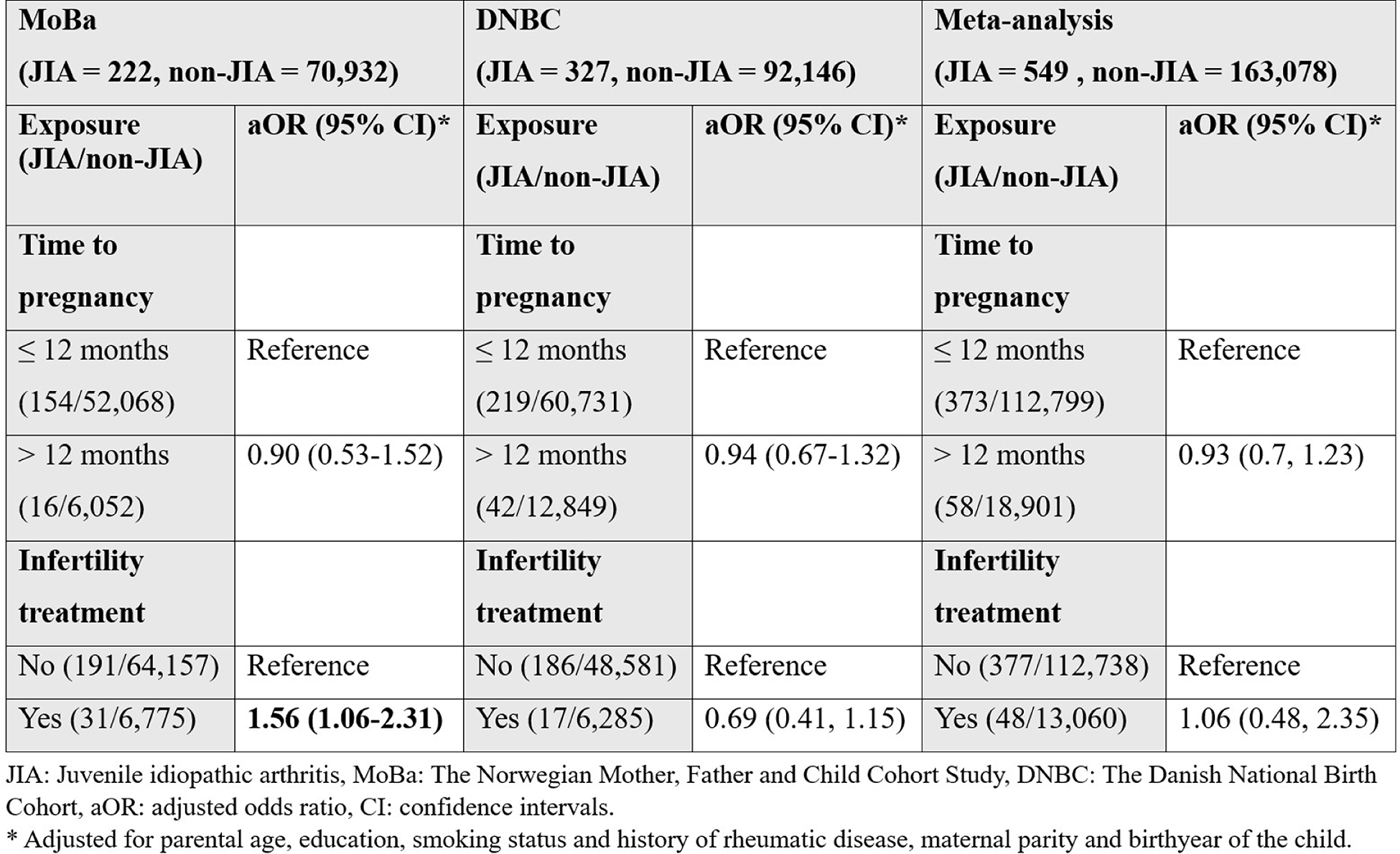
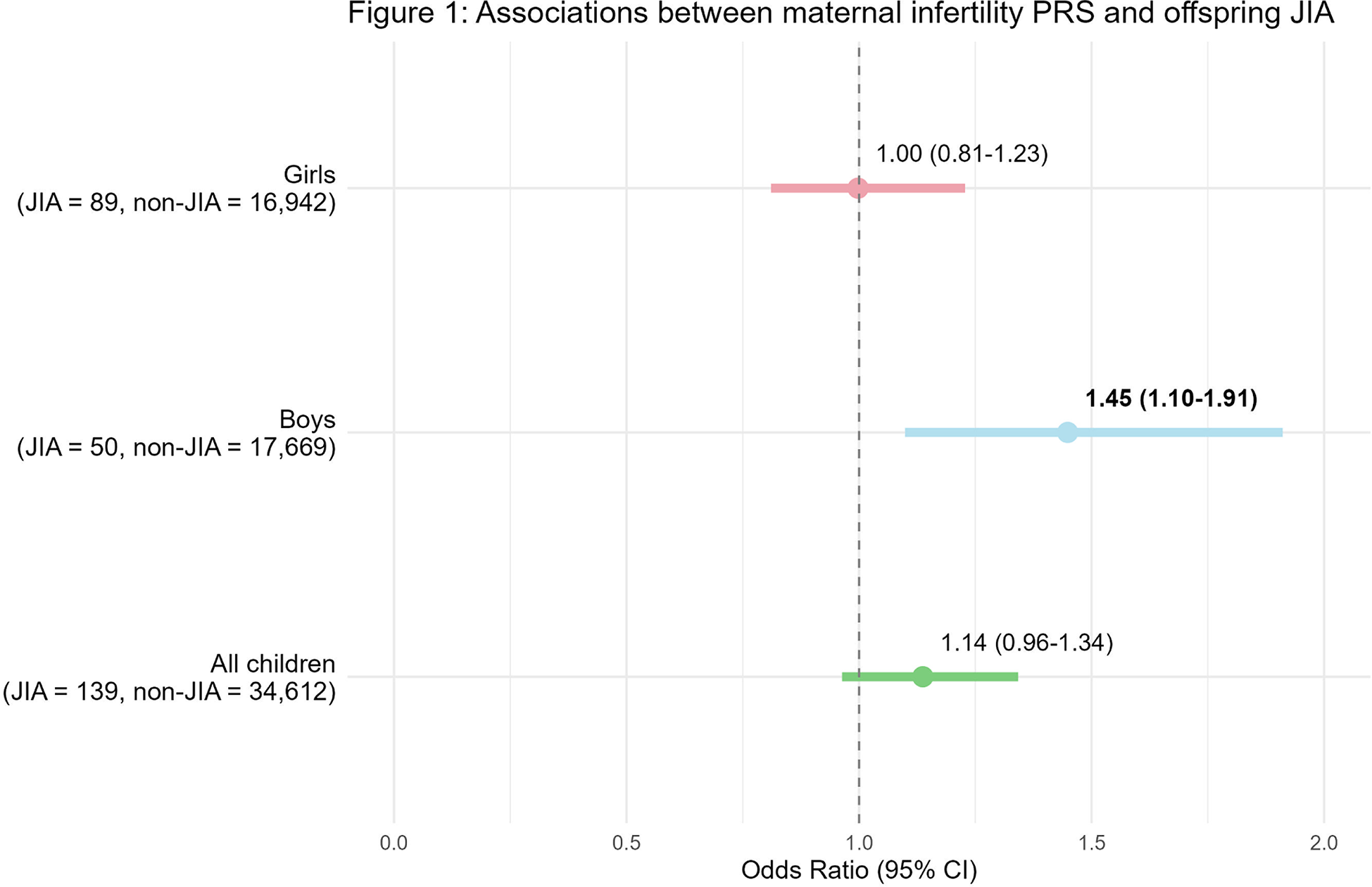
Results: Our final analytical sample included 549 parental couples with children that later developed JIA (222 in MoBa and 327 in DNBC) and 163,078 that did not (70,932 in MoBa and 92,146 in DNBC). Genotype data were available for 34,751 mothers in MoBa, of whom 139 had children with JIA, and 34,612 had children without JIA. We did not observe any robust associations between time to pregnancy or infertility treatment and JIA in the meta-analysis ( Table 1 ). In MoBa, however, ever receiving infertility treatment was associated with higher JIA risk (aOR 1.56, 95% CI 1.06-2.31). The maternal PRS for infertility was strongly associated with self-reported infertility in MoBa (p<0.001). Furthermore, the PRS was associated with increased JIA risk in boys (aOR 1.45, 95% CI 1.10-1.91), but not in girls ( Figure 1 ). There was a modest but significant genetic correlation of 0.28 (SE = 0.09; p = 0.003) between all-cause maternal infertility and JIA.
Conclusions: This is the second study to find an association between parental infertility and increased risk of JIA in their child. Conflicting results between the two cohorts might reflect different information extracted from the questions regarding infertility treatment: in DNBC, some of the mothers who did not use infertility treatment in the current pregnancy may have used it in previous pregnancies. A novel strength of our study is the use of a PRS for infertility as a proxy for the exposure, identifying an association between genetic risk for maternal infertility and increased risk of JIA in boys. Furthermore, a significant polygenic correlation supports the hypothesis of shared genetic risk factors between the two conditions and warrants further investigation.
Table 1. Associations between parental infertility and their child’s risk of developing JIA
REFERENCES: [1] Sperling CD, et al. Hum Reprod. 2019;34(6).
[2] Brandlistuen RE, et al. Int J Epidemiol. 2025;5.
[3] Strandberg-Larsen K, et al. Int J Epidemiol. 2025;54(4).
[4] Hestetun SV, et al. Arthritis Rheumatol. 2025;77.
[5] Venkatesh SS, et al. Nat Genet. 2025.
[6] López-Isac E., et al. Ann Rheum Dis. 2021;80(3).
Acknowledgments: NIL.
Disclosure of Interests: None declared.