fetching data ... 
Background: Juvenile idiopathic arthritis (JIA) is the most common chronic inflammatory rheumatic disease in children and is characterised by persistent joint inflammation, marked clinical heterogeneity, and a substantial risk of long-term disability. Genome-wide association studies (GWAS) have identified numerous loci associated with JIA susceptibility; however, most risk variants lie in non-coding regions, complicating the identification of causal effector(s) and pathways.
Objectives: To address this challenge, we sought to identify plasma proteins with potential causal roles in JIA by integrating large-scale GWAS data with blood proteomic and transcriptomic data, and to evaluate their functional relevance and druggability.
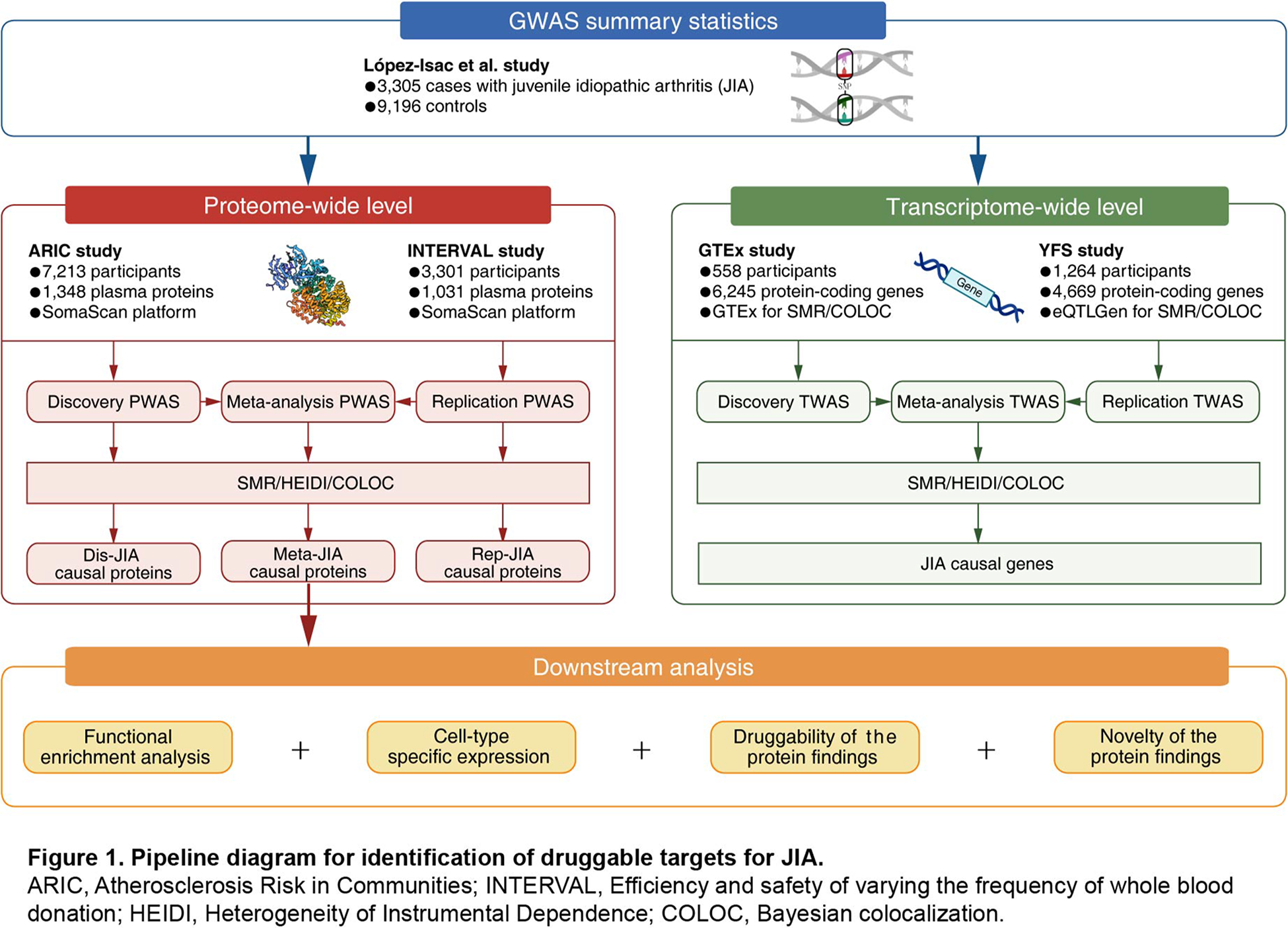
Methods: We integrated summary statistics from the largest JIA GWAS (3,305 cases; 9,196 controls) with two independent blood proteomic datasets (ARIC, n = 7,213; INTERVAL, n = 3,301) to conduct discovery, validation, and meta-analysis of proteome-wide association studies (PWAS). Protein abundance was estimated using elastic net and SuSiE models and integrated with GWAS data through the FUSION framework (MHC region excluded). Potential causal proteins were prioritized via summary data-based Mendelian randomization (SMR) and Bayesian colocalization to distinguish pleiotropy from linkage and identify shared causal variants. To assess whether prioritized proteins also exhibited transcriptional dysregulation, we conducted transcriptome-wide association studies (TWAS) using whole-blood expression reference panels from GTEx v8 (discovery cohort, n = 558) and the Finnish Young Scientists Study (validation cohort, n = 1,264). Gene expression prediction weights were derived using multiple models implemented in FUSION, and discovery and validation results from both PWAS and TWAS were meta-analysed using METAL. Functional enrichment were assessed using Metascape. Finally, drug-gene interactions were queried via the Drug-Gene Interaction Database to identify existing compounds with potential therapeutic relevance.
Results: Discovery PWAS identified six JIA-associated plasma proteins (ERAP2, GP1BA, ICAM5, LMAN2L, UXS1, and MX1), four of which (ERAP2, GP1BA, ICAM5, and MX1) have been previously implicated in JIA or other immune-mediated diseases. SMR highlighted five nominally significant proteins among the PWAS hits, with 16 surviving false discovery rate correction. Subsequent HEIDI and Bayesian colocalization analyses support shared causal variants for ERAP2, GP1BA, LMAN2L, and UXS1. Replication PWAS confirmed associations for ERAP2, LMAN2L, and ICAM5. In the replication analysis, SMR and HEIDI identified 11 protein–JIA associations; however, Bayesian colocalization supported shared genetic signals only for ERAP2, LMAN2L, and GP1BA, underscoring the robustness of these proteins across analytical frameworks. Meta-analysis integrating discovery and replication data identified 22 associated proteins, all wit h strengthened signals. Functional enrichment analysis revealed significant overrepresentation of immune-related pathways, including antigen processing and presentation, Th17 cell differentiation, cytokine-mediated signalling, the JAK-STAT pathway, and platelet-related biological processes. At the transcriptional level, TWAS meta-analysis identified 80 JIA-associated genes, 76 of which replicated. After SMR and colocalization filtering, only five genes ( ERAP2 , ACTA2 , CLN3 , GSDMB , and ORMDL3 ) showed evidence of shared causal signals, with ERAP2 being the only gene overlapping with PWAS results, suggesting concordant genetic regulation at both mRNA and protein levels. Finally, drug-gene interaction analysis identified investigational agents targeting GP1BA (ampifabidetide) and ERAP2 (toseturta), highlighting potential translational opportunities for JIA therapy.
Conclusions: Integration of multi-omics data identified five plasma proteins with strong evidence for a causal role in JIA, providing protein-level insights into the molecular mechanisms underlying JIA and highlighting potential targets for future therapeutic development and repurposing.
REFERENCES: [1] Prakken B, Albani S, Martini A. Juvenile Idiopathic Arthritis. Lancet (2011) 377(9783):2138-49. doi: 10.1016/S0140-6736(11)60244-4.
[2] McHugh J. New Genetic Risk Loci Found for Jia. Nat Rev Rheumatol (2021) 17(1):4. doi: 10.1038/s41584-020-00553-3.
[3] Zhang J, Dutta D, Kottgen A, Tin A, Schlosser P, Grams ME, et al. Plasma Proteome Analyses in Individuals of European and African Ancestry Identify Cis-Pqtls and Models for Proteome-Wide Association Studies. Nat Genet (2022) 54(5):593-602. Epub 20220502. doi: 10.1038/s41588-022-01051-w.
[4] Li B, Ritchie MD. From Gwas to Gene: Transcriptome-Wide Association Studies and Other Methods to Functionally Understand Gwas Discoveries. Front Genet (2021) 12:713230. Epub 20210930. doi: 10.3389/fgene.2021.713230.
[5] Zhu Z, Zhang F, Hu H, Bakshi A, Robinson MR, Powell JE, et al. Integration of Summary Data from Gwas and Eqtl Studies Predicts Complex Trait Gene Targets. Nat Genet (2016) 48(5):481-7. Epub 20160328. doi: 10.1038/ng.3538.
Acknowledgments: NIL.
Disclosure of Interests: None declared.