fetching data ... 
Background: Pulmonary artery involvement is one of the most severe and life-threatening manifestations of Behçet’s Disease (BD). It mostly presents with pulmonary artery thrombosis (PAT), while aneurysm formation is seen rarely. Whether BD-related PAT represents a distinct clinical and radiological course compared with non-Behçet patients remains unclear.
Objectives: To compare the anatomical distribution, radiological evolution, and clinical outcomes of PAT in patients with BD and non-Behçet patients.
Methods: We conducted a retrospective cohort study including patients with radiologically confirmed PAT followed at our tertiary rheumatology center. Patients were classified into Behçet Disease (BD) and non-Behçet groups according to established diagnostic criteria. Demographic characteristics, pulmonary artery involvement patterns, and outcomes were recorded. PAT was classified according to the most proximal anatomical level affected (main, lobar, segmental, subsegmental, and small-caliber distal arteries). Radiological evolution on follow-up imaging was categorized as regression, stability, or progression. Relapse was defined as recurrence of pulmonary or other vascular involvement after the initial pulmonary event. Mortality was recorded during follow-up.
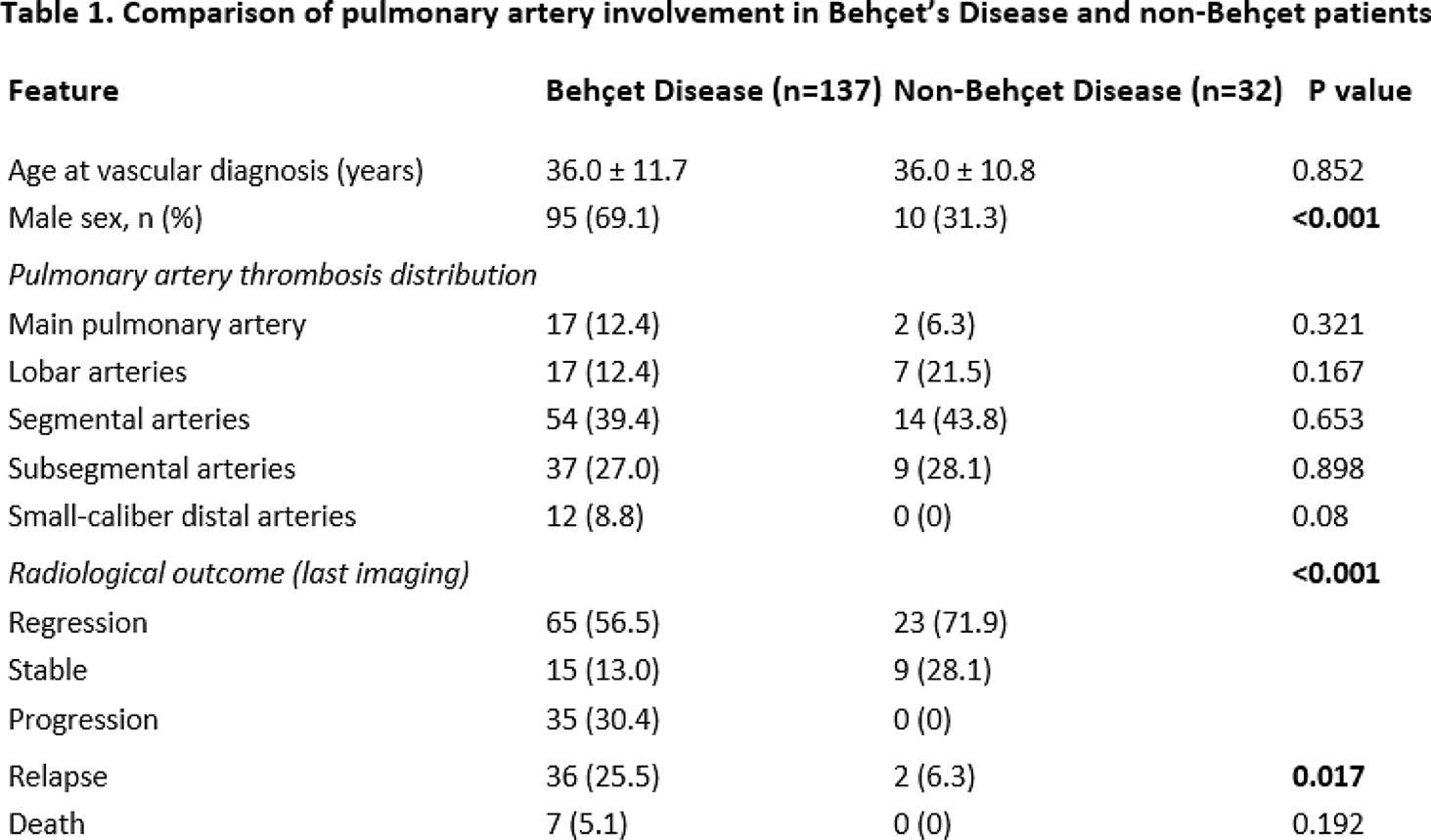
Results: A total of 169 patients were included: 137 with BD and 32 non-Behçet patients. Age at diagnosis of vascular involvement was similar between groups (36.0 ± 11.7 vs 36.0 ± 10.8 years, p =0.852). However, BD patients were predominantly male (69.1%), whereas non-Behçet patients were predominantly female (68.8%, p <0.001). PAT was symptomatic in 69.3% of Behçet patients, most commonly presenting with dyspnea (50.4%), cough (23.4%), and chest pain (19.0%). Hemoptysis occurred in 11.6% of cases. Approximately one-third of PAT cases were detected incidentally during radiological evaluation for surveillance or other vascular manifestations, particularly in patients with elevated acute-phase reactants prompting assessment of disease activity or vascular flare. During a median follow-up of 102 months, relapse occurred in 26.3% of patients, with a median time to first relapse of 24.5 months. Relapse occured in 6.3 % of non-BD patients during median 53 months follow-up. Immunosuppressive therapy was used in 132/137 (96.4%) BS patients (azathioprine 67.9%, cyclophosphamide 14.6%, anti-TNF 13.9%). Anticoagulation was prescribed in 85 (62.0%), and 77 (56.2%) received combined anticoagulation plus immunosuppression. All non-BD patients received anticoagulation. The anatomical distribution of PAT at the main, lobar, segmental, and subsegmental levels was comparable between the two groups. In contrast, small-caliber distal pulmonary artery involvement was observed exclusively in BD patients (8.8% vs 0%), suggesting a more diffuse vasculitic phenotype (Table 1). Radiological outcomes differed markedly between groups. On last imaging, progression was observed in 30.4% of BD patients but in none of the non-Behçet patients, whereas regression was more frequent in the non-Behçet group (71.9% vs 56.5%) ( p <0.001). Relapse occurred significantly more often in BD patients (26.3 % vs 6.3%, p =0.017). Mortality occurred in 5.1% of BS patients and in none of the non-Behçet patients during follow-up.
Conclusions: PAT in BD constitutes a distinct and more aggressive vascular phenotype compared with non-Behçet pulmonary artery thrombosis. Although proximal anatomical distribution is similar, BS patients demonstrate exclusive distal small-vessel involvement, higher rates of radiological progression, and a significantly increased risk of relapse, reflecting ongoing inflammatory vasculopathy despite immunosuppressive treatments. These findings emphasize the need for close radiological surveillance and more intensive immunosuppressive strategies in PAT of Behçet Disease.
REFERENCES: NIL.
Acknowledgments: NIL.
Disclosure of Interests: None declared.