fetching data ... 
Background: Previous studies support the role of both genetic and environmental factors in the pathogenesis of Behçet syndrome (BS) and suggest that there may be differences in the pathogenesis of organ manifestations.
Objectives: We aimed to evaluate a sizeable cohort of familial BS patients for the concordance of sex, clinical phenotypes, HLA-B51 positivity, ERAP-1 variations, and their associations among first-degree relatives both of whom have BS.
Methods: In this single-center, retrospective, cross-sectional study, charts of 11,560 BS patients were screened to identify patients with at least one first-degree relative diagnosed with BS (familial BS). A total of 920 (8%) familial BS patients were identified, 713 of them could be included in the study and data on HLA-B51 status was available in 339 of these. Among these patients, 24 HLA-B51 positive family pairs were selected for ERAP-1 sequencing based on discordance for uveitis or vascular involvement. Exons 2, 5, 6, 11 and 15 of ERAP-1 were analyzed by Sanger sequencing. Additionally, 1,744 non-familial BS patients were identified for comparison. Associations were assessed using 2×2 contingency tables, odds ratios (ORs), 95% confidence intervals (CIs), and Fisher’s exact test.
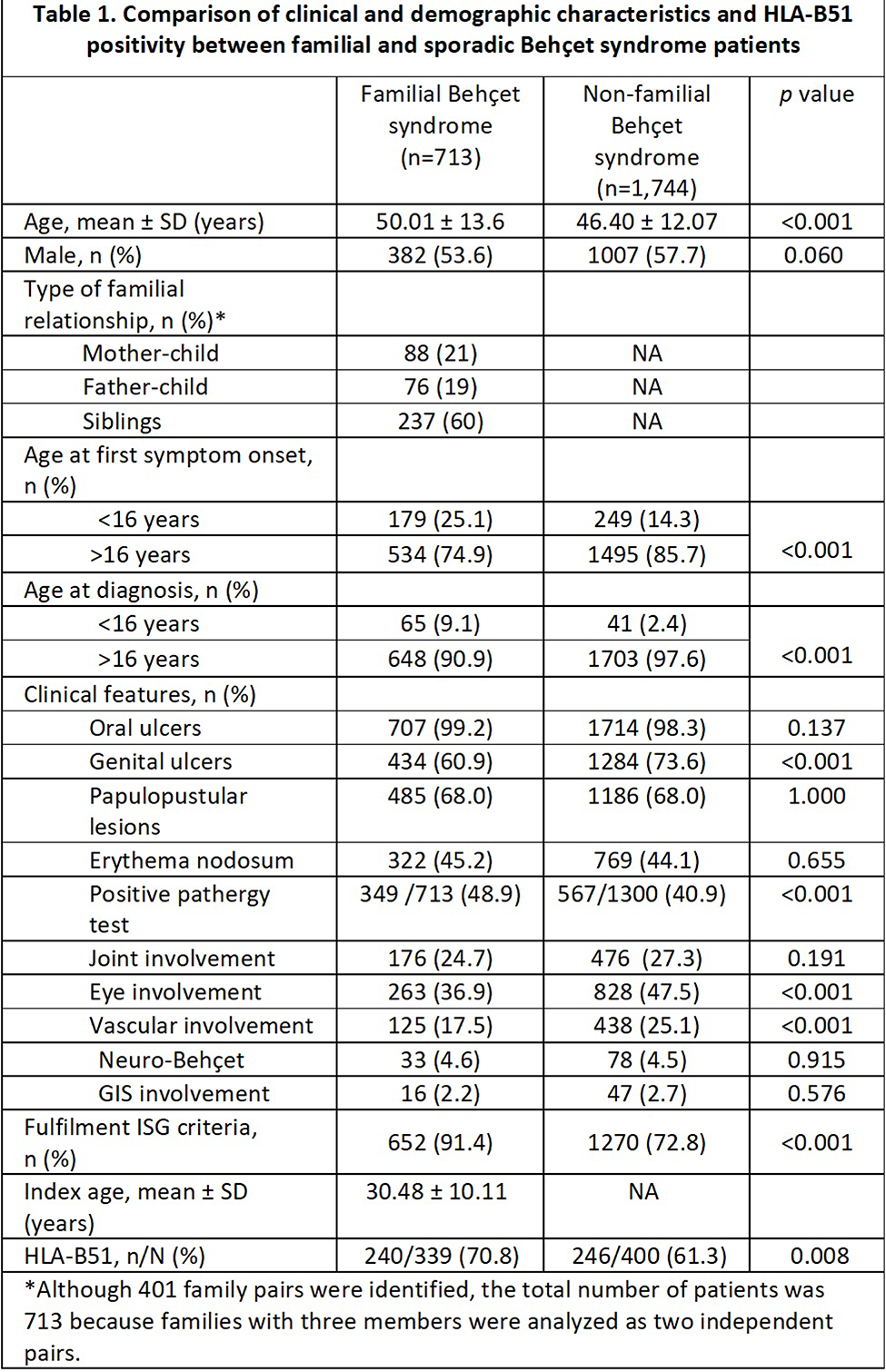
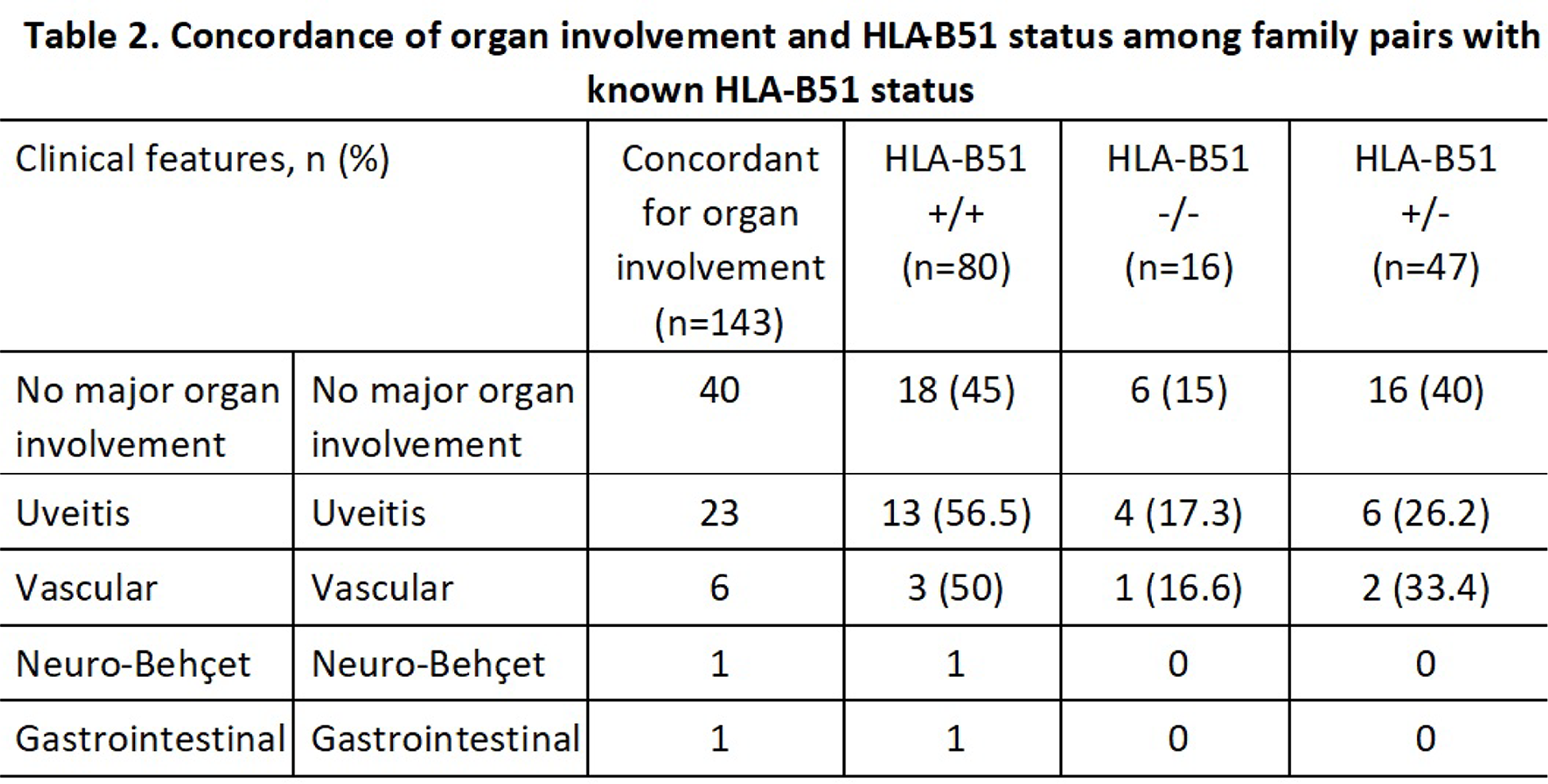
Results: Among the 713 familial BS patients, there were 401 first-degree relative pairs (237 sibling pairs, 88 mother-child pairs, and 76 father-child pairs). Thirty-one families had more than 2 members with BS. Overall, familial BS patients had a younger age at first symptom and at disease onset, higher rates of pathergy and HLA B51 positivity, and lower rates of genital ulcer, ocular, and vascular involvements compared to non-familial patients (Table 1). Concordance rate among familial pairs for each type of organ involvement were 73/231 (31.6%) for uveitis, 12/121 (9.9%) for vascular involvement, 5/40 (8%) for nervous system involvement, and 2/13 (15.3%) for gastrointestinal involvement. Among the 210 family pairs discordant for sex, major organ involvement was more common in men than in women (47.5% vs 26.4% for uveitis, 25.0% vs 6.2% for vascular involvement, 8.0% vs 4.1% for nervous system involvement, 2.5% vs 0.5% for gastrointestinal involvement). However, discordance rates for organ involvement were similar among family pairs discordant for sex and those concordant for sex (106/210, 50.5% vs 89/191, 46.6%, p=0.50). Among the 143 family pairs with HLA-B51 data, 71 pairs were concordant for organ involvement. Among these, only 36 (50.7%) were concordant for HLA-B51 positivity (Table 2). The sequencing of exons of the ERAP1 gene detected variants that are common in the general population, although some of them were proposed to be associated with BS in previous studies. Comparison of these variations with clinical findings, especially intra-familial analysis, did not show any significant associations between variations and clinical phenotypes.
Conclusions: Less ocular and vascular involvement among our patients with familial BS compared to our non-familial patients may be associated with diagnosis of milder forms due to the presence of another family member with BS. Earlier disease onset was compatible with genetic anticipation that was formerly observed in BS. Majority of first-degree relative pairs with BS were discordant for organ domains. Discordance for sex does not seem to be the main driver of discordance for organ involvement within family pairs. HLA-B51 positivity does not seem to be associated with concordance of clinical phenotypes within families. ERAP1 variants also did not contribute to clinical concordance, among HLA-B51 positive family pairs.
REFERENCES: NIL.
Acknowledgments: NIL.
Disclosure of Interests: Melis Damla Ozcan: None declared, Asli Kirectepe Aydn: None declared, Sinem Nihal Esatoglu: None declared, Yesim Ozguler: None declared, Emire Seyahi: None declared, Melike Melikoglu: None declared, Erkan Yilmaz: None declared, Mehtap Dogruel: None declared, Gulen Hatemi Abbvie, Amgen, Novartis,UCB Pharma, Abbvie, Soligenix, UCB Pharma.