fetching data ... 
Background: Chronic low back pain is a major public health issue, causing long-lasting impairments in quality of life, work participation, and social functioning [1]. In France, a substantial proportion of patients attend intensive spinal functional restoration programs in rehabilitation centers, as recommended by the French National Authority for Health (HAS) [2]. However, after discharge, the transition to community care remains limited, and home-based support is virtually absent, compromising adherence to recommended exercise programs [3].
Objectives: To assess the impact of a 3-month remote monitoring program using an exercise-prescription application on functional disability in patients with chronic or subacute low back pain, after a total follow-up duration of 3.5 months.
Methods: This was a multicenter (8 French rehabilitation centers), prospective, randomized, open-label trial (IDRCB No. 2023-A00486-39). Adult patients, enrolled at the end of an inpatient or intensive rehabilitation stay, were randomized (1:1) either to an intervention group receiving a personalized exercise program through a mobile application (Class I medical device) combined with asynchronous monitoring triggered by alerts (pain, adherence, difficulty), or to a control group receiving an exercise booklet and standard recommendations.
The primary outcome was functional disability assessed by the Oswestry Disability Index (ODI v2.1a) 3 months after discharge. Statistical analyses were conducted in an intention-to-treat framework (Mann–Whitney test, log-linear MMRM model).
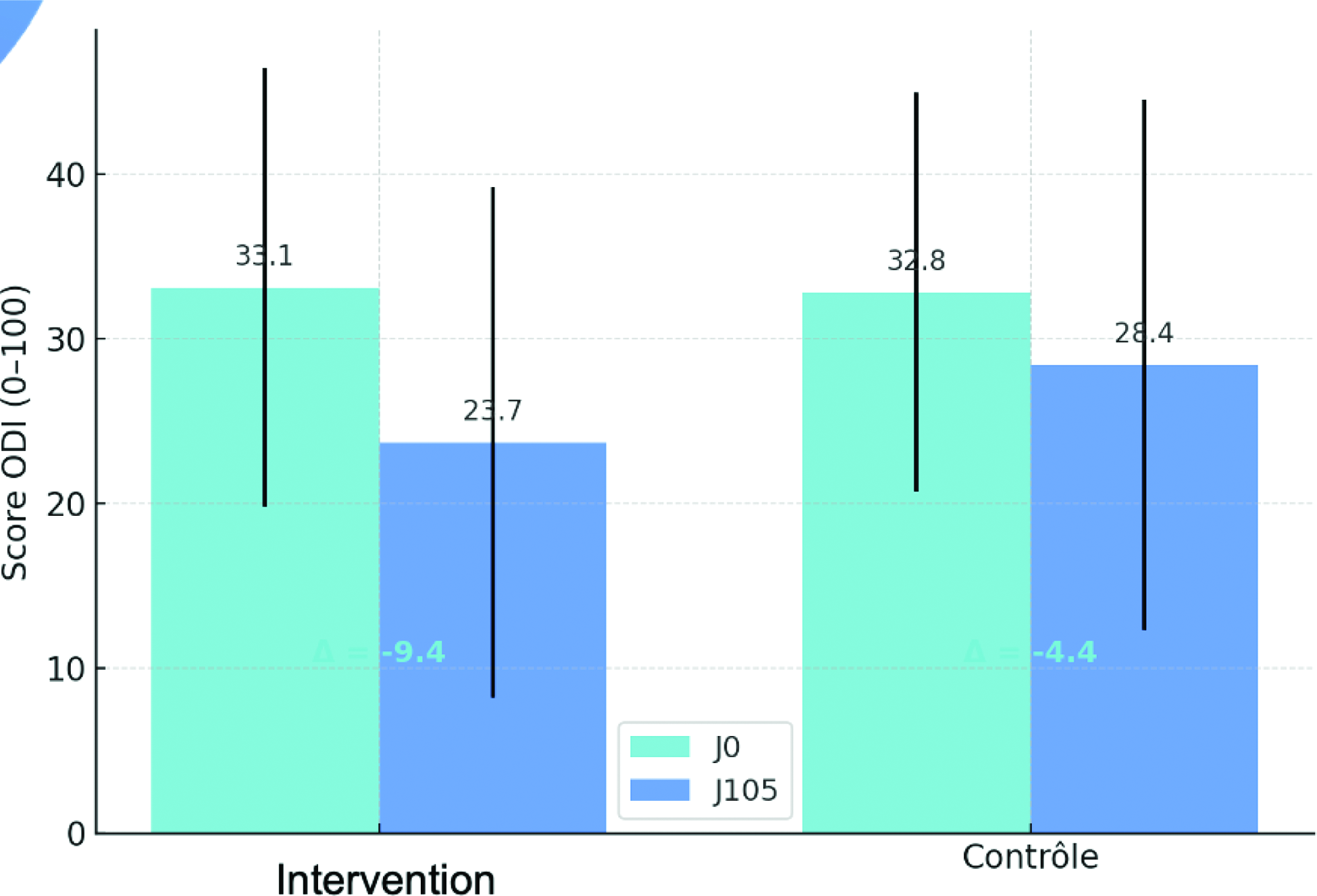
Results: A total of 227 patients were included between June 2023 and April 2025 (64% women; mean age 46 ± 10 years; 57% on sick leave; mean BMI 27 ± 5; mean symptom duration 8 ± 9 years). At Day 105, improvement in functional disability was greater in the intervention group: ODI 23.7 ± 15.5 versus 28.4 ± 16.1 in the control group (mean difference 4.7 points; p = 0.03). Findings were confirmed in modified ITT, per-protocol analyses, and after imputation of missing data. Post-hoc analyses showed a significantly higher proportion of responders (ODI improvement >30%) in the intervention group (55% vs 30%, p = 0.01).
A significant advantage in the telemonitored group was also observed regarding concomitant care and sick leave duration (p < 0.05). No significant differences were found for adherence or quality of life. One adverse event possibly related to the device (transient pain) was reported, non-serious and expected.
Conclusions: Combining a personalized exercise program delivered through a mobile application with 3-month asynchronous remote monitoring after an intensive spinal restoration program significantly improves functional capacity in patients with chronic low back pain. Although statistically significant, the magnitude of the effect remains modest and raises questions about its clinical relevance.
REFERENCES: [1] Ferreira et al. The Lancet Rheumatology. 1 juin 2023;5(6):e316-29.
[2] Bailly et al, HAS 2019
[3] Palazzo et al. Annals of Physical and Rehabilitation Medicine. 1 avr 2016;59(2):107-13.
Acknowledgments: NIL.
Disclosure of Interests: Valérie Wieczorek: None declared, Alexis Homs: None declared, Jephté Tété Houedakor: None declared, André Thevenon: None declared, Emmanuelle Chaleat: None declared, Mathieu De-Seze: None declared, Philippe Carson-Jouzel: None declared, Gwendal Delaruelle: None declared, Thomas Davergne Axomove.