fetching data ... 
Background: Knee osteoarthritis (OA) is a prevalent condition associated with pain, reduced physical function and quality of life, as well as a growing impact on the healthcare system. In clinical guidelines, the core treatments including exercise, weight management, support for self-management and patient education are recommended for all people with symptomatic OA. Nevertheless, people with knee OA are frequently referred to specialist healthcare for a surgical consultation without first having received appropriate patient education or tried the recommended core treatments. Moreover, during consultations in specialist healthcare, clinicians assessing a patient’s need for joint replacement surgery often have limited time and available information to determine the most appropriate treatment option, in collaboration with the patient. To address these challenges, we have developed the GENUS-app, which provides an 8-week patient education and exercise program designed to improve patients’ OA knowledge, support engagement in recommended treatments, and track symptoms and treatment preferences in the waiting period before surgical consultation in specialist healthcare.
Objectives: The aim of this study was to assess the technical, operational, clinical, and trial feasibility of the GENUS-app for patients with knee OA referred for consideration of surgical treatment in specialist healthcare. The findings will determine whether a future large randomised controlled trial (RCT) is warranted.
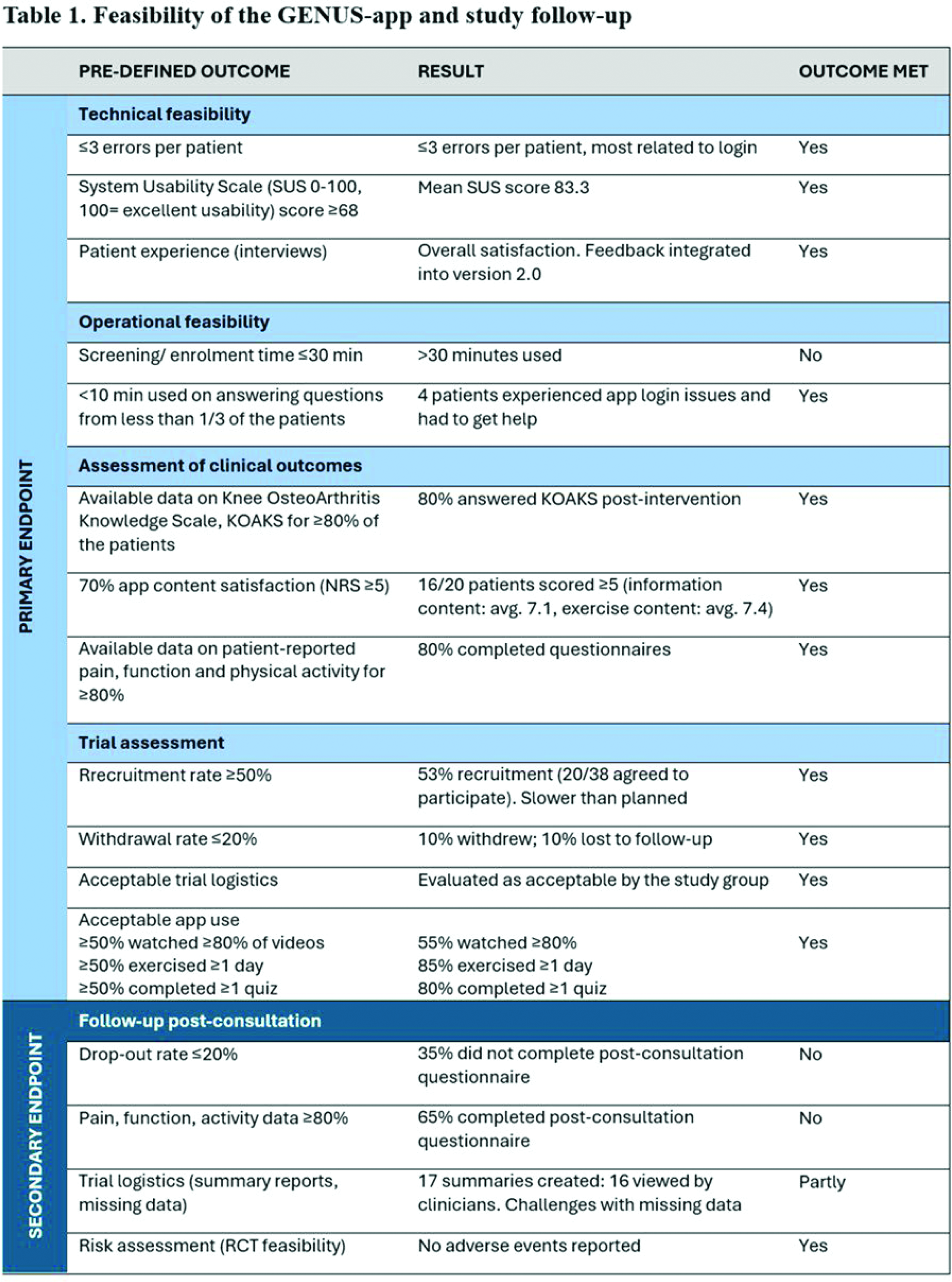
Methods: This single-group feasibility study included individuals aged ≥50 years referred to surgical consultation due to knee OA at Diakonhjemmet Hospital in Oslo, Norway. Participants were excluded if they had already received joint replacement surgery of the contralateral knee or were referred for revision surgery, if they had uncontrolled serious comorbidities, cognitive dysfunction, were referred for surgery due to trauma conditions, psoriatic/rheumatoid arthritis, were unable to understand Norwegian, or did not have a smartphone. The study period lasted from the time of referral to one day after surgical consultation (approx. 12-16 weeks after referral). Data was collected from December 2024 to April 2025. The study participants received access to the GENUS-app, which included 2-4 weekly educational videos, quizzes, questionnaires, a note-taking function and instructional exercise videos (3 levels of difficulty), aiming to improve general physical activity and lower extremity muscle strength. The app provided reminders to exercise three times per week and weekly motivational feedback on the progress and use of the app content. The primary endpoint of the study was acceptable overall feasibility of the GENUS-app after 8 weeks, defined as a 70% or higher fulfilment of technical and operational feasibility, clinical and trial assessments as described in Table 1. The secondary endpoint was acceptable overall feasibility of the study follow-up, defined as 70% or higher fulfilment of trial logistics from the end of intervention to study completion (Table 1). All participants were invited to an individual interview (semi-structured interview) at the end of the intervention period to explore user experiences.
Results: A total of twenty participants (50% women) with a mean age of 66 years were included in the study. 5 (25%) of the participants were employed, and 9 (44%) had university education. 10 (50%) participants had previously received physiotherapy, and 2 (10%) had previously attended an OA patient education course. 11 participants (6 women) were interviewed. The primary endpoint assessment of technical and operational feasibility, clinical outcomes, and trial logistics demonstrated acceptable feasibility, with 11 of 12 (92%) of the predefined outcomes met (Table 1). The secondary endpoint (follow-up post consultation) was partly met, revealing challenges with missing patient-reported data at the post-consultation time point (Table 1). The participants from the interviews reported that they perceived the app as useful, user-friendly, and easy to navigate. Several participants reported that the app provided new knowledge, which enhanced the quality of their consultation. All interviewed participants described increased motivation to perform weekly exercises after using the app.
Conclusions: The GENUS-app demonstrated acceptable feasibility and was perceived as relevant and useful during the pre-consultation waiting period. However, strategies to improve recruitment efficiency should be investigated before initiating a full-scale randomized controlled trial
REFERENCES: NIL.
Acknowledgments: NIL.
Disclosure of Interests: None declared.