fetching data ... 
Background: Work supports a person’s health and wellbeing. Approximately one in five Europeans live with a rheumatic and musculoskeletal disease (RMD), which translates to an estimated 120 million people (European League against Rheumatism [EULAR], 2024). People living with RMDs can experience challenges in maintaining their work roles with absenteeism, presenteeism, job loss and permanent work disability common. While research is examining how vocational rehabilitation can support work ability in this cohort, access to services that support work roles remains inequitable. Digital health technologies are advancing and show potential to provide early intervention in RMD self-management skills and vocational rehabilitation at a population-level. They enable the delivery of scalable and equitable interventions, particularly when clinical resources are limited. The flexibility provided by digital technology may enhance service delivery to people with RMDs, by facilitating earlier access to services and minimising time away from work for appointments, thereby supporting sustained work roles.
Objectives: This scoping review aimed to explore the use of digital health technologies in delivering interventions that support work ability among people living with RMDs.
Methods: The scoping review was conducted using the Joanna Briggs Institute methodological framework. The Population – Concept – Context framework was used to identify search keywords. A systematic search of peer-reviewed databases including CINAHL, Pubmed, Scopus, Embase, Ovid (Medline), Cochrane Library, APA PsychInfo, Campbell Collaboration, Web of Science Core Collection (Clarivate) & JBI Evidence Synthesis and grey literature repositories was conducted in October 2025. Reference lists and citation tracking were hand-searched. Eligible studies included primary research studies on digital interventions to support work ability in people with RMDs. Only English language publications were included, with no restrictions on publication date. Screening was reported in accordance with the PRISMA-ScR guidelines. Data were synthesised using the Person-Environment-Occupation-Performance (PEOP) occupational therapy model (Baum et al., 2015). Descriptive and content analysis were used.
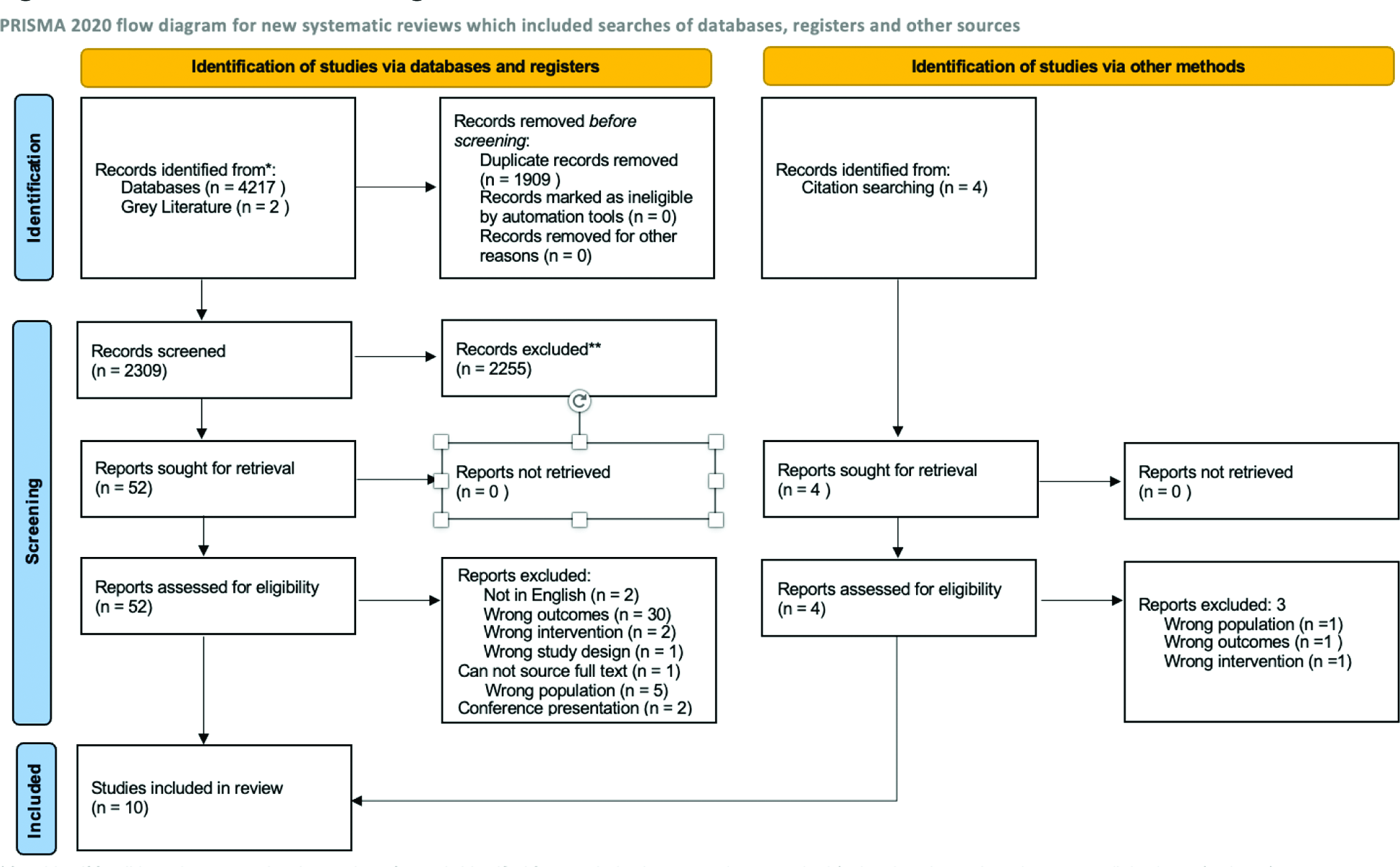
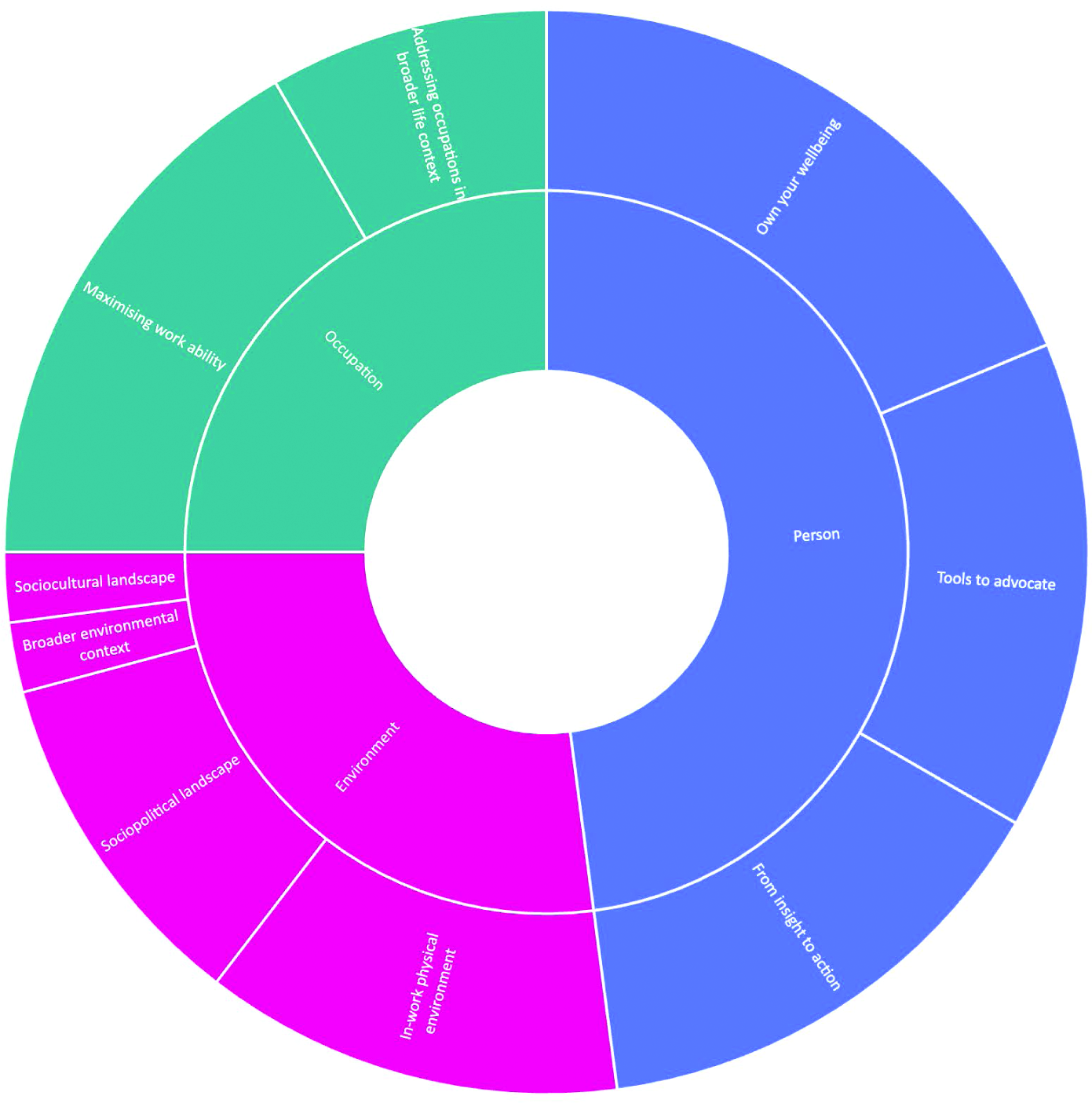
Results: The search identified 4223 titles, of which ten studies were included following screening (Figure 1). Study designs included randomised controlled trials, mixed methods and a prospective design. A variety of digital health intervention types and formats was identified, including live online group programmes, self-paced digital content, and mobile tracking or cue-based supports. In seven studies, interventions were delivered exclusively through digital health modalities, whereas in three studies, digital health formed a component of a broader work-focused intervention. Three person-focused intervention subcategories were identified: (i) own your wellbeing, (ii) from insight to action, and (iii) tools to advocate. Environment-focused intervention subcategories included: (i) the in-work physical environment, (ii) the sociopolitical landscape, (iii) the sociocultural landscape, and (iv) the broader environmental context. Two occupation-focused intervention subcategories were identified: (i) maximising work ability and (ii) addressing occupations in the broader life context (Figure 2). Outcome measures and evaluation approaches reflected PEOP domains and varied across studies. Some studies focused on occupation and performance outcomes related to work ability, while others examined person-level outcomes, including symptoms and quality of life. Intervention effectiveness was synthesised using qualitative and quantitative evidence and categorised into perceptions of impact, adherence and engagement, accessibility and suitability, and areas for refinement.
Conclusions: This scoping review maps the existing evidence on digital health interventions to support work ability in people living with RMDs, highlighting a limited number of studies addressing this issue. Digital health interventions were applied across person, environment, and occupation domains, with interventions most commonly targeting person-level factors and fewer addressing environmental and occupational influences on work participation. The PEOP model offers a useful framework for conceptualising holistic, work-focused digital interventions. Reported outcomes suggest potential benefits for work ability, symptom management, accessibility, and service efficiency, however, heterogeneity in intervention design and outcome measures limits conclusions. Digital health interventions may facilitate more flexible and efficient service delivery in the context of increasing demand and finite workforce resources. Further research is needed to determine which interventions are most effectively delivered digitally, incorporating evidence on acceptability, usability, timing, and the balance between guided and self-directed approaches. Greater consistency and conceptual clarity in outcome measurement is further required to capture the complex nature of work ability.
PRISMA flow diagram
Interventions mapped to PEOP framework
REFERENCES: [1] Baum, C.M., Bass, J.D., Christiansen, C.H. Theory, models, frameworks, and classifications. In: C. H. Christiansen, C. M. Baum, & J. D. Bass (Eds.) Occupational Therapy: Performance, Participation and Well-Being . 4th ed. Slack, Inc.; 2015:23-47.
[2] EULAR. (2024).
EULAR 2024 – 2029 European Manifesto: ‘Promoting a European response to the health and socio-economic challenges of Rheumatic and Musculo-skeletal Diseases (RMDs).’
Retrieved from
Acknowledgments: NIL.
Disclosure of Interests: None declared.