fetching data ... 
Background: Physical activity (PA) is a critical and modifiable modulator of immune function, yet the biological mechanisms intertwined with autoimmune diseases (ADs) remain elusive [1]. While epidemiological links exist, it is unclear whether these associations arise from direct causal effects or a shared genetic predisposition governing both behavior and immune regulation.
Objectives: We aimed to systematically dissect the genomic interface between four PAs [2]—including moderate-to-vigorous intensity physical activity during leisure time (MVPA), leisure screen time (LST), sedentary behavior at work (SDW), and sedentary commuting (SDC)—and six major ADs, specifically rheumatoid arthritis (RA)[3], systemic lupus erythematosus (SLE)[4], primary sclerosing cholangitis (PSC)[5], Type 1 diabetes (T1D)[6], and Crohn’s disease (CD) and ulcerative colitis (UC)[7]. The primary goals were to characterize the shared genetic architecture, elucidate common molecular drivers, and uncover specific biological pathways linking physical activity to autoimmunity.
Methods: We performed a comprehensive, multi-layered genomic analysis integrating summary statistics from large-scale GWAS (up to 661,399 individuals) covering four PA phenotypes and six major ADs. We systematically dissected the genetic architecture using LDSC MiXeR, and LAVA assessed causality via Mendelian randomization (MR) accounting for sample overlap (MRlap) and pinpointed shared molecular mechanisms using PLACO and integrative functional mapping (FUMAMAGMA) combined with tissue-specific enrichment.
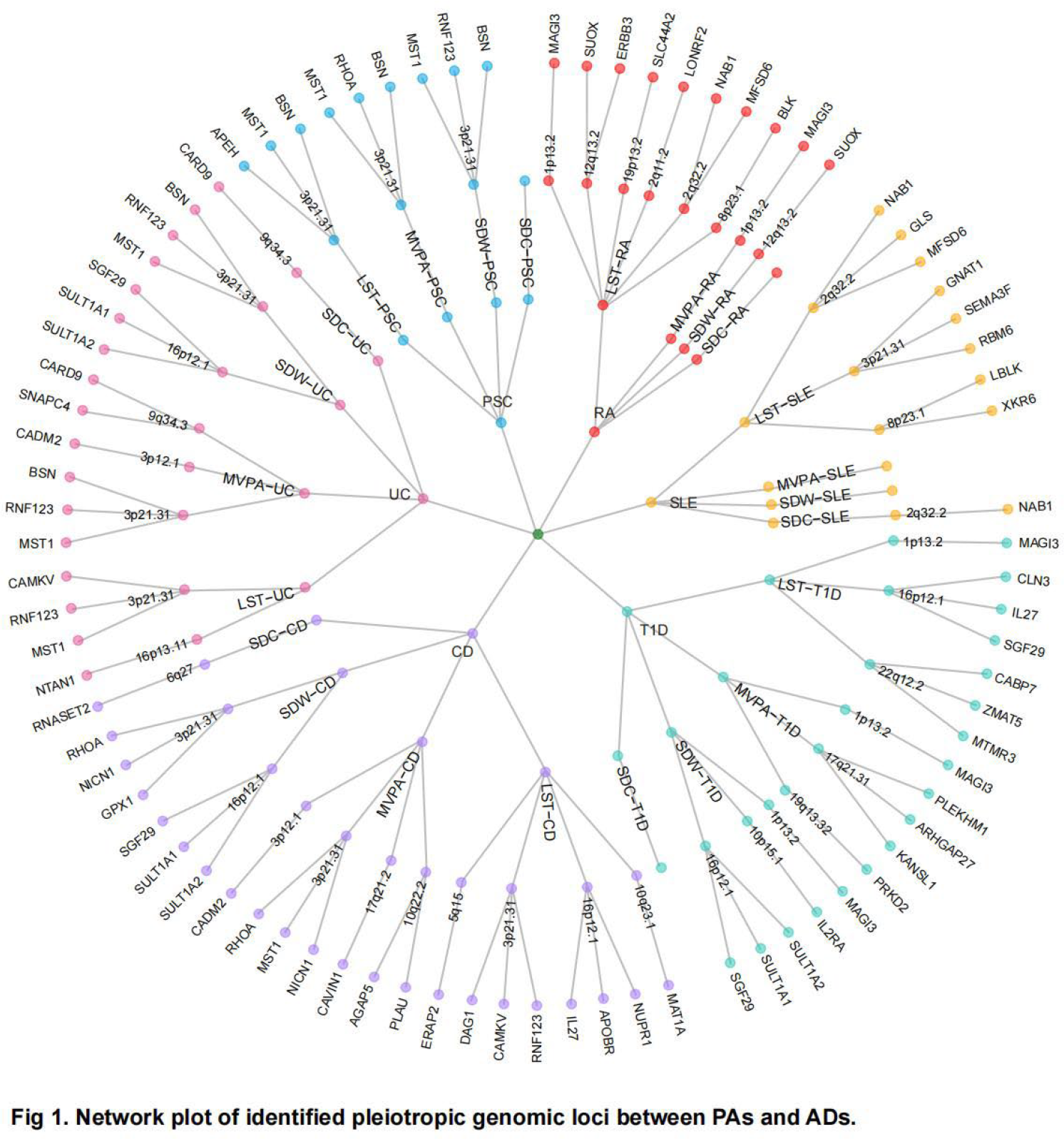
Results: We identified extensive polygenic overlap and a complex bidirectional genetic correlation pattern: active behaviors were genetically protective against ADs, whereas sedentary behaviors shared significant risk loci. MR analyses revealed a predominant reverse causal effect, suggesting that genetic liability to ADs (e.g., SLE, PSC, T1D) significantly reduces physical activity levels. Critically, beyond vertical causality, we discovered widespread horizontal pleiotropy, identifying 3p21.31 as a master regulatory hotspot. Within this locus, key pleiotropic genes—including GPX1 , MST1 , and BSN —were found to converge on protein serine/threonine kinase regulation and apoptotic signaling pathways, serving as molecular bridges linking exercise-induced metabolic adaptation with immune homeostasis.Our comprehensive assessment of PAs and ADs revealed extensive polygenic overlap and a complex shared genetic architecture, emphasizing their intertwined biological foundation. Consistent with these overlaps, we observed a bidirectional pattern of genome-wide genetic correlations: active PAs (e.g., MVPA) exhibited negative r g with ADs, whereas inactive PAs (e.g., LST, SDW, SDC) showed positive correlations, suggesting distinct genetic architectures underlying activity type. Together with these correlations, mendelian randomization (MR) analysis revealed several causal relationships, including negative associations between SLE-LST, PSC-LST, SLE-MVPA, PSC-MVPA, and T1D-MVPA, which suggests that a higher genetic liability to some ADs may reduce both LST and MVPA. Exploring horizontal pleiotropy, we identified several significant pleiotropic loci and genes, notably GPX1 , AMT , NICN1 , APEH , MST1 , RNF123 , and BSN —all located within the 3p21.31 locus, a major hotspot mediating shared metabolic and immune regulation. In parallel, pathway analyses highlighted key biological processes involved, particularly protein serine/threonine kinase regulation and apoptotic signaling, which may serve as molecular bridges connecting exercise metabolism and immune homeostasis (Figure 1).
Conclusions: Our study expands the understanding of the lifestyle-immunity interface, revealing that physical inactivity and autoimmunity share a substantial genetic basis. By highlighting 3p21.31 and specific kinase-regulated pathways, these findings provide novel molecular insights that may inform future therapeutic and lifestyle strategies for autoimmune management.
REFERENCES: [1] SHARIF K, WATAD A, BRAGAZZI N L, et al. Physical activity and autoimmune diseases: Get moving and manage the disease[J]. Autoimmunity reviews, 2018,17(1):53-72.DOI:10.1016/j.autrev.2017.11.010.
[2] WANG Z, EMMERICH A, PILLON N J, et al. Genome-wide association analyses of physical activity and sedentary behavior provide insights into underlying mechanisms and roles in disease prevention[J]. Nature genetics, 2022,54(9):1332-1344.DOI:10.1038/s41588-022-01165-1.
[3] ISHIGAKI K, SAKAUE S, TERAO C, et al. Multi-ancestry genome-wide association analyses identify novel genetic mechanisms in rheumatoid arthritis[J]. Nature genetics, 2022,54(11):1640-1651.DOI:10.1038/s41588-022-01213-w.
[4] BENTHAM J, MORRIS D L, GRAHAM D S C, et al. Genetic association analyses implicate aberrant regulation of innate and adaptive immunity genes in the pathogenesis of systemic lupus erythematosus[J]. Nature genetics, 2015,47(12):1457-1464.DOI:10.1038/ng.3434.
[5] JI S, JURAN B D, MUCHA S, et al. Genome-wide association study of primary sclerosing cholangitis identifies new risk loci and quantifies the genetic relationship with inflammatory bowel disease[J]. Nature genetics, 2017,49(2):269-273.DOI:10.1038/ng.3745.
[6] CHIOU J, GEUSZ R J, OKINO M, et al. Interpreting type 1 diabetes risk with genetics and single-cell epigenomics[J]. Nature, 2021,594(7863):398-402.DOI:10.1038/s41586-021-03552-w.
[7] de LANGE K M, MOUTSIANAS L, LEE J C, et al. Genome-wide association study implicates immune activation of multiple integrin genes in inflammatory bowel disease[J]. Nature genetics, 2017,49(2):256-261.DOI:10.1038/ng.3760.
Acknowledgments: NIL.
Disclosure of Interests: None declared.