fetching data ... 
Background: T cell–mediated autoimmune diseases are driven by sustained activation of pathogenic effector T cells and an inability to establish durable immune tolerance. Pathogenic effector T cells persist despite anti-inflammatory therapies, while regulatory T cell (Treg) function remains insufficient or unstable [1,2]. Treg expansion in autoimmune or inflammatory diseases promotes immune tolerance by restoring immune cell balance, as demonstrated in situ and in recent clinical trials [3]. Transforming Growth Factor-beta (TGF-β) plays a central role in regulatory T cell (Treg) differentiation and maintenance; however, its systemic delivery is not clinically viable due to broad receptor engagement and associated safety liabilities [4–6]. TGFβRIII, in contrast to the high expression of TGFβRII in neutrophils, is virtually absent in this cell type and highly concentrated on T cells [7]. Consequently, the TGFβRIII-biased signaling axis may therefore effectively induce Treg differentiation and expansion, whilst avoiding the risk of neutrophil-mediated off-target toxicity.
Objectives: To develop and characterize a bispecific αCD3-TGF-β fusion protein that integrates CD3-mediated T cell modulation with localized, TGFβRIII-biased TGF-β activity, enabling selective suppression of pathogenic T cells and durable induction of regulatory T cells to restore immune tolerance in T cell-mediated autoimmune diseases.
Methods: The fusion protein (ATG-207) was developed by introducing a peptide-masked and TGFβRIII-biased TGF-β domain to an anti-CD3 antibody. In vitro assays were performed to assess T cell activation/exhaustion, T cell receptor (TCR) expression, cytokine release, and regulatory T cell induction. Therapeutic efficacy and pharmacodynamic effects were evaluated in murine models of T cell–mediated autoimmune disease. The proteomic profile of T cells isolated from human PBMCs pre- and post- the treatment of ATG-207 was studied using liquid chromatography-tandem mass spectrometry (LC-MS/MS).
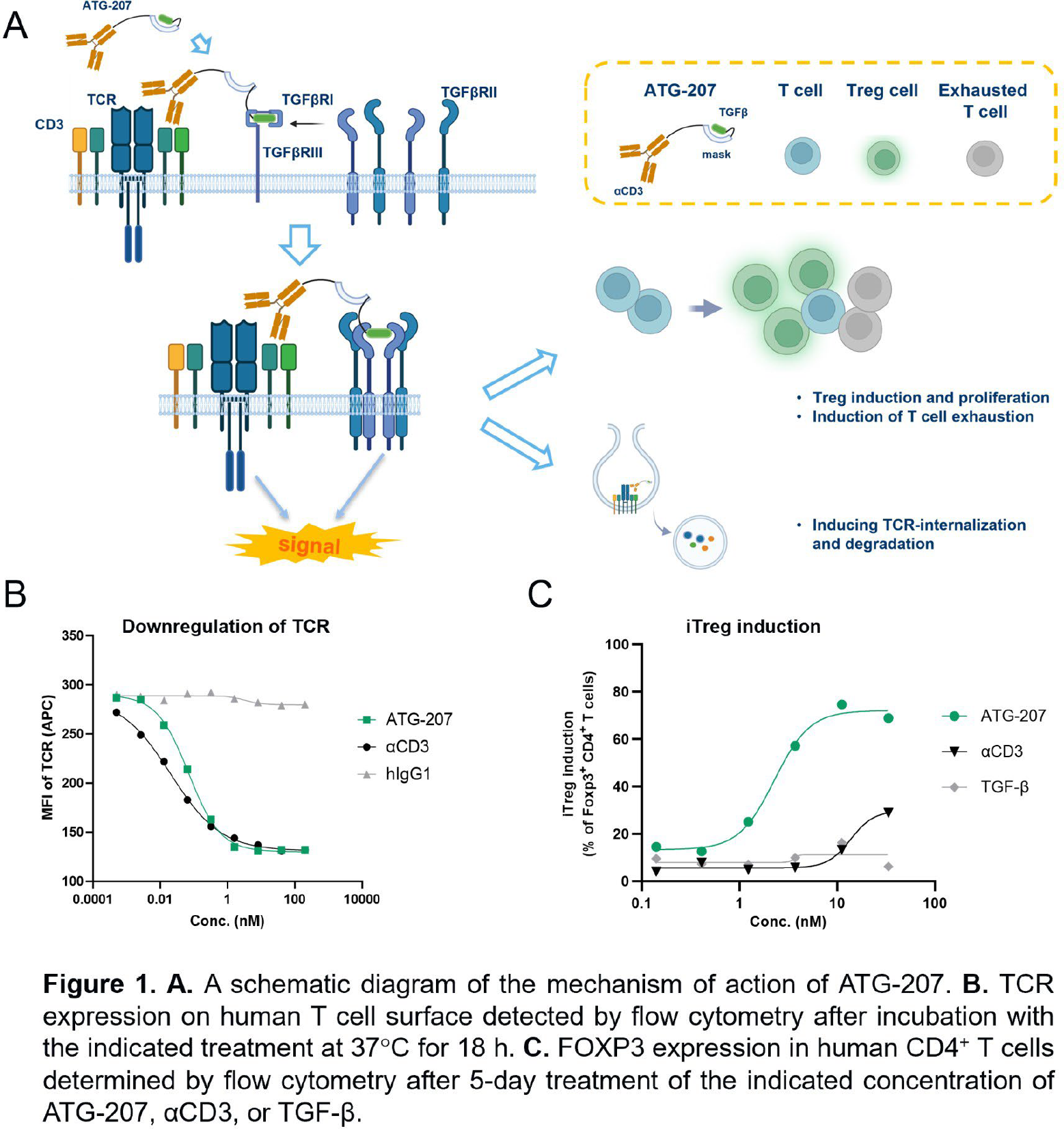
Results: ATG-207 demonstrated a binding preference for TGFβRIII (Figure 1A). Consistent with its CD3-mediated activity, ATG-207 effectively downregulated surface T cell receptor (TCR) expression on T cells, with an EC 50 in the sub-nanomolar range (Figure 1B). Upon prolonged exposure, ATG-207 induced a state of T cell exhaustion, as indicated by the upregulation of multiple exhaustion-associated markers, such as LAG-3, TIM-3 and PD-1. In parallel, ATG-207 potently induced regulatory T cells in vitro, with an EC 50 in the single-digit nanomolar range (Figure 1C). In vivo, ATG-207 mouse surrogate molecule demonstrated therapeutic efficacy in an experimental autoimmune encephalomyelitis (EAE) mouse model, while its efficacy in additional autoimmune disease models is currently under evaluation. Notably, compared with an unbiased αCD3–TGF-β fusion protein control, ATG-207 or its mouse surrogate molecule induced substantially lower levels of proinflammatory cytokine release both in human whole blood assays after 48 hours of incubation and in mice 2 hours following intravenous administration. This attenuated cytokine profile suggests reduced off-target immune activation and supports a favorable systemic safety profile.
Conclusions: ATG-207 combines CD3-mediated T cell modulation with TGFβRIII-biased TGF-β signaling to selectively suppress pathogenic T cells while promoting regulatory T cell differentiation. This dual mechanism enabled effective control of autoimmune pathology in preclinical models with minimal cytokine release. The results highlight the potential of receptor-biased and context-restricted TGF-β delivery as a next-generation approach for immune tolerance restoration.
REFERENCES: [1] Herold KC, Bundy BN, Long SA, et al. An Anti-CD3 Antibody, Teplizumab, in Relatives at Risk for Type 1 Diabetes. N Engl J Med . 2019;381(7):603-613. doi:10.1056/NEJMoa1902226.
[2] Sims EK, Bundy BN, Stier K, et al. Teplizumab improves and stabilizes beta cell function in antibody-positive high-risk individuals. Sci Transl Med . 2021;13(583):eabc8980. doi:10.1126/scitranslmed.abc8980.
[3] Balancing immunity with Tregs. Nat Biotechnol. 2026 Jan 6. doi: 10.1038/s41587-025-02990-5. Epub ahead of print. PMID: 41495429.
[4] Sanjabi S, Oh SA, Li MO. Regulation of the Immune Response by TGF-β: From Conception to Autoimmunity and Infection. Cold Spring Harb Perspect Biol . 2017;9(6):a022236. Published 2017 Jun 1. doi:10.1101/cshperspect.a022236.
[5] Massagué J, Sheppard D. TGF-β signaling in health and disease. Cell . 2023;186(19):4007-4037. doi:10.1016/j.cell.2023.07.036.
[6] Ouyang W, Beckett O, Ma Q, Li MO. Transforming growth factor-beta signaling curbs thymic negative selection promoting regulatory T cell development. Immunity . 2010;32(5):642-653. doi:10.1016/j.immuni.2010.04.012.
[7]
Acknowledgments: NIL.
Disclosure of Interests: Ya Kong employed by Shanghai Antengene Corporation Limited, Peng Chen employed by Shanghai Antengene Corporation Limited, Ge Lin employed by Shanghai Antengene Corporation Limited, Xueli Chen employed by Shanghai Antengene Corporation Limited, Jay Mei Antengene Corporation, Celegene, Novartis Oncology, Johnson & Johnson Pharmaceutical Ltd., Bing Hou employed by Antengene Corporation