fetching data ... 
Background: Systemic lupus erythematosus (SLE) is an autoimmune disease primarily caused by B-cell dysfunction. In SLE, the proliferating peripheral age-associated B cells (ABCs, also known as CD11c + B cells) mediate lupus pathogenesis by producing autoantibodies. However, whether the aberrant expansion of ABCs originates in the bone marrow and the molecular mechanisms underlying abnormal ABCs expansion in the bone marrow remain unclear.
Objectives: This study aims to investigate the abnormal differentiation patterns of pro-B cells in SLE bone marrow and to explore the mechanisms driving the abnormal expansion of pro-B cells towards pathogenic ABC-like B cells in SLE bone marrow.
Methods: Bone marrow samples were obtained from patients with SLE and healthy volunteers for flow cytometric analysis of bone marrow B cells. The lupus mouse model was established by R848 induction. Pro-B cells from mouse bone marrow were sorted using a flow cytometer for bulk RNA sequencing. CEBPA inhibitors are used to investigate the role of CEBPA in abnormal B-cell differentiation. CUT&TAG sequencing and qPCR were used to verify binding of CEBPA to the ZEB2 promoter regions. ZEB2 siRNA was used to knock down ZEB2.
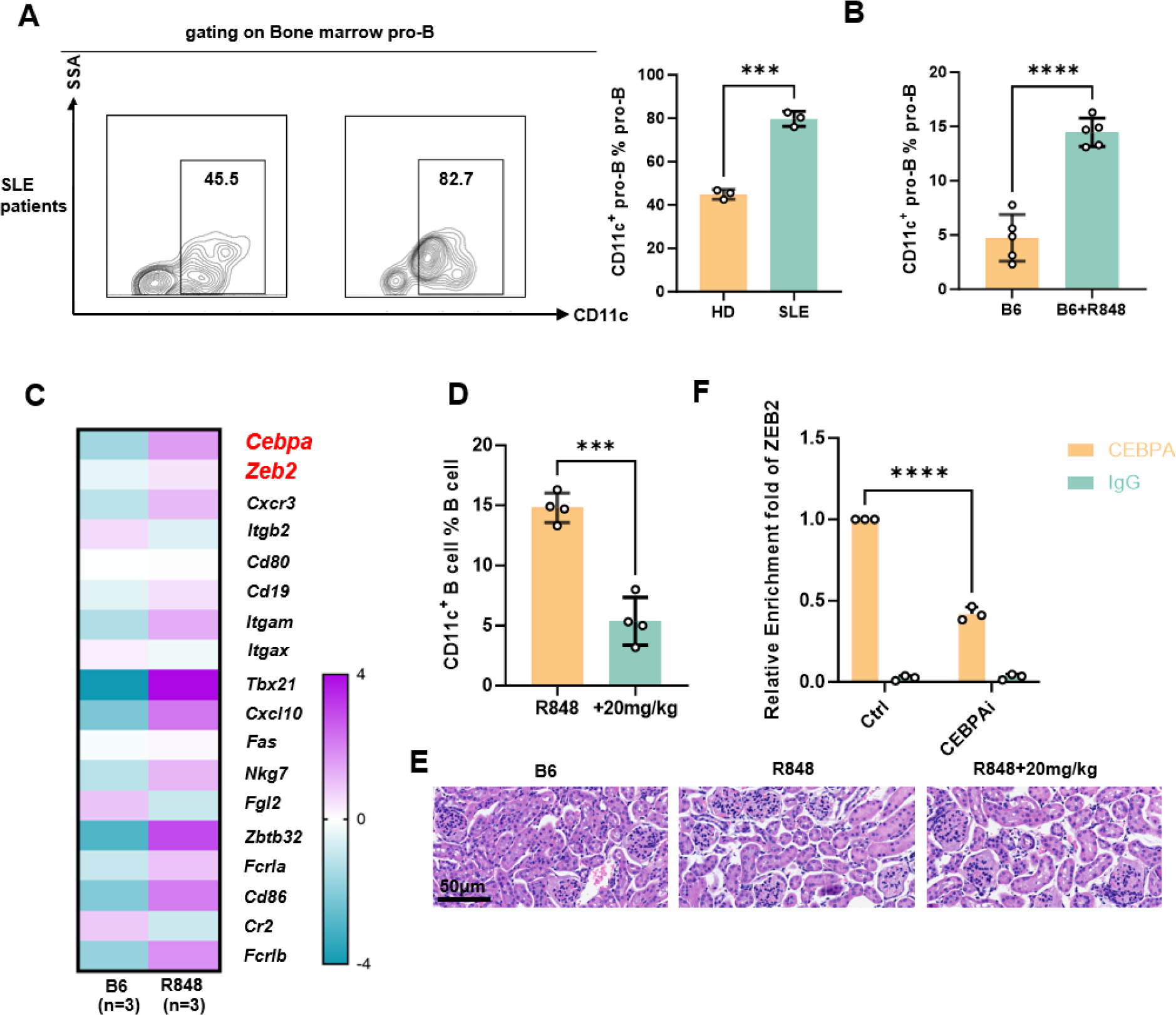
Results: SLE patients and SLE mice showed an upregulation trend of CD11c + pro-B cells (ABC-like B cells) in their bone marrow, as determined by flow cytometry (Figure 1A-B). Omics data revealed that SLE mouse pro-B cells exhibited an ABC-like transcriptional signature, with CEBPA and ZEB2 identified as key genes (Figure 1C). Consistently, bone marrow B cells showed increased protein levels of CEBPA and ZEB2 in SLE patients. To investigate the role of CEBPA, we treated the bone marrow of SLE patients with CEBPA inhibitors in vitro and found that the proportion of CD11c + B cells was significantly downregulated. This phenomenon has also been validated in mice. Furthermore, after one month of oral CEBPA inhibitor treatment, the proportion of CD11c + B cells was significantly reduced compared to the control group (Figure 1D), accompanied by a decrease in the deposition of infiltrated leukocytes in kidney sections (Figure 1E). CUT&TAG sequencing and qPCR on bone marrow B cells from SLE patients demonstrated that CEBPA directly occupied the ZEB2 promoter regions. Upon CEBPA inhibition, CEBPA occupancy decreased (Figure 1F). Knockdown of ZEB2 decreased the proportion of CD11c + B cells in the bone marrow of SLE mice.
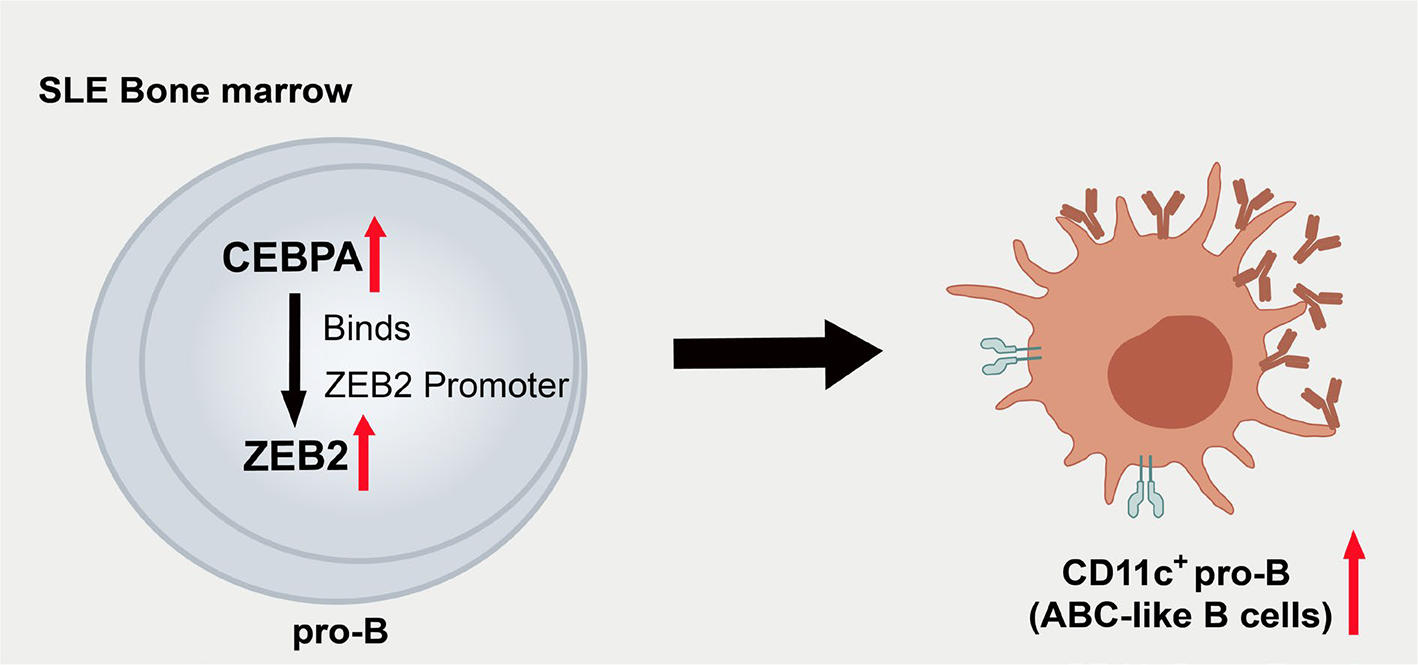
Conclusions: This study identifies CEBPA as a central driver of abnormal expansion of ABC-like B cells at the pro-B stage in the bone marrow of SLE patients. Mechanistically, CEBPA promotes ZEB2 expression, a vital transcription factor of ABCs [1]. This phenomenon can be reversed by inhibiting CEBPA, suggesting that CEBPA may represent an important therapeutic target for SLE.
(A–B) The proportion of CD11c + pro-B cells in the bone marrow of SLE patients and mice compared with controls was detected by flow cytometry. (C) Bulk RNA sequencing was performed on pro-B cells from SLE mice and control mice. (D) The proportion of CD11c + B cells in the bone marrow of SLE mice after oral treatment with the CEBPA inhibitor (20 mg/kg) or vehicle controls was detected by flow cytometry. (E) Representative results of renal pathology from controls, SLE mice, and CEBPA inhibitor–treated mice. (F) CUT&TAG sequencing and qPCR were performed on bone marrow B cells from SLE patients before and after CEBPA inhibitor treatment.
Graphical abstract.
REFERENCES: [1] Dai D et al. Science. 2024.
Acknowledgments: NIL.
Disclosure of Interests: None declared.