fetching data ... 
Background: Systemic lupus erythematosus (SLE) is a chronic autoimmune disease characterized by dysregulated humoral immunity with sustained B-cell activation, autoantibody production, and immune complex-mediated organ injury. BAFF (B-cell activating factor) and APRIL (a proliferation-inducing ligand) play central and non-redundant roles in B-cell survival, differentiation, and plasma-cell maintenance, and elevated BAFF/APRIL expression has been associated with SLE disease activity and lupus nephritis. Accordingly, dual inhibition of BAFF and APRIL represents a rational therapeutic strategy to achieve broader suppression of pathogenic humoral immune responses than targeting either cytokine alone. This therapeutic strategy is supported by the clinical development of telitacicept, a dual BAFF/APRIL inhibitor approved in China for the treatment of active SLE with a once-weekly subcutaneous dosing regimen. These findings support continued development of next-generation dual BAFF/APRIL inhibitors.
Objectives: To evaluate the mechanistic and translational preclinical profile of GenSci136 by characterizing its in vitro BAFF/APRIL inhibitory activity, its in vivo efficacy in a spontaneous murine model of SLE, and its exploratory pharmacokinetic (PK) and pharmacodynamic (PD) properties in non-human primates.
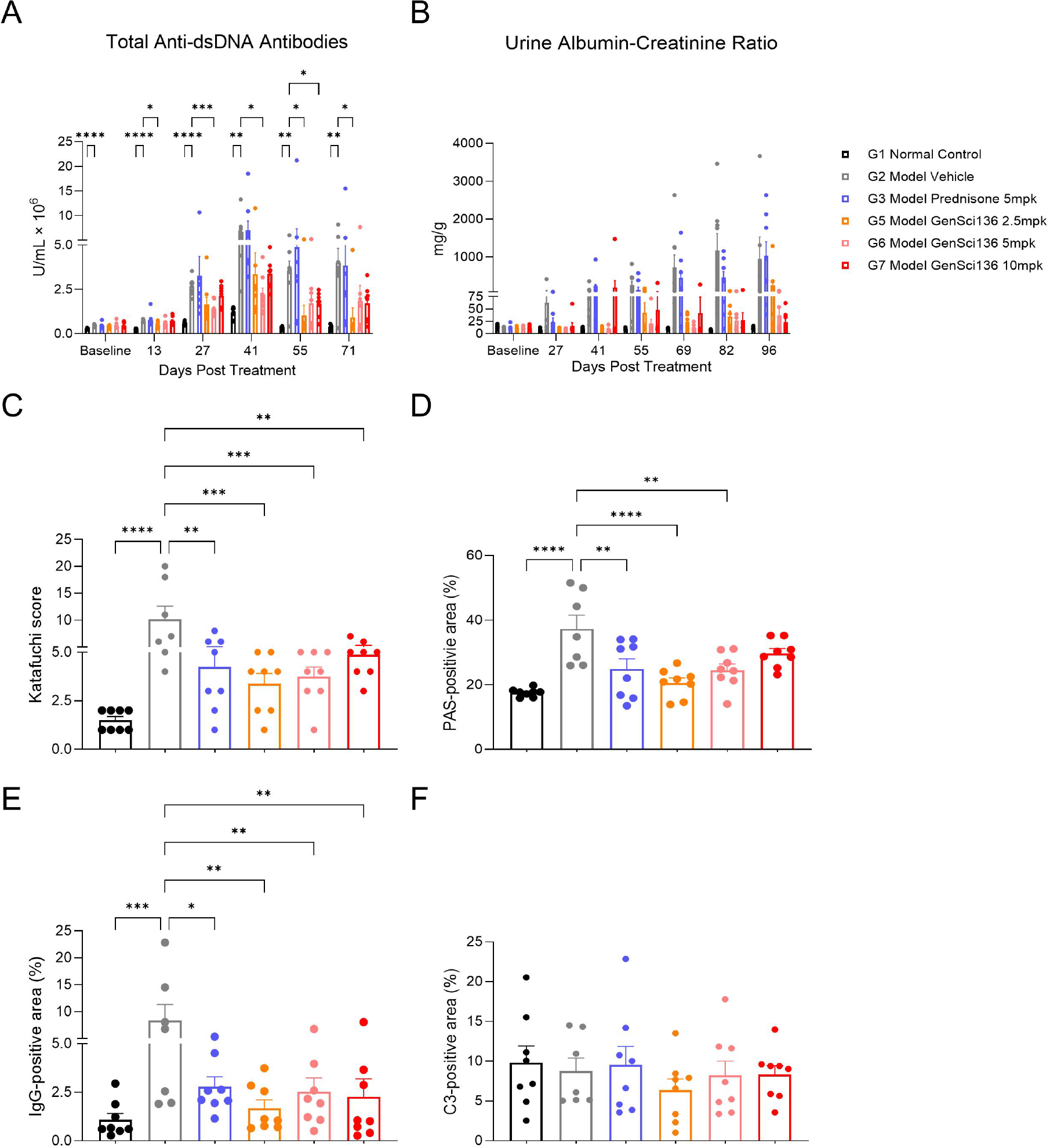
Methods: Binding affinity of GenSci136 to BAFF and APRIL homo- and heterotrimeric ligands was determined using surface plasmon resonance. Functional inhibition of BAFF/APRIL signaling was assessed using cell-based luciferase reporter assays. Primary human B-cell assays were performed to evaluate effects on expansion of B-cell subsets and immunoglobulin secretion. In vivo efficacy was assessed in female MRL/MpJ-Faslpr/J (MRL/lpr) mice randomized to receive vehicle, prednisone, or GenSci136 at multiple dose levels for 14 weeks. Serum anti-dsDNA antibodies were quantified by ELISA. Renal function was evaluated by serum creatinine, blood urea nitrogen, and urinary albumin-to-creatinine ratio (UACR). Renal pathology was assessed by histology (H&E and PAS) and immunofluorescence (IgG and complement C3). Exploratory PK/PD assessments of GenSci136 were conducted following single subcutaneous administration in cynomolgus monkeys.
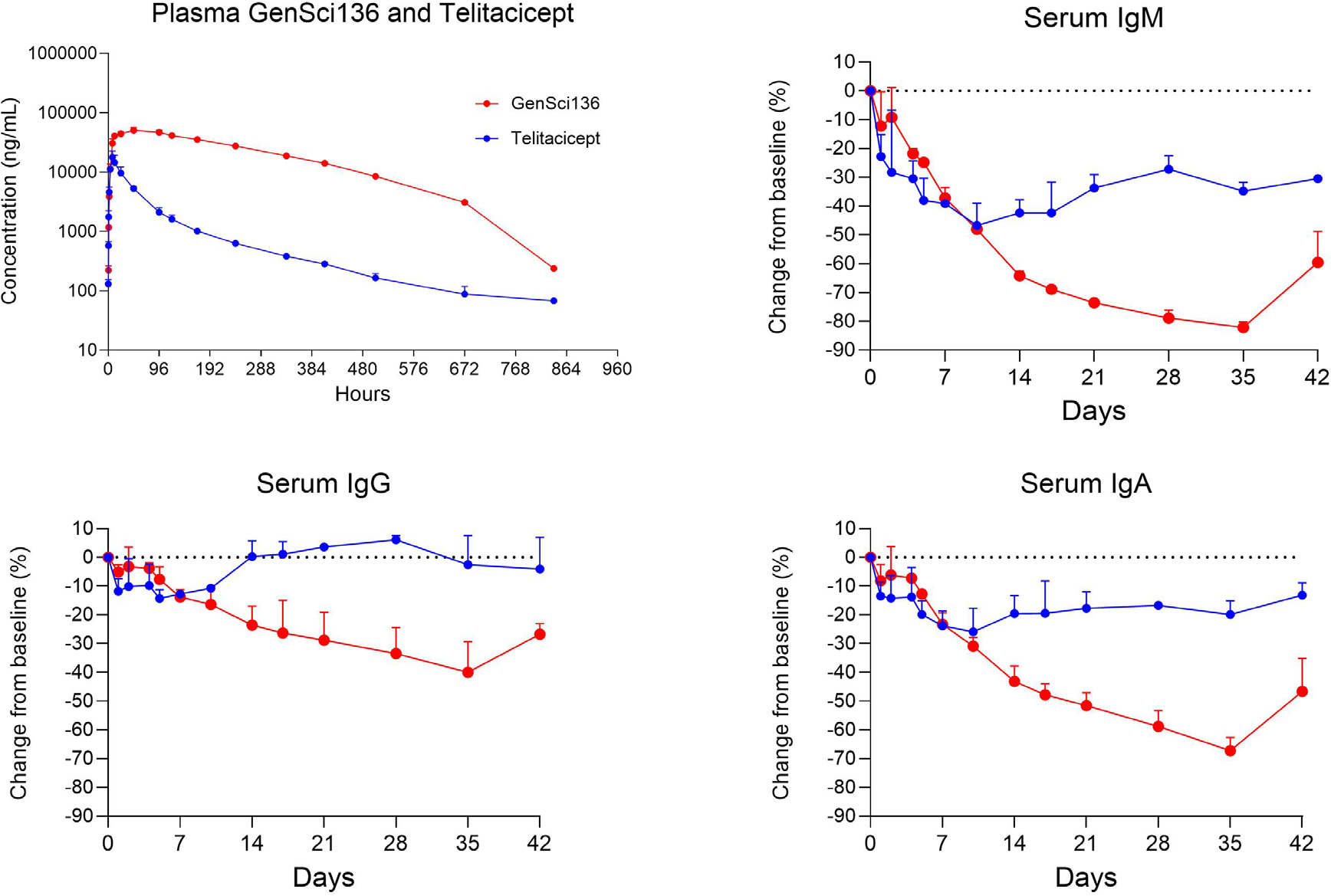
Results: GenSci136 bound BAFF and APRIL with high affinity and demonstrated stronger binding potency in biochemical assays than telitacicept. Consistently, GenSci136 more effectively inhibited BAFF- and APRIL-mediated activation of BAFF-R, TACI, and BCMA signaling in luciferase reporter assays and showed greater suppression of BAFF/APRIL-dependent expansion of class-switched memory B cells or plasma cells and immunoglobulin secretion in primary human B-cell assays. In the MRL/lpr spontaneous lupus mouse model, GenSci136 induced pronounced reduction in serum levels of total anti-dsDNA antibodies. GenSci136 treatment improved renal function, as evidenced by reductions in serum creatinine and blood urea nitrogen, and decreases in UACR. Histopathological analysis demonstrated attenuation of glomerular injury and reduced mesangial expansion. Glomerular IgG deposition was reduced following GenSci136 treatment, whereas glomerular C3 deposition showed minimal change across experimental groups. In an exploratory PK/PD study in cynomolgus monkeys, a single subcutaneous administration of GenSci136 provided more sustained systemic exposure than telitacicept, with a longer mean residence time. Consistent with this pharmacokinetic profile, GenSci136 induced greater and more sustained reductions in circulating immunoglobulin (IgM, IgA, IgG) levels relative to telitacicept, indicating prolonged pharmacodynamic activity.
Conclusions: GenSci136 demonstrates robust BAFF/APRIL pathway inhibition with sustained suppression of pathogenic humoral immune responses, supporting its further clinical development for SLE and lupus nephritis.
GenSci136 reduced total anti-dsDNA antibodies, improved UACR, and attenuated renal pathology in the MRL/lpr spontaneous lupus mouse model.
Exploratory PK/PD assessment of GenSci136 with telitacicept as reference drug at 3 mg/kg dose in cynomolgus monkeys.
REFERENCES: NIL.
Acknowledgments: NIL.
Disclosure of Interests: BO QU Changchun GeneScience Pharmaceutical Co., Ltd., Qian Hao Changchun GeneScience Pharmaceutical Co., Ltd., Peng Qi Changchun GeneScience Pharmaceutical Co., Ltd., Yuyan Chen Changchun GeneScience Pharmaceutical Co., Ltd., Jin Wang Changchun GeneScience Pharmaceutical Co., Ltd., Yuting Lu Changchun GeneScience Pharmaceutical Co., Ltd., Xinyuan liu Changchun GeneScience Pharmaceutical Co., Ltd., Hailong Wang Changchun GeneScience Pharmaceutical Co., Ltd., Dewan Ren Changchun GeneScience Pharmaceutical Co., Ltd., Lin Dai Changchun GeneScience Pharmaceutical Co., Ltd., Jialing Cao Changchun GeneScience Pharmaceutical Co., Ltd., GULIANG XIA Changchun GeneScience Pharmaceutical Co., Ltd., Haizhou Zhang Changchun GeneScience Pharmaceutical Co., Ltd., XIAOZHEN WANG Changchun GeneScience Pharmaceutical Co., Ltd., Siqin Wang Changchun GeneScience Pharmaceutical Co., Ltd., Lei Jin Changchun GeneScience Pharmaceutical Co., Ltd.