fetching data ... 
Background: Systemic Lupus Erythematosus (SLE) is a systemic autoimmune disease characterised by B-cell hyperactivation and secretion of pathogenic autoantibodies against intracellular nuclear autoantigens. SLE pathogenesis is complex, involving both the innate and adaptive immune systems; current treatments often involve general immunosuppressants which can result in serious side effects such as increased infection risks when used long-term. The monoclonal antibody anifrolumab (the latest biologic approved for SLE use), had a patient response rate of less than 50% in clinical trials [1], potentially due to high disease heterogeneity. A critical unmet clinical need is therefore to discover potential therapeutic targets that aim for the restoration of immune homeostasis rather than blanket suppression.
Objectives: To use multi-dimensional analysis of the B cell compartment in adult patients with SLE and age-matched healthy controls to examine perturbations of the B cell immunome and discover potential B cell subset therapeutic targets.
Methods: To achieve this, we examined mass cytometry data derived from 40 CpG ODN2006 and CD40L stimulated peripheral blood mononuclear cells (PBMC) samples from adult patients with SLE (n = 26) and their age-matched healthy controls (n = 23, 19 females, 4 males). The SLE patients (23 females, 3 males) had a median age of 39.5 (interquartile range [IQR]: 28 to 53.5) years with a median SLEDAI-2K score of 4 (IQR: 0 to 6). Batch effect correction, clustering, and annotation of CD19 + B cell subsets based on marker expression were performed using our unsupervised Extended Polydimensional Immunome Characterization (EPIC) pipeline [2]. We compared the frequency of naive (IgD + CD27 - ), memory (IgD - CD27 + ) and double-negative (IgD - CD27 - ) CD19 + B cell subsets between SLE patients and healthy controls. Frequencies are expressed as a percentage of total CD19 + CD3 - CD14 - CD56 - PBMCs and described with median and IQR. Statistical significance is defined as p<0.05 (Mann-Whitney U test with Bonferroni correction).
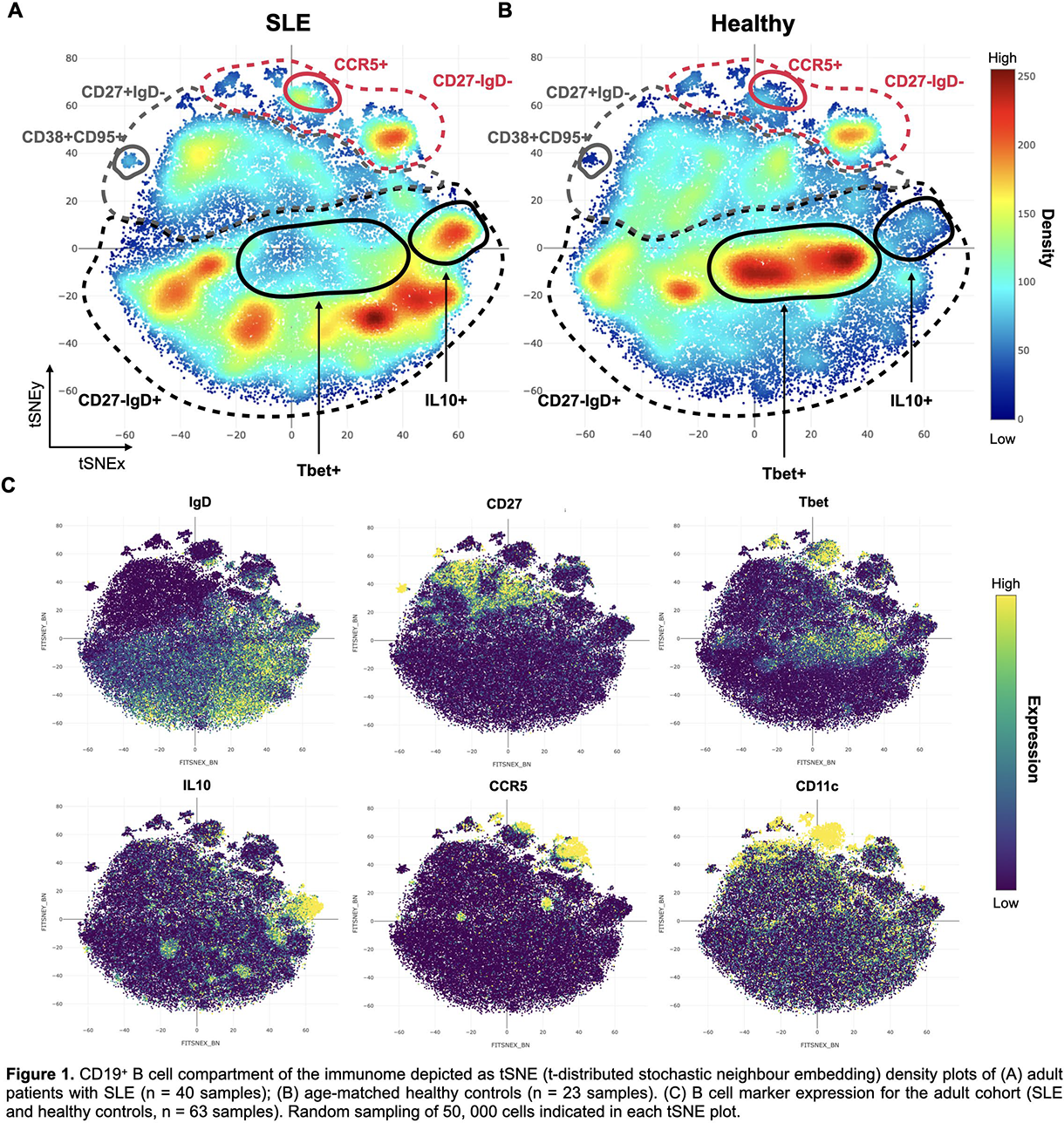
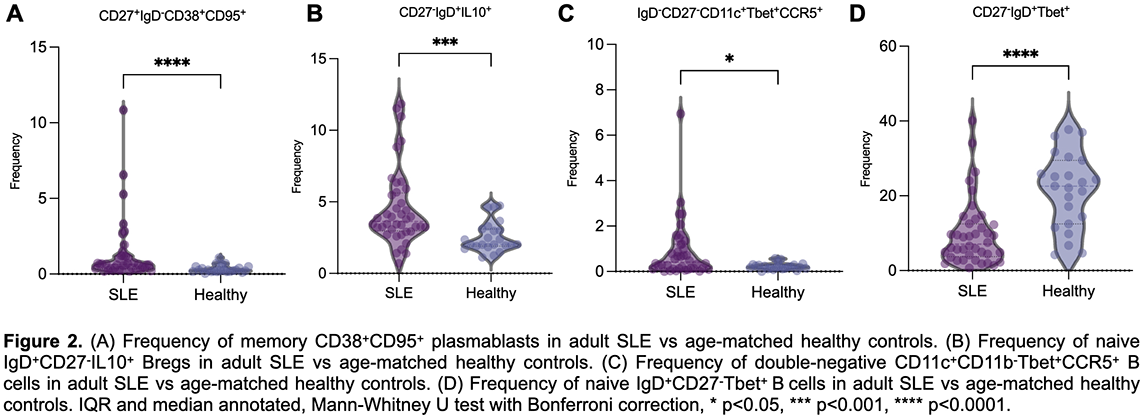
Results: There were significant changes observed across multiple B cell compartments, notably the naive cell compartment, between adult lupus and age-matched healthy controls (Figure 1A and B). The frequencies of memory CD38 + CD95 + plasmablasts (SLE vs. healthy: 0.41 [0.12-1.20]% vs. 0.20 [0.14-0.29]%, p<0.0001), naive IgD + CD27 - IL10 + regulatory B cells (Bregs; SLE vs. healthy: 3.63 [2.96-5.62]% vs. 2.03 [1.91-3.11]%, p<0.001), and double-negative CD11c + CD11b - Tbet + CCR5 + B cells (SLE vs. healthy: 0.41 [0.13-1.20]% vs. 0.14 [0.20-0.29]%, p<0.05) were significantly increased in adult SLE relative to age-matched healthy controls (Figure 2A-2C). Of interest, there was a significant decrease in the frequency of naive IgD + CD27 - Tbet + cells (SLE vs. healthy: 7.06 [3.71-12.48]% vs. 22.57 [12.46-29.46]%, p<0.0001) in SLE relative to healthy controls (Figure 2D).
Conclusions: There are a few notable perturbations of the B cell compartment in adult SLE relative to healthy adults. First, an increased frequency of CD38 + CD95 + plasmablasts, indicating an increase in activated plasmablasts in disease. Breg frequency was also increased in SLE, suggesting Bregs are either dysfunctional in SLE or their magnitude of increase is inadequate to suppress autoreactivity. Increased frequency of double-negative Tbet + CCR5 + B cells may enable cell trafficking to the kidneys and skin of patients with SLE due to upregulation of the chemokine CCL3 in these disease microenvironments. Finally, the significant decrease in naive Tbet + cell frequency in SLE may suggest a role of Tbet in normal B cell immunobiology that is lost in the autoimmune state. Due to the central role of B cells in SLE pathogenesis, these identified cell subtypes may provide therapeutic targets to develop for SLE, particularly the deranged Breg and naive Tbet + cell subsets.
REFERENCES: [1] Morand EF et al. N Engl J Med. 2019 Dec;382(3):211-221.
[2] Yeo JG et al. Nat Biotechnol. 2020 Jun;38(6):679-684.
Acknowledgments: NIL.
Disclosure of Interests: None declared.