fetching data ... 
Background: Recurrent pregnancy loss (RPL) is a multifactorial condition in which immune and inflammatory mechanisms are increasingly implicated. Beyond chromosomal abnormalities, growing evidence suggests that early pregnancy failure may involve altered maternal immune adaptation and dysregulated inflammatory responses at the materno-fetal interface, sharing conceptual features with immune-mediated inflammatory diseases. These observations have led to the off-label use of immunomodulatory therapies such as intralipid infusions, anti-TNF agents and corticosteroids, particularly in women experiencing repeated pregnancy losses, although comparative effectiveness data remain limited.
Objectives: To evaluate the association between intralipid infusions, adalimumab and corticosteroids and the risk of pregnancy loss before 12 weeks of gestation (WG) in women with recurrent pregnancy loss.
Methods: We conducted a prospective observational cohort study including women with immune-mediated recurrent pregnancy loss managed in a our centre. Immunomodulatory treatments were initiated after repeated pregnancy losses. The primary outcome was pregnancy loss before 12 WG; ongoing pregnancy ≥12 WG or live birth was considered a success. Time-to-event analyses were performed using adjusted Cox proportional hazards models, estimating treatment effects versus no immunomodulatory treatment. Models were adjusted for maternal age (restricted cubic splines) and number of previous pregnancy losses. Prespecified subgroup analyses included polycystic ovary syndrome, endometriosis, low ovarian reserve, autoimmune disease and thyroid disorders.
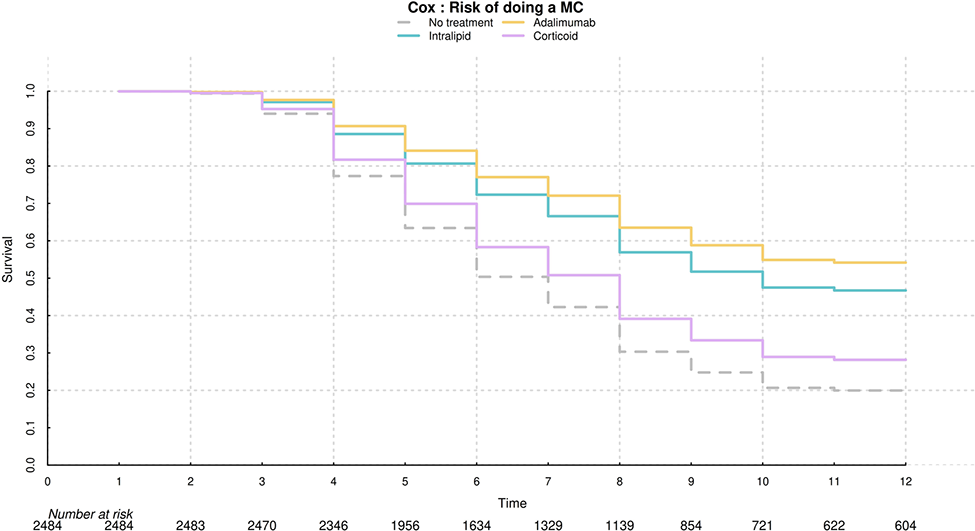
Results: A total of 527 women with immune-mediated recurrent pregnancy loss were included, contributing 4,120 pregnancies . At cohort entry, median age at first pregnancy was 29.8 years [25.4; 33.4] and median BMI 24.1 kg/m 2 [21.4; 28.3]; Ethnicity was predominantly European (57.4%), followed by North African (18.0%) and sub-Saharan African (10.1%). Comorbidities included autoimmune disease (27/527; 5.1%), hypothyroidism (9.5%), polycystic ovary syndrome (PCOS; 11.4%), deeply infiltrating endometriosis (9.3%), and adenomyosis (15.2%). Median antral follicle count was 14 [9; 20]. In the main adjusted Cox model, intralipid infusions, adalimumab and corticosteroids were each independently associated with a significantly reduced risk of pregnancy loss before 12 WG:
Intralipid : HR 0.472 (95% CI 0.366–0.609 ; p< 0.001 )
Adalimumab : HR 0.381 (95% CI 0.236–0.614 ; p< 0.001 )
Corticosteroids : HR 0.786 (95% CI 0.633–0.977 ; p= 0.030 )
The number of previous pregnancy losses was not significantly associated with outcome (HR 1.028, 95% CI 0.994–1.062; p=0.104). Subgroup analyses suggested heterogeneous treatment associations, with consistent signals observed in clinical contexts commonly associated with inflammatory or immune dysregulation, including autoimmune disease, thyroid disorders, endometriosis, polycystic ovary syndrome and low ovarian reserve.
Conclusions: In this real-world cohort of women with immune-mediated recurrent pregnancy loss treated after repeated pregnancy failures, intralipid infusions, adalimumab and corticosteroids were associated with a lower risk of early pregnancy loss. These findings support the relevance of immunomodulatory strategies at the interface between reproductive medicine and rheumatology and highlight the need for prospective controlled studies to better define patient selection.
Comparative survival curves (treatments vs untreated)
REFERENCES: [1] Rüegg L, Pluma A, Hamroun S, et al. EULAR recommendations for use of antirheumatic drugs in reproduction, pregnancy, and lactation: 2024 update. Ann Rheum Dis. 2025;84(6):910-926. doi:10.1016/j.ard.2025.02.023. PMID: 40287311.
[2] Dimitriadis E, Menkhorst E, Saito S, Kutteh WH, Brosens JJ. Recurrent pregnancy loss. Nat Rev Dis Primers. 2020;6:98. doi:10.1038/s41572-020-00228-z. PMID: 33303732.
[3] Mekinian A, Cohen J, Alijotas-Reig J, et al. Unexplained recurrent miscarriage and recurrent implantation failure: Is there a place for immunomodulation? Am J Reprod Immunol. 2016;76(1):8-28. doi:10.1111/aji.12493. PMID: 26847715.
Acknowledgments: NIL.
Disclosure of Interests: None declared.