fetching data ... 
Background: Antinuclear antibodies (ANA) are widely used as a screening tool for systemic autoimmune rheumatic diseases (SARDs). While ANA titers < 1/160 are frequently observed in healthy individuals, patients with high ANA titers and negative extractable nuclear antibodies (ENA) often pose a diagnostic and follow-up challenge, as they may be asymptomatic or present with nonspecific complaints that do not fulfill classification criteria for SARDs. However, data on the prognostic significance of isolated high-titer ANA positivity and the long-term risk of progression to SARDs in this population remain limited, leading to uncertainty in follow-up strategies and patient counseling.
Objectives: To estimate the 5-year probability of developing SARDs in individuals with high-titer antinuclear antibodies and negative ENA.
The secondary objective was to describe factors associated with ANA positivity in the absence of diagnosed SARDs.
Methods: A retrospective observational study was conducted at a tertiary care hospital. ANA were assessed using indirect immunofluorescence on HEp-2 cells, considered the gold standard method. High ANA titers were defined as dilutions ≥1:640. ANA determinations performed in 2018 and requested from primary care or first referrals to the Rheumatology Department were randomly selected from the Immunology Department database of our center. Patients with ANA ≥1:640 and negative ENA were included, provided that no SARDs were diagnosed at baseline. Clinical records were reviewed five years after the initial ANA determination to assess the development of SARDs. Variables assessed included age, sex, ANA pattern at baseline and the subsequent diagnosis of SARDs. If a patient developed any SARDs, additional variables were collected: age at diagnosis, ANA pattern at diagnosis, ENA or other co-antibodies, symptoms at baseline and at diagnosis. The SARDs assessed were Sjögren’s syndrome, systemic lupus erythematosus, idiopathic inflammatory myopathies, and systemic sclerosis. Other known potential causes of ANA positivity were also described; when patients had a well-established alternative condition associated with ANA positivity without fulfilling classification criteria for SARDs (e.g., active or chronic infections, prior anti–tumor necrosis factor therapy, other autoimmune diseases), ANA positivity was attributed to these conditions rather than to SARDs.
Results: A total of 107 cases were included (87 females and 20 males), with a mean age of 57.5 ± 15 years (range 21–86). Homogeneous ANA pattern was the most frequent in 91.5% cases, followed by fine speckled (28%) and cytoplasmic speckled (11%). 21 cases shared more than one pattern, being the most frequent combination homogeneous plus fine cytoplasmic in nine cases. Coarse speckled, centromeric, and nucleolar patterns were each observed in one case.
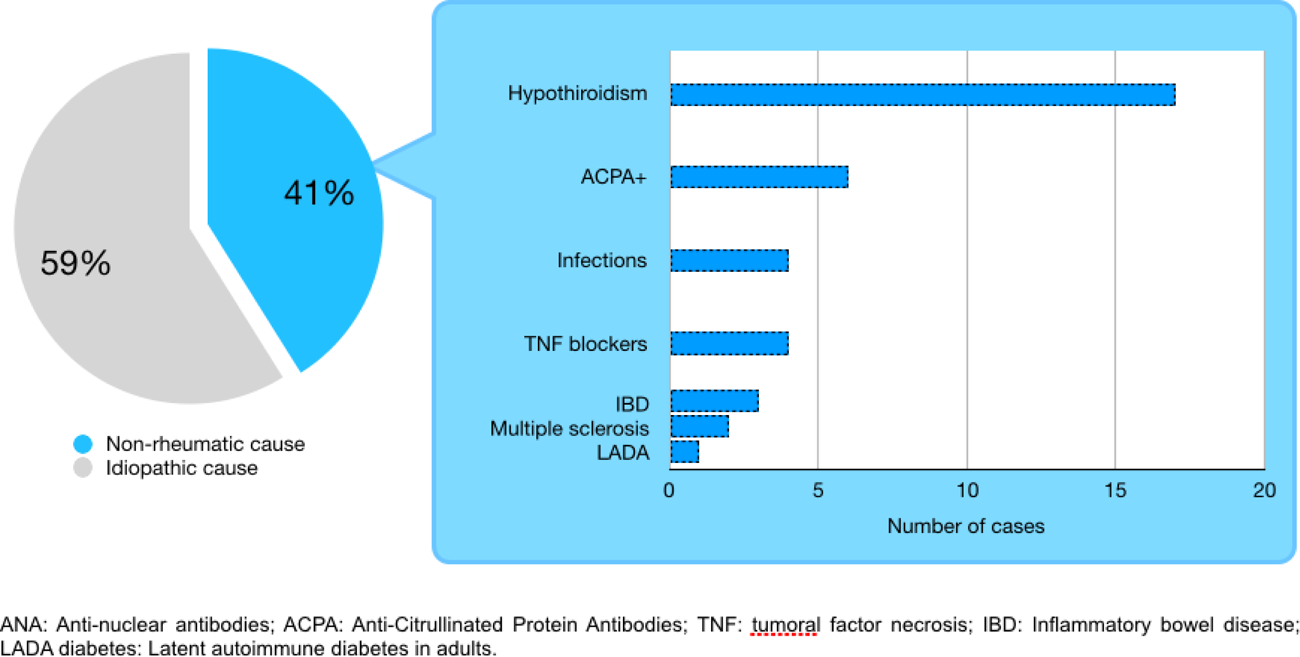
At baseline, non-rheumatic causes of ANA positivity were identified in 44 patients (41.1%), whereas no alternative cause was identified in 63 cases (58.9%). Amongst them, eighteen patients (16.8%) presented with one or more symptoms compatible with SARDs but did not meet classification criteria. These symptoms included inflammatory arthralgia (n=5), arthritis (n=3), sicca symptoms (n=3), Raynaud’s phenomenon (n=3), oral aphthosis (n=2), photosensitivity (n=2), chronic pleural effusion (n=1), and recurrent facial palsy (n=1). The remaining 45 cases (42.1%) were asymptomatic throughout the entire follow-up period.
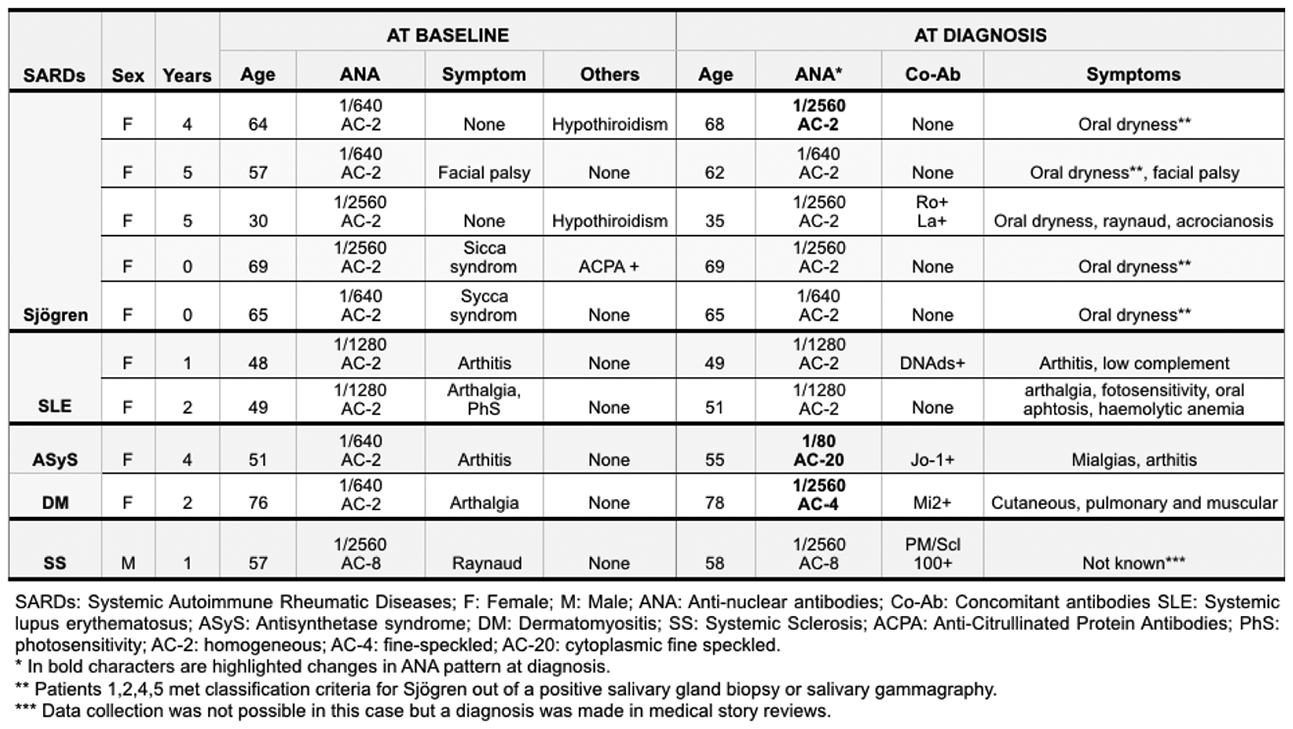
After five years, 10 patients (10.7%) developed SARDs, corresponding to a 5-year cumulative incidence and positive predictive value of 10.7%. Diagnoses included Sjögren’s syndrome (n=5), systemic lupus erythematosus (n=2), idiopathic inflammatory myopathy (n=2), and systemic sclerosis (n=1); one additional patient was classified as having very early diagnosis of systemic sclerosis (VEDOSS). The mean time to SARD diagnosis was 2.18 ± 1.99 years, with a median of 2 years (IQR 0.5–4). The predominant baseline ANA pattern was homogeneous (n=9). However, changes in ANA pattern at diagnosis were observed only in patients with idiopathic inflammatory myopathy (n=2). Newly positive co-autoantibodies emerged in five patients, while an increase in ANA titers was observed in only one case. The clinical and serological characteristics of patients who developed SARDs are summarized in Table 1 .
The presence of at least one suggestive symptom at baseline was strongly associated with progression to SARDs at five years (RR 19.8, 95% CI 4.6–85.5). Eight of the ten patients who developed SARDs presented with baseline symptoms, including inflammatory arthralgia (n=2), arthritis (n=2), sicca symptoms (n=2), Raynaud’s phenomenon (n=1), oral aphthosis (n=1), and facial palsy (n=1); however, the majority (7/10) did not fulfill classification criteria for a definite SARD until at least one year later.
Patients with alternative conditions associated with ANA positivity are described in Figure 1 . Three of the ten patients who developed definite SARDs had a pre-existing associated condition (two with hypothyroidism and one with ACPA positivity), whereas the majority of patients with alternative causes of ANA positivity (n=41; 93%) did not develop SARDs.
Conclusions: In individuals with ANA ≥1:640 and negative ENA, the 5-year cumulative incidence of SARDs was 10.7%.
The presence of one suggestive clinical symptom at baseline was strongly associated with progression to SARDs at five years (RR 19.8, 95% CI 4.6–85.5).
Progression occurred predominantly several years after the initial ANA determination, with a median time to diagnosis of 2 years (IQR 0.5–4), supporting the need for long-term clinical follow-up rather than short-term surveillance alone.
The majority of patients with alternative causes of ANA positivity did not progress to SARDs in five years (n=41; 93 %).
These results must be interpreted within the limitations of a retrospective, single-center study.
Table 1. Patients that developed SARDs.
Other non-rheumatic causes for ANA positivity.
REFERENCES: NIL.
Acknowledgments: NIL.
Disclosure of Interests: None declared.