fetching data ... 
Background: Autoimmune diseases present substantial challenges for risk prediction due to their complex, multifactorial pathogenesis, which encompasses both genetic predisposition and environmental factors [1, 2]. Therefore, identifying modifiable risk factors and developing clinical risk stratification strategies remain key research priorities, with biological age acceleration emerging as a valuable predictive indicator.
Objectives: To explore the relationship between accelerated biological aging and the risk of prevalence, incidence, and co-occurrence of 20 autoimmune diseases.
Methods: We calculated biological age using the phenotypic age (PhenoAge) and Klemera-Doubal method (KDMAge) based on blood biomarkers and chronological age. Biological aging accelerations were computed as residuals from regressing KDMAge and PhenoAge against chronological age. Autoimmune Diseases were diagnosed using the ICD-10 codes. We conducted cross-sectional and longitudinal analyses using log-binomial regression and Cox proportional hazards regression to assess the association between accelerated biological aging and the risk of various autoimmune diseases in the UK Biobank. The association between biological age acceleration and the co-occurrence of autoimmune diseases was assessed using multinomial logistic regression.
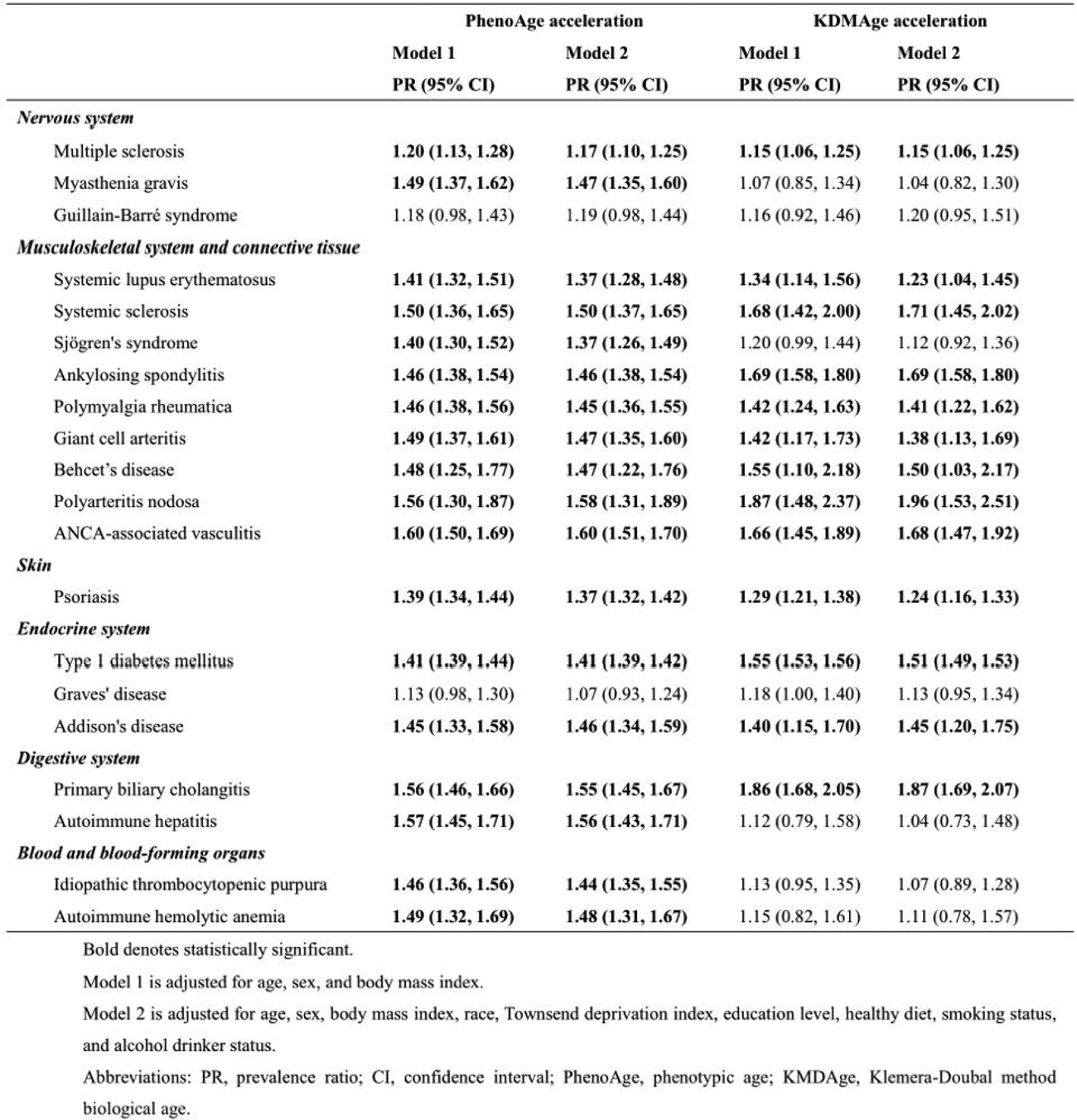
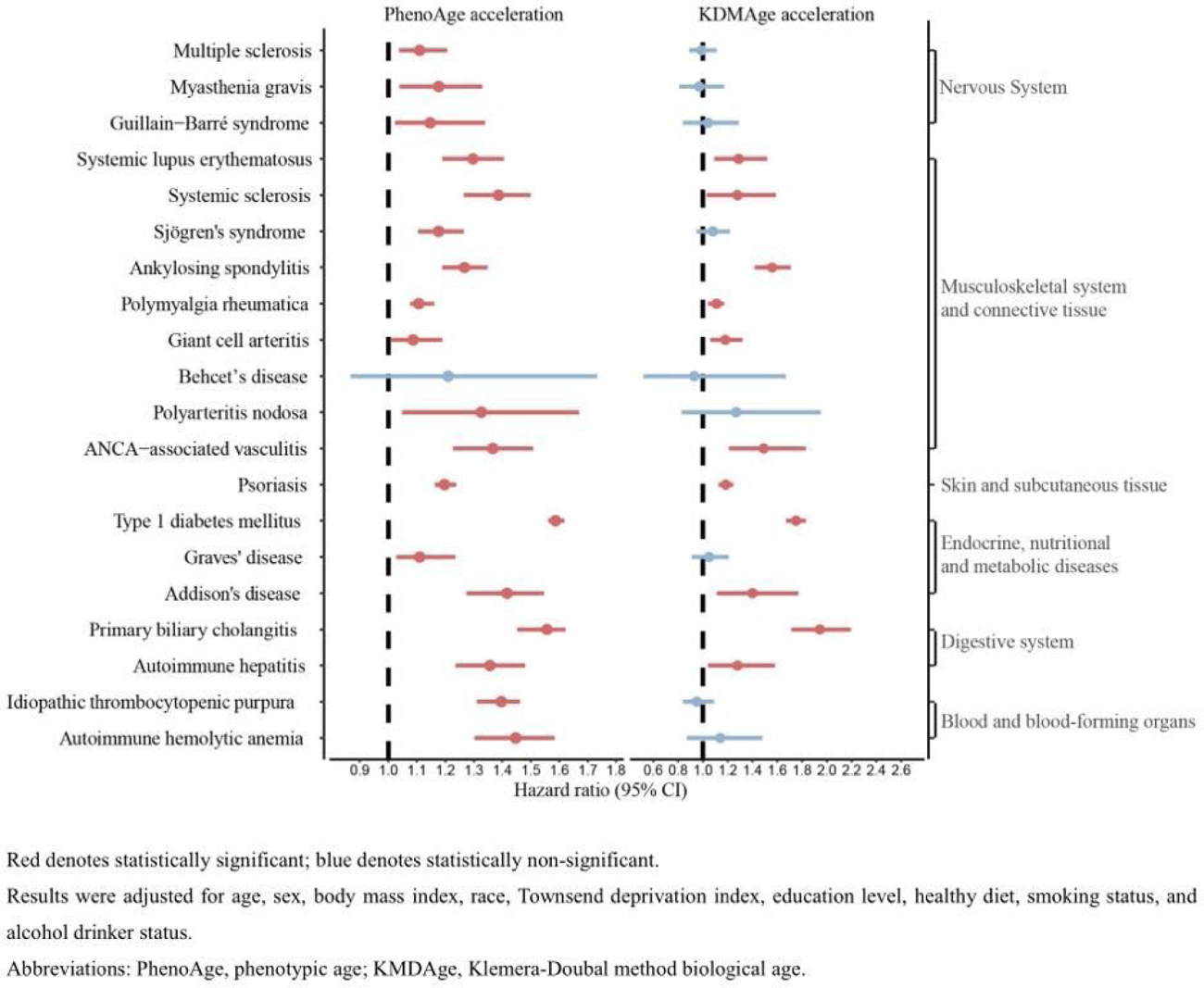
Results: In cross-sectional analyses of 332,261 participants, each standard deviation (SD) increase in biological age acceleration was associated with a 15% to 96% higher prevalence of 18 autoimmune diseases (Table 1). Survival analysis demonstrated that biological age acceleration was associated with an 8% to 97% increased risk of incident autoimmune diseases across 19 conditions (Figure 1). Each SD increase in biological age acceleration was associated with a greater than 50% increased risk of developing two diseases: Type 1 diabetes mellitus (PhenoAge hazard ratio [HR] 1.58, [95% CI 1.56–1.60]; KDMAge HR 1.63, [95% CI 1.57–1.68]), and primary biliary cholangitis (PhenoAge HR 1.55, [95% CI 1.48–1.64]; KDMAge HR 1.97, [95% CI 1.83–2.13]). Compared to individuals without any autoimmune disease, each SD increase in biological age acceleration was associated with 29% to 78% greater odds for the co-occurrence of two or more autoimmune diseases.
Conclusions: Our findings revealed a significant association between accelerated biological aging and the risk of autoimmune diseases. Identifying individuals with accelerated biological aging may enhance risk stratification and inform early interventions to reduce disease burden.
Table 1. Association between per 1 SD biological age acceleration and the risk of prevalent autoimmune diseases.
Forest of hazard ratios and 95% confidence intervals (95%CI) of per 1 SD biological age acceleration in autoimmune diseases.
REFERENCES: [1] De Luca F, Shoenfeld Y. The microbiome in autoimmune diseases. Clin Exp Immunol. 2019;195:74-85.
[2] Miller FW, Pollard KM, Parks CG, Germolec DR, Leung PS, Selmi C, et al. Criteria for environmentally associated autoimmune diseases. J Autoimmun. 2012;39:253-8.
Acknowledgments: NIL.
Disclosure of Interests: None declared.