fetching data ... 
Background: Regulatory T cells (Tregs) are essential for maternal-fetal tolerance, and their deficiency has been implicated in immune-mediated pregnancy loss. Low-dose interleukin-2 (IL-2LD) selectively expands and activates Tregs and has shown efficacy in murine models of spontaneous immune-mediated miscarriage.
Objectives: We conducted a proof-of-concept study to assess the safety, immunological effects, and preliminary clinical outcomes of IL-2 LD in women with unexplained recurrent early pregnancy loss.
Methods: FACIL-2 was an open-label study (NCT03970954) including 15 women with ≥5 unexplained recurrent early pregnancy losses. Participants received IL-2 LD (3 MIU/day for 5 consecutive days per cycle), starting 10 days after the first day of menstruation, for up to five cycles if pregnancy was not achieved. Circulating Tregs were quantified by flow cytometry. Pregnancy outcomes and safety were prospectively recorded. Additionally, nine women with similar clinical characteristics received IL-2 LD under compassionate use without immunomonitoring. We conducted a proof-of-concept study to assess the safety, immunological effects, and preliminary clinical outcomes of IL-2 LD in women with unexplained recurrent early pregnancy loss.
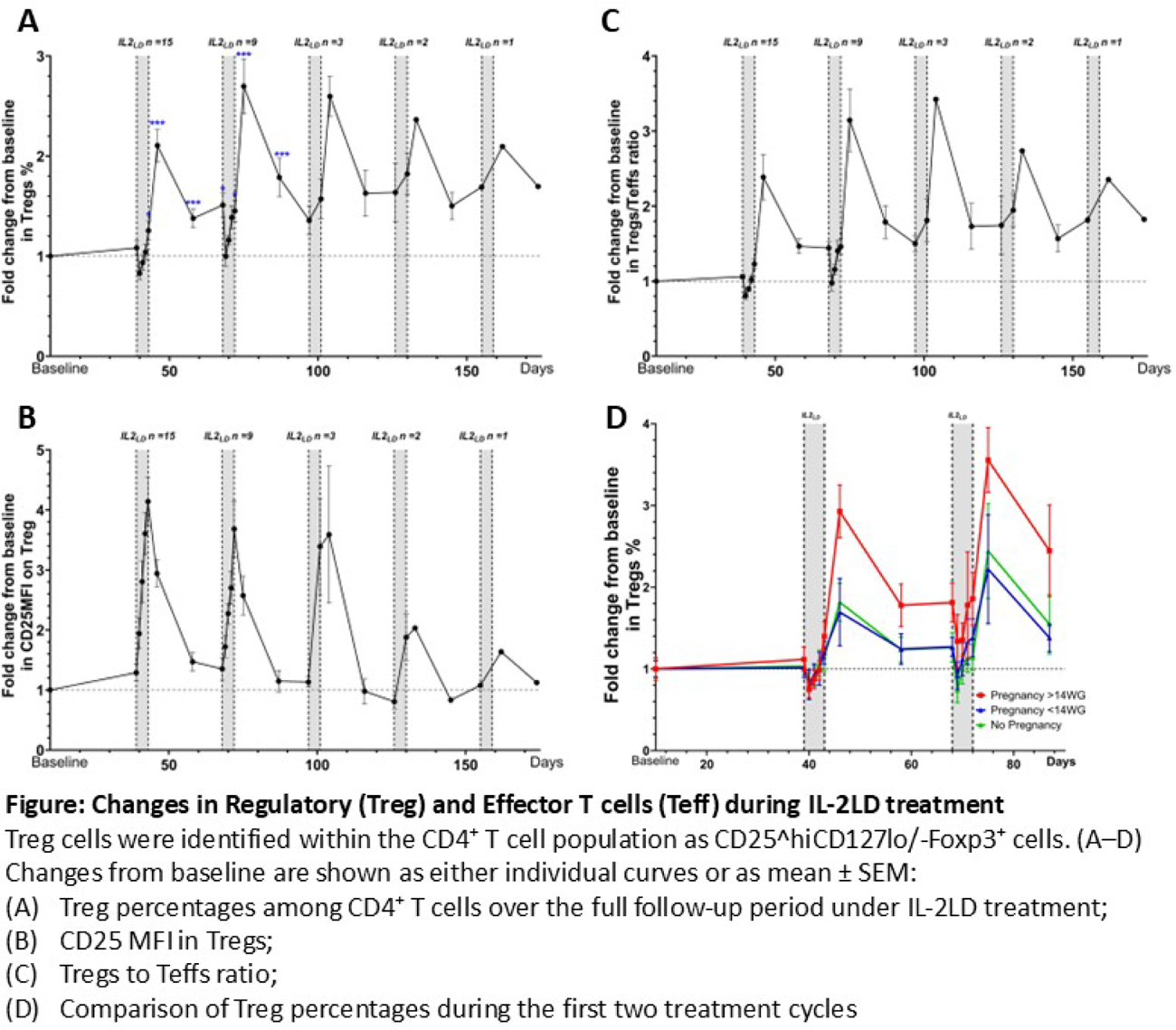
Results: In FACIL-2 participants, IL-2LD significantly increased circulating Tregs, with a mean 2.0-fold rise at day-8 compared with baseline (p<0.001), meeting the primary endpoint, and sustained elevation at day-29.
Eight pregnancies occured, of which four were viable at 12 weeks, resulting in three live births and one late miscarriage at 20 weeks.
Women with successful pregnancies showed significantly greater Treg expansion compared with those without successful outcomes (day-0 to day-8: 2.87 vs. 1.64-fold, p=0.03; day-0 to day-29: 1.71 vs. 1.24-fold, p=0.008).
In the compassionate-use cohort, five pregnancies occurred, resulting in two live births.
IL-2 LD was well tolerated, with only mild and manageable adverse events. All newborns were healthy.
Conclusions: IL-2LD was safe and consistently expanded Tregs in women with severe unexplained recurrent early pregnancy loss. These preliminary clinical and immunological findings support further controlled studies to evaluate IL-2 LD as an immunomodulatory strategy in immune-mediated pregnancy loss, including extended treatment through early gestation.
REFERENCES: [1] Aluvihare VR, Kallikourdis M, Betz AG. Regulatory T cells mediate maternal tolerance to the fetus. Nat Immunol 2004;5:266–271.
[2] Lee SK, Kim JY, Hur SE, et al. Imbalance of Foxp3+ regulatory T cells in idiopathic recurrent pregnancy loss. Hum Reprod 2011;26:2964–2973.
[3] Rosenzwajg M, Lorenzon R, Cacoub P, et al. Low-dose interleukin-2 across autoimmune diseases. Ann Rheum Dis 2019;78:209–217.
Acknowledgments: NIL.
Disclosure of Interests: None declared.