fetching data ... 
Background: Systemic sclerosis (SSc) is associated with primary cardiac involvement, which, when clinically overt, portends poor outcomes [1]. We have reported on subclinical cardiac MRI (CMR) myocardial tissue abnormalities [2] and have identified preliminary protein associations with CMR tissue measures. We have also capitalised on CMR’s multiparametric tissue, functional and anatomical characterisation to identify 3 preliminary CMR measure-based clusters.
Objectives: To identify proteomic biomarkers associated with three CMR-defined primary SSc cardiac phenotypes.
Methods: Serum samples from our previously characterised cohort of 76 individuals with SSc and no known cardiovascular history [2] were used to measure 355 proteins across four pre-defined Olink panels (Inflammation, Cardiovascular-II, Cardiovascular-III, Cardiometabolic). Bayesian logistic regression analyses, unsupervised hierarchical clustering, and protein network analyses were applied. The odds of association between normalised protein expression (NPX) and one of three identified cardiac clusters (near-normal, dilated-fibrotic and hyperdynamic-concentric) was determined. The NPX for each protein was given on a log 2 scale, such that a unit increase in NPX corresponded to a doubling of the serum protein concentration. Two logistic regression models, adjusted for age, sex, body mass index, systolic blood pressure, and smoking status were used to identify proteins associated with each non-normal phenotype (dilated-fibrotic and hyperdynamic-concentric) compared to the near-normal phenotype. Nominally significant proteins were identified where the odds of association for each unit increase in NPX was P<0.05.
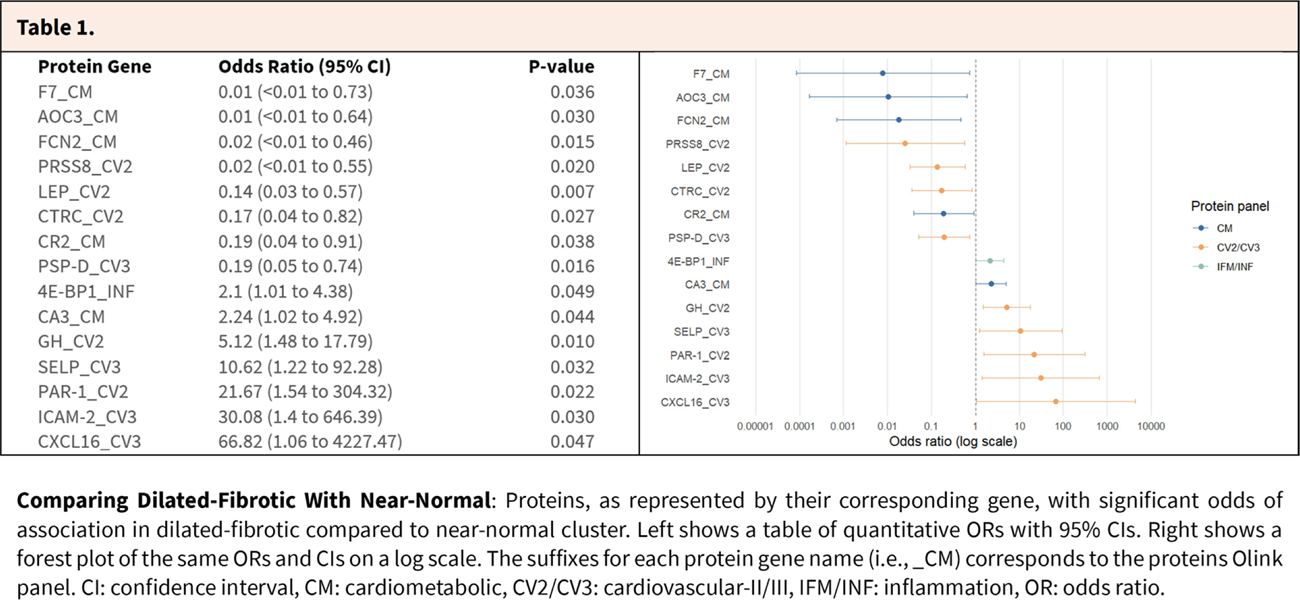
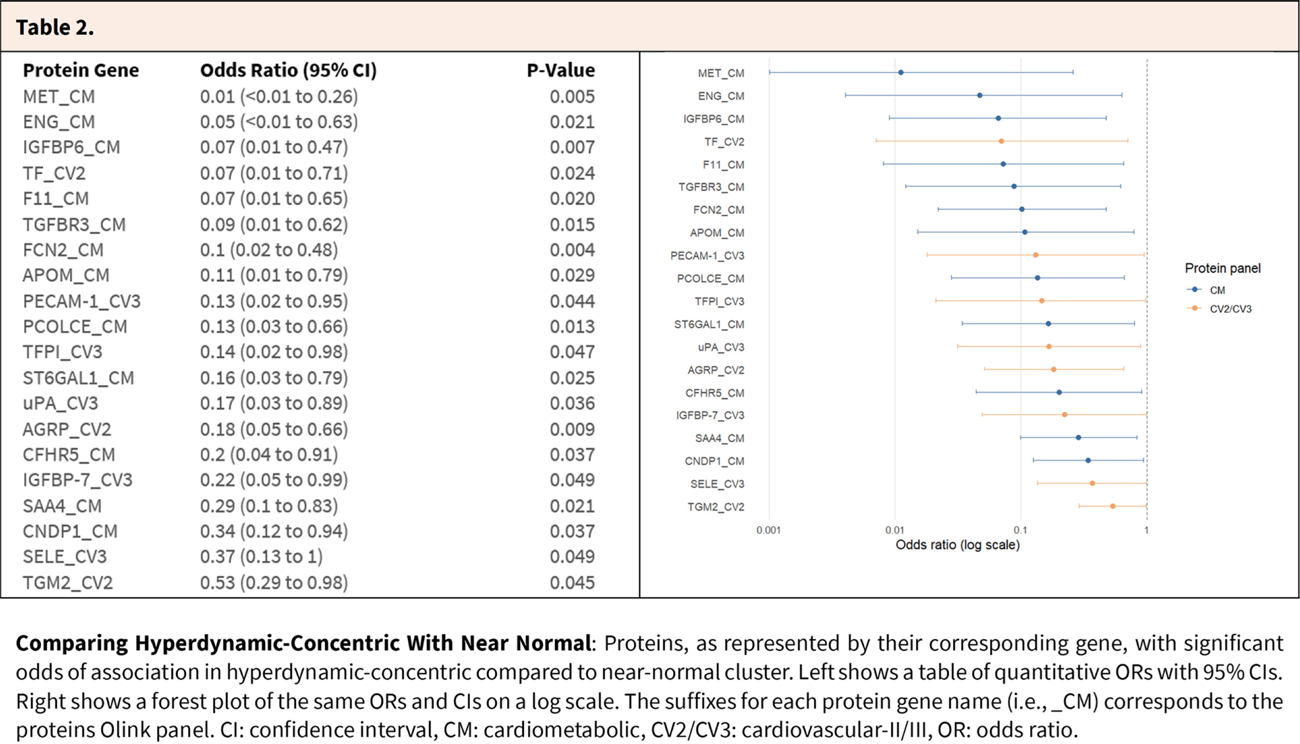
Results: The logistic regression model comparing dilated-fibrotic with near-normal phenotypes identified 15 significant proteins. Eight proteins had an odds ratio (OR) of <1.0, suggesting that for each unit increase in NPX people had a lower odds of being in the dilated-fibrotic phenotype, and were more likely to have a near-normal cardiac phenotype. Conversely, the remaining seven proteins had an OR of >1.0, such that people with higher NPX were more likely to be in the dilated-fibrotic cardiac cluster (P<0.05) (Figure 1). Key proteins represented common domains such as complement signalling (Ficolin-2 (FCN2) and Complement receptor type 2 (CR2) [OR: <1.0]) and cell adhesion (Membrane primary amine oxidase (AOC3) [OR: <1.0] and Intercellular adhesion molecule 2 (ICAM-2) [OR:>1.0]). The model comparing hyperdynamic-concentric and near-normal phenotypes identified 20 significant proteins, all of which had an OR of <1.0. No proteins demonstrated the opposite relationship [OR:>1.0] (P<0.05) (Figure 2). Categorisation by function also identified common areas across complement signalling (Ficolin-2 (FCN2) and Complement factor H-related protein 5 (CFHR5)), and coagulation pathways (Tissue factor (TF), Coagulation factor XI (F11), Tissue factor pathway inhibitor (TFPI), and Urokinase plasminogen activator surface receptor (uPA)). One proteomic biomarker, Ficolin-2, overlapped across the two models.
Conclusions: Several proteins across functional domains such as complement signalling, cell adhesion, and coagulation, were associated with clinically meaningful primary, subclinical cardiac phenotypes in SSc. Future study should validate these proteins and clusters, and assess their utility as predictive and mechanistic biomarkers for SSc-primary heart involvement.
REFERENCES: [1] Buch MH, Mallat Z, Dweck MR, Tarkin JM, O’Regan DP, Ferreira V, et al. Current understanding and management of cardiovascular involvement in rheumatic immune-mediated inflammatory diseases. Nat Rev Rheumatol 2024;20:614–34.
[2] Dumitru RB, Bissell LA, Erhayiem B, Kidambi A, Dumitru AMH, Fent G, et al. Cardiovascular outcomes in systemic sclerosis with abnormal cardiovascular MRI and serum cardiac biomarkers. RMD Open 2021;7:e001689.
Acknowledgments: NIL.
Disclosure of Interests: None declared.