fetching data ... 
Background: With the aging of the population, cognitive impairment has emerged as an important clinical issue in patients with rheumatoid arthritis (RA). Chronic inflammation has been implicated in cognitive vulnerability; however, the association between RA-related inflammatory markers and cognitive function remains insufficiently explored. In particular, it remains unclear whether markers reflecting RA-specific inflammatory activity provide additional information on cognitive function beyond general systemic inflammatory measures.
Objectives: To investigate the association between serum matrix metalloproteinase-3 (MMP-3), a marker of RA-related inflammatory activity, and cognitive function assessed by the Mini-Mental State Examination (MMSE) [1], and to compare this association with that of erythrocyte sedimentation rate (ESR).
Methods: This cross-sectional study included 130 patients with RA. Cognitive function was assessed using the MMSE. Serum MMP-3 and ESR levels were measured, and both variables were log-transformed due to skewed distributions. Multivariable linear regression analyses were performed with MMSE score as the dependent variable, adjusting for age, sex, educational level, and frailty assessed by the Kihon Checklist. ESR was additionally included to examine whether the association between MMP-3 and cognitive function was independent of nonspecific systemic inflammation. As a secondary analysis, mild cognitive impairment (MCI) was defined as an MMSE score ≤27, and logistic regression analyses were conducted. Sensitivity analyses were performed with additional adjustment for renal function and glucocorticoid use.
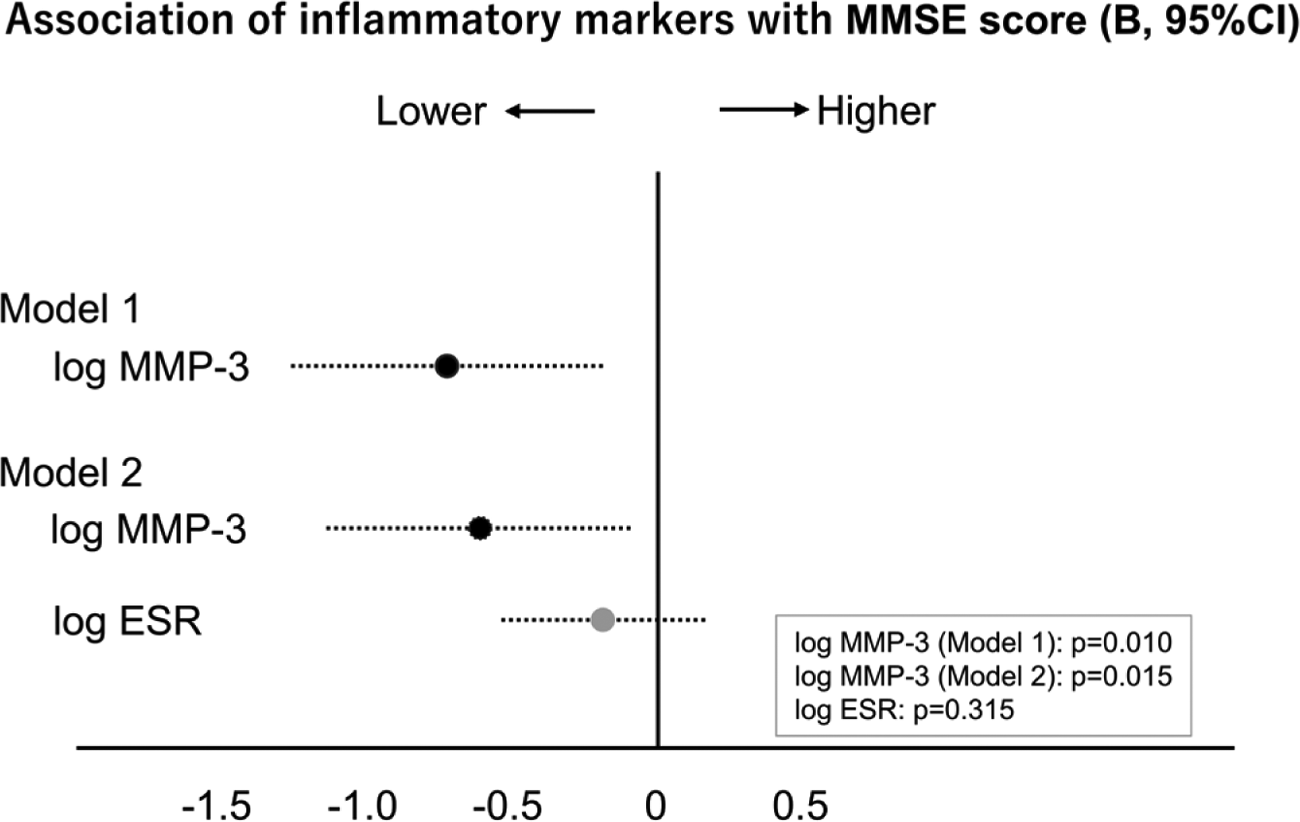
Results: Among the 130 patients, 34 (26.2%) were classified as having MCI. In multivariable linear regression analyses, higher serum log-transformed MMP-3 levels were independently associated with lower MMSE scores after adjustment for age, sex, educational level, and frailty. This association remained significant after additional adjustment for log-transformed ESR, whereas ESR itself was not independently associated with MMSE score (Figure 1). Consistent results were observed in logistic regression analyses using MCI as the outcome, in which higher log-transformed MMP-3 levels were associated with increased odds of MCI. These associations were not materially altered after adjustment for renal function or glucocorticoid use.
Conclusions: In patients with rheumatoid arthritis, serum MMP-3 levels were independently associated with cognitive function, whereas nonspecific systemic inflammation reflected by ESR was not. These findings suggest that RA-related inflammatory activity captured by MMP-3 may be relevant to cognitive vulnerability beyond general inflammatory burden.
Forest plot showing the association between inflammatory markers and MMSE score in patients with RA. The plot displays unstandardized regression coefficients (B) with 95% confidence intervals from multivariable linear regression models. Model 1 was adjusted for age, sex, educational level, and frailty. Model 2 included additional adjustment for log-transformed ESR. Negative values indicate lower MMSE scores.
REFERENCES: [1] Tombaugh TN, McIntyre NJ (1992) The mini-mental state examination: a comprehensive review. J Am Geriatr Soc 40:922-935.
Acknowledgments: NIL.
Disclosure of Interests: None declared.