fetching data ... 
Background: The CD27–CD70 pathway contributes to lymphocyte activation and B–T cell interactions in rheumatoid arthritis (RA). CD27 is a marker of memory B cells, and soluble CD27 has been linked to RA disease activity. Circulating anti-CD27 antibodies may reflect immune dysregulation in RA.
Objectives: To investigate serum anti-CD27 antibody levels and their potential clinical significance in RA.
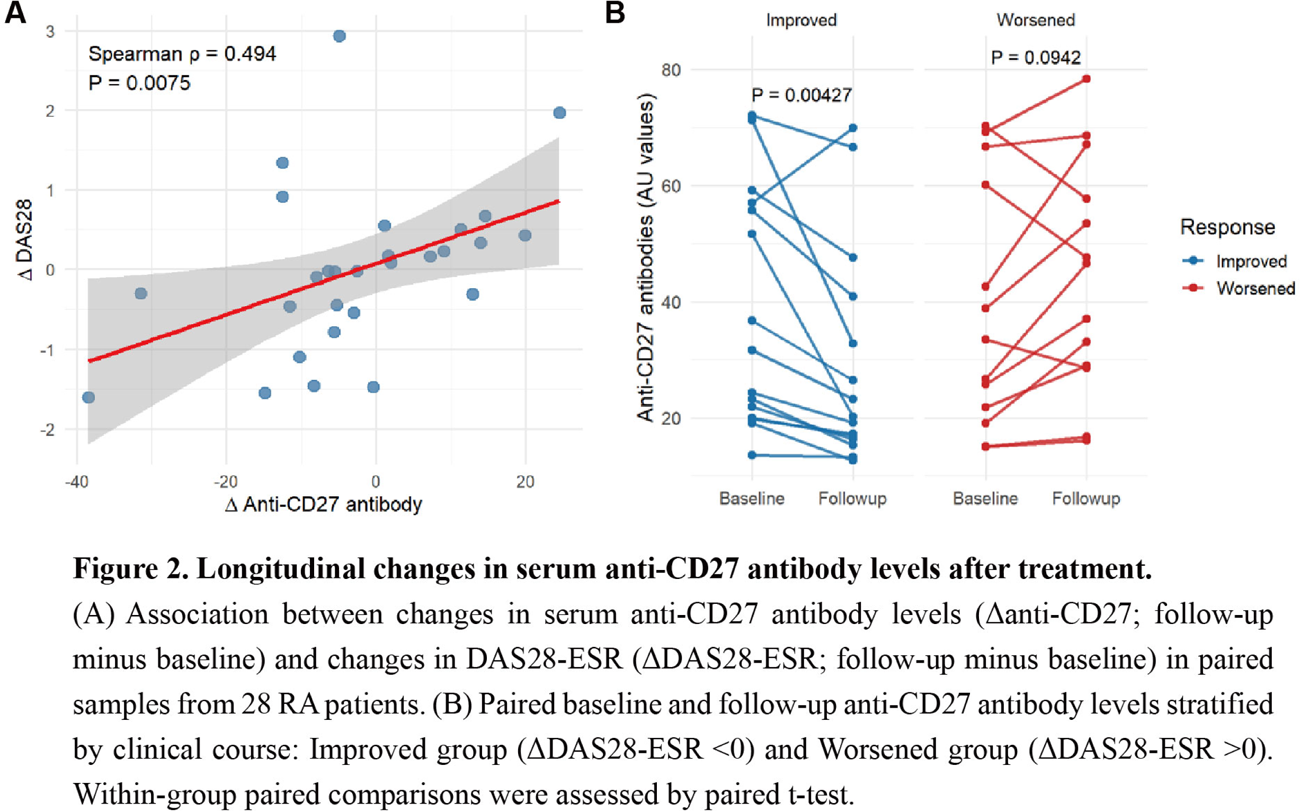
Methods: Serum levels of anti-CD27 antibodies were measured by enzyme-linked immunosorbent assay in 97 RA patients and 24 healthy controls (HC). RA patients were stratified into early RA (disease duration ≤24 months; n=24) and established RA (>24 months; n=73). Disease activity was assessed using the 28-joint Disease Activity Score based on erythrocyte sedimentation rate (DAS28-ESR) and categorized as remission (DAS28-ESR < 2.6), low-to-moderate activity (2.6–5.1) and high activity (>5.1). Group comparisons were performed using non-parametric tests (Mann–Whitney U test for two groups and Kruskal–Wallis test with post hoc Dunn’s multiple comparisons for three or more groups). Associations between anti-CD27 antibody levels and clinical parameters were analyzed using Spearman correlation. In a paired cohort (n=28) with baseline and follow-up samples after treatment, changes (Δ) in anti-CD27 antibody levels and DAS28-ESR were calculated as follow-up minus baseline. Patients were classified as Improved (ΔDAS28-ESR < 0) or Worsened (ΔDAS28-ESR > 0) groups for within-patient comparisons.
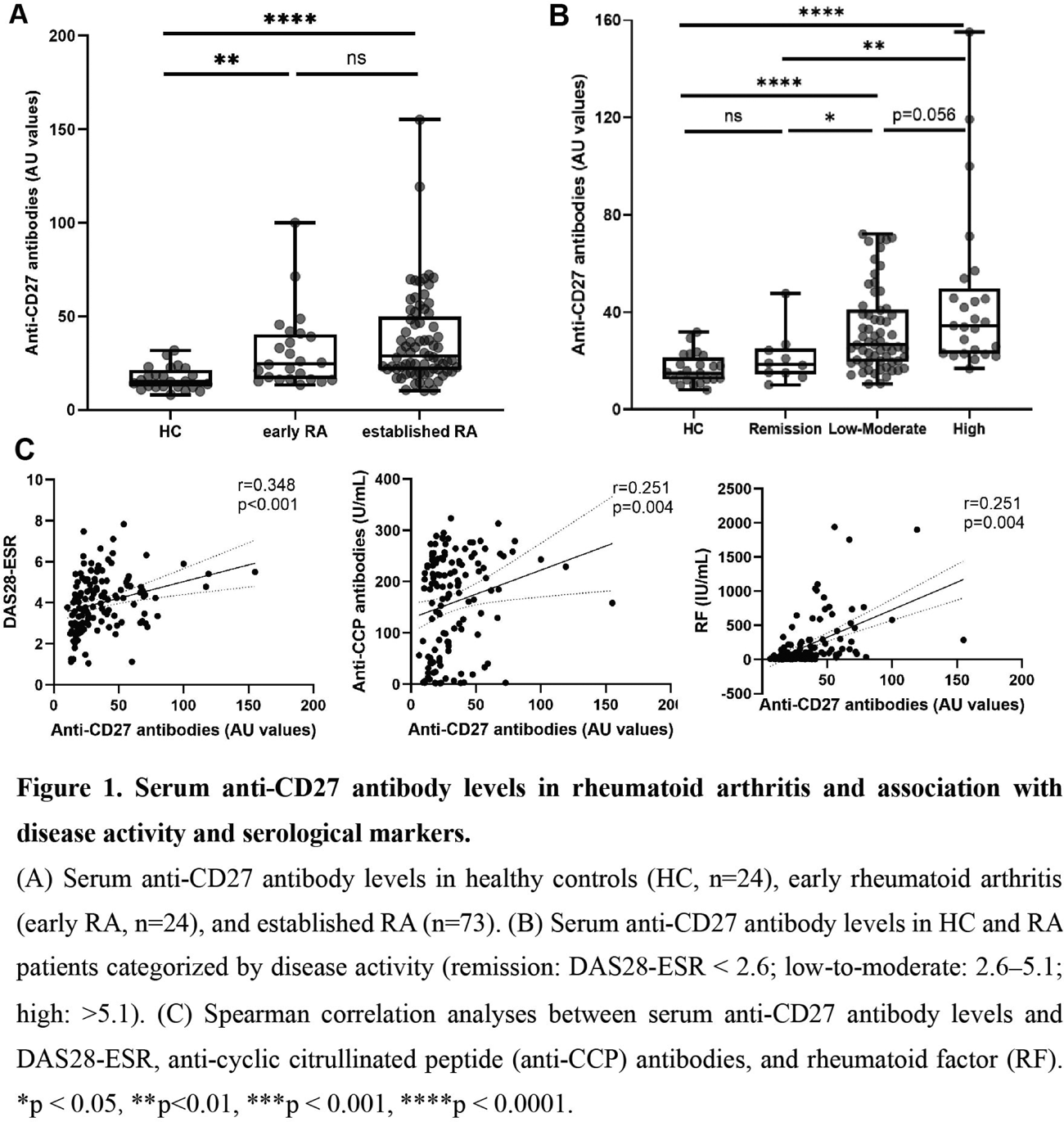
Results: Serum anti-CD27 antibody levels were significantly elevated in both early RA and established RA compared with HC (p<0.01 and p<0.001, respectively) (Figure 1A). Anti-CD27 antibody levels were higher in patients with active RA than in HC and patients in remission, with a stepwise increase across activity categories. There was no significant difference in anti-CD27 levels between remission group and HC (Figure 1B). Anti-CD27 antibody levels correlated positively with DAS28-ESR as well as anti-cyclic citrullinated peptide antibodies (anti-CCP), and rheumatoid factor (RF) (p<0.01) (Figure 1C). In paired samples (n=28), Δanti-CD27 antibody levels correlated positively with ΔDAS28-ESR (Spearman’s ρ = 0.494, p = 0.008) (Figure 2A). Anti-CD27 antibody levels decreased from baseline to follow-up in the Improved group (paired t-test, p=0.004), whereas a non-significant increase was observed in the Worsened group (p=0.09) (Figure 2B).
Conclusions: Serum anti-CD27 antibody levels were associated with RA disease activity and showed concordant within-patient changes with DAS28-ESR after treatment. These findings support further evaluation of anti-CD27 antibodies as an activity-associated serological measure in RA.
REFERENCES: [1] Park JK, Han BK, Park JA, et al. CD70-expressing CD4 T cells produce IFN-γ and IL-17 in rheumatoid arthritis. Rheumatology (Oxford ). 2014;53(10):1896-1900. doi:10.1093/rheumatology/keu171.
[2] Klein U, Rajewsky K, Küppers R. Human immunoglobulin (Ig)M+IgD+ peripheral blood B cells expressing the CD27 cell surface antigen carry somatically mutated variable region genes: CD27 as a general marker for somatically mutated (memory) B cells. J Exp Med . 1998;188(9):1679-1689. doi:10.1084/jem.188.9.1679.
[3] Shi L, Yang J, Xu J, Dai J, Li J. Elevated serum soluble CD27 levels are associated with both disease activity and humoral immune activity in patients with rheumatoid arthritis. Clin Exp Rheumatol . 2024;42(5):983-990. doi:10.55563/clinexprheumatol/fq5d3i.
Acknowledgments: NIL.
Disclosure of Interests: None declared.