fetching data ... 
Background: According to the Global Burden of Disease Study report, osteoarthritis is one of the leading causes of years lived with disability worldwide [1]. Hand osteoarthritis (HOA), is the most common form of osteoarthritis, and is expected to become increasingly prevalent as the global population ages, affecting approximately half of all women and one quarter of men over their lifetime [2]. HOA is a condition that leads to pain, functional limitations, and reduced quality of life [1,3]. Non-pharmacological management, including education, exercise, and assistive strategies, is recommended as first-line treatment [3]. For a long time, HOA was an under prioritized disease. Systematic reviews suggest that some interventions, such as hand exercises, may provide improvements in pain, function, and stiffness although the evidence on non-pharmacological interventions remains limited and heterogeneous [4,5]. However, there is a lack of detailed understanding of the specific non-pharmacological support needs that people with hand OA consider important. To inform the development of relevant and effective non-pharmacological interventions for people with HOA, a comprehensive overview of existing evidence is needed. This includes understanding the support needs that people with HOA consider important and describing the content of current non-pharmacological interventions that involve active participation, such as structured hand exercises or engagement in hand-based occupations.
Objectives: This study aims to: 1) describe support needs for non-pharmacological interventions with active participation for people with HOA and, 2) identify and report existing non-pharmacological interventions with active participation for people with HOA.
Methods: A systematic review was conducted in line with Kahn et al [6]. A systematic literature search was performed in November 2025 across five databases (Embase, CINAHL, CENTRAL, MEDLINE, and PsycINFO) using a block search on population and intervention. The quality of the included studies was evaluated using the Critical Appraisal Skills Programme (CASP) tools for qualitative research, while the Cochrane Risk of Bias Tool (RoB 5.1.0) was applied to assess bias in intervention studies. The study protocol was pre-registered with PROSPERO (registration ID: CRD420261284670).
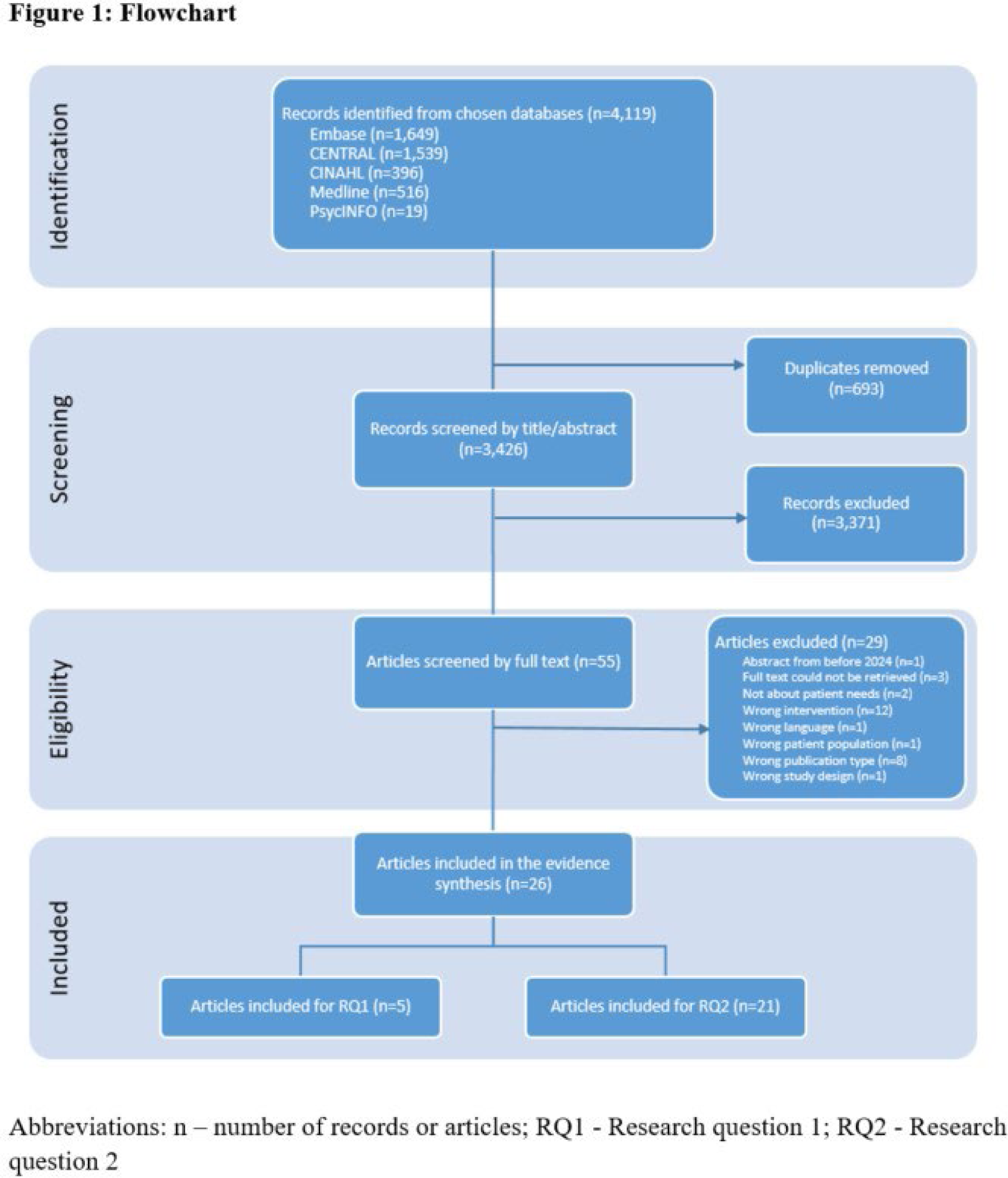
Results: From 4,119 records identified, five papers addressed people with HAO support needs, and 21 papers described the content of non-pharmacological interventions (Figure 1). Five papers reported the needs of people with HOA, primarily through semi-structured interviews. Five overall needs were identified: 1) Knowledge about HOA, which refers to understanding the disease to reduce uncertainty. 2) Exercises and use of hands in everyday activities, to be able to do hand exercises and improve the daily functioning of hands. 3) Assistive devices, to perform and participate in everyday activities. 4) Support from the social environment, especially close relatives, to manage everyday activities, 5) Self-managing strategies, referring to managing and coping with everyday life with HOA.
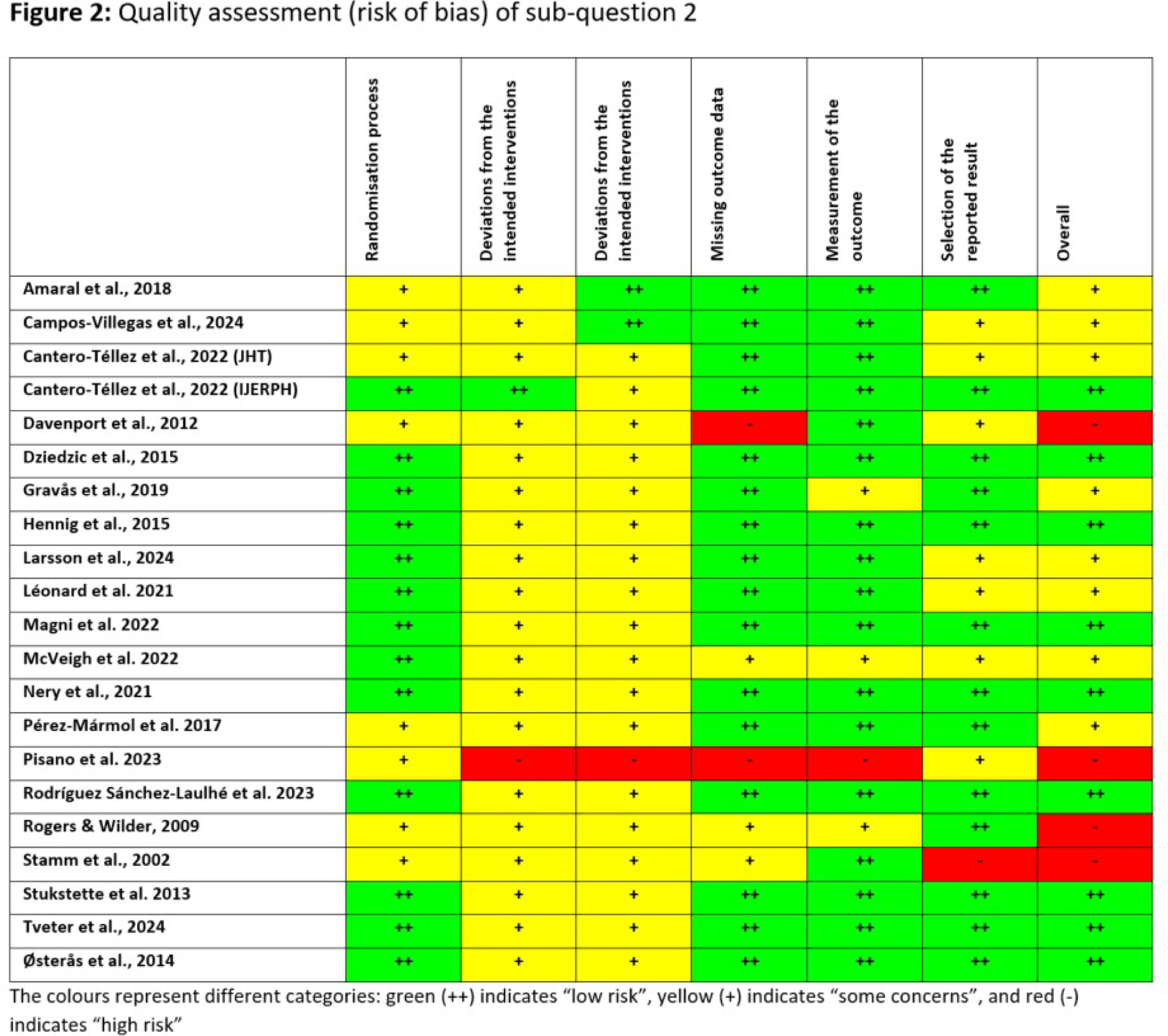
Across the 21 included intervention papers, existing non-pharmacological interventions with active participation for people with HOA were identified. The evidence base consisted primarily of 20 randomised controlled trials (RCTs) and one feasibility study. The most common non-pharmacological interventions, with active participation, were structured hand exercise programs, including range of motion exercises, progressive resistance training, and sensorimotor or proprioceptive exercises. Several RCTs specifically targeted thumb carpometacarpal (CMC) joint stabilisation through strengthening and coordination exercises. In addition to exercise-based interventions, activity-based interventions and joint protection education were identified, frequently integrated within multimodal programs. These approaches involved participants in daily activities, adopting joint protection strategies, and modifying behaviour to support continued hand use and participation. Self-management components were included in six of the 21 studies, most often as part of multimodal non-pharmacological interventions. These components commonly consisted of education about HOA instruction in joint protection strategies and guidance on managing symptoms in everyday activities. Self-management was frequently supported through home-based exercise programs, with participants encouraged to take responsibility for regular practice using written materials, exercise logs, or digital guidance. The 21 interventions were typically delivered as home-based programs, supervised sessions, or combined formats, with intervention durations most often ranging from eight to 16 weeks. In one RCT and one feasibility study, self-management interventions were delivered through a mobile health application providing structured exercise programs and educational content. Of the 21 papers reviewed, most were rated as moderate quality (12 papers), with eight classified as low quality, and one meeting high-quality criteria (Figure 2).
Conclusions: This systematic review shows that people with HOA report multifaceted support needs that are partly addressed by existing non-pharmacological interventions. These interventions are mostly exercise-based and often delivered as multimodal programs combining hand exercises with education, joint protection strategies, and self-management support. While the majority of interventions address key patient-identified needs, the overall quality of evidence is mainly moderate to low. Future research should focus on developing and evaluating high-quality, patient-centred non-pharmacological interventions that explicitly integrate identified support needs and support long-term self-management for people with HOA.
REFERENCES: [1] Cross et al. 2014, PMID: 24553908
[2] Qin et al. 2017, PMID: 28470947
[3] Kloppenburg et al. 2019, PMID: 30154087
[4] Kjeken et al. 2025, PMID: 39793978
[5] Kjeken et al. 2011, PMID: 21630479
[6] Kahn et al. PMID: 12612111
Acknowledgments: NIL.
Disclosure of Interests: None declared.