fetching data ... 
Background: Patient and Public Involvement (PPI) has evolved from optional to essential in health and care research. The UK Standards for Public Involvement (NIHR, 2019) define six value-based domains: Inclusive Opportunities, Working Together, Support & Learning, Communications, Impact, and Governance, all aimed at improving consistency, quality, and accountability. In rheumatology, the 2023 EULAR recommendations emphasise clear roles, training, coordination, and evaluation. Evidence highlights meaningful benefits: a 2014 systematic review found PPI empowers service users, enriches researcher insights, and increases community awareness. Despite these benefits, PPI continues to be inconsistently implemented (Vanneste, 2025). Funders play a critical role in changing this, through guidelines and activities, such as publishing evidence on how they embed PPI, applying grant-making criteria, and using tools to enable meaningful PPI throughout their funded research (Landrum, 2022). Arthritis UK has actively embedded PPI across its research funding processes, moving from initial involvement in funding panels to embedding it throughout the research funding cycle. This includes requiring and monitoring PPI in the development and delivery of funded projects, as well as setting clear guidelines for meaningful involvement.
Objectives: To embed meaningful PPI throughout research funding and governance, ensuring involvement is embedded into decision-making at every stage, from priority setting and application review to monitoring and evaluation.
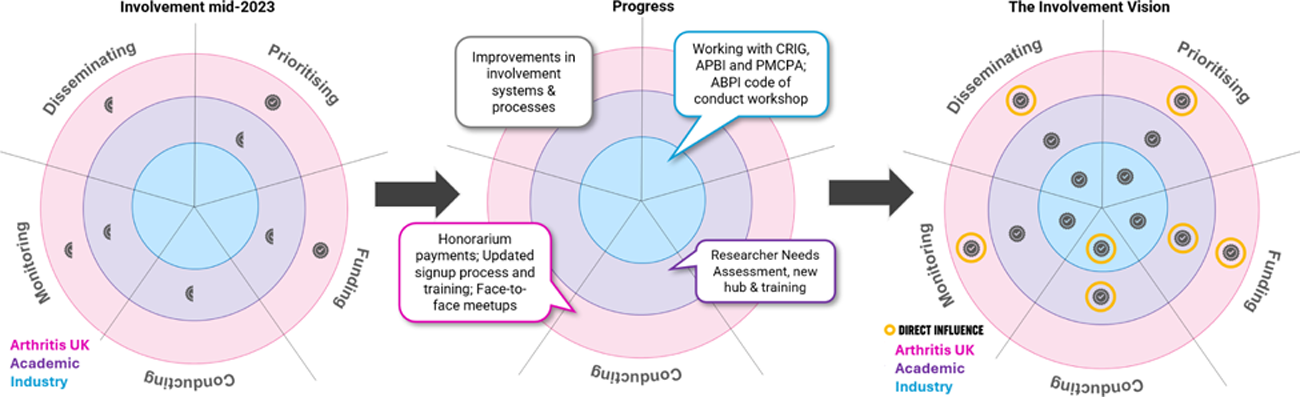
Methods: Our research strategy was co-developed with people with lived experience of arthritis. As a charity delivering services, conducting research, and influencing policy, multiple insights into lived experience are gathered and integrated with expertise from advisory groups to define evidence-based priorities. A dedicated research involvement team supports a network of Research Partners (RPs) from diverse backgrounds, trained and supported to shape research. In 2023, the team reviewed its approach, planning to expand opportunities for involvement, such as engagement with the pharmaceutical sector, increased support for researchers and streamlined processes (see Figure 1). A new, co-produced journey of training, staff and peer support, regular engagement and feedback was implemented, alongside honorarium payments. The recruitment of new RPs through this journey ensured that partnership work was grounded in mutual understading and trust. RPs contribute across the research funding lifecycle: priority setting, funding decisions, communication, design and delivery, monitoring, and governance. Fundamental principles, such as using RP co-chairs and ensuring RP input before technical experts are implemented to maintain power balance.
Results: In the 2024/25 financial year, RPs completed 106 funding application reviews. By the end of 2025, the network comprised 154 RPs, with 79 actively involved in projects or committees and 57 trained and ready to review funding applications. A workshop with 20 RPs explored motivations and experiences, revealing two key positive themes. First, involvement provided personal value through unique opportunities such as travel, networking, and learning about research processes. Many reported increased confidence to pursue further PPI roles or study, and some described how transforming lived challenges into positive contributions improved their mental health. RPs also felt empowered to advocate for themselves in healthcare, citing enhanced knowledge of their condition and research. Second, RPs felt valued when their lived experience was recognised as expertise. Face-to-face engagement fostered a sense of community and mutual respect. They emphasised the importance of being listened to and described moments of genuine partnership. A January 2025 survey found that 85% of RPs agreed they make a difference to our work, 80% agreed that they are confident that we take their input into account when making decisions. Most also reported gaining knowledge, skills, and confidence. Despite these benefits, challenges remain. Communication gaps left some RPs feeling “out of the loop,” while administrative barriers such as delays in travel claims and system errors created frustration, though improvements have been co-produced since. Representation is a significant concern, with addressing diversity a priority: planned efforts include piloting inclusive approaches, building trust through community-based engagement, and balancing required charity governance structures with flexibility to meet people where they are. Another challenge is maintaining authentic perspectives among experienced PPI members while providing training to enable contributions. Tenure limits and ongoing recruitment help ensure both new and experienced perspectives are heard throughout. Continued reflection and adaptation are essential to ensure meaningful and representative involvement. A lack of impact data remains a challenge. Arthritis UK has reviewed existing impact measurement literature and conducted workshops with PPI members to explore the impact they feel they have made. Separating the impact on our organisational decision-making and the impact on our research itself is key moving forward to build a stronger picture of this. Annual surveys have proved useful, but exploring ways to capture impact, insight and lessons learned more organically would further strengthen our understanding.
Conclusions: Embedding meaningful involvement throughout a research funding organisation is achievable and can influence organisational decision-making at many levels, from strategy to funding. The impact of this approach spans beyond the projects or decisions to impact teams and individuals. Success requires time, resources, and a transparent, flexible, and learning-based approach, underpinned by strong processes and a commitment to diversity.
Evolution of Involvement at Arthritis UK
REFERENCES: NIL.
Acknowledgments: NIL.
Disclosure of Interests: None declared.