fetching data ... 
Background: Self-management refers to an individual’s active role in managing symptoms, treatment, physical and psychosocial consequences, and lifestyle adjustment associated with chronic conditions [1]. The EULAR recommendations highlight self-management strategies and healthy lifestyle behaviors, such as physical activity, nutrition, and maintaining work participation, as key elements in preventing disease progression and promoting overall well-being among people living with rheumatic and musculoskeletal diseases (RMDs) [2]. While reliable information is essential, successful lifestyle change typically requires additional support. From a behavior change perspective, it is crucial to incorporate the patient’s viewpoint by helping individuals identify meaningful goals, translate them into actions, and monitor progress over time [3]. Web-based interventions may offer a flexible and cost-effective way to support individuals with RMDs in adopting lifestyle changes that promote well-being.
Objectives: The aim was to support people living with RMDs in improving lifestyle habits and establishing sustainable health behaviors through a web-based group intervention. The intervention was implemented as part of the Omahoitopolku project by the Finnish Rheumatism Association.
Methods: Seven web-based group programs were delivered in 2024–2025: two focusing on sleep and recovery, two on physical activity, two on nutrition, and one on pain management. Each program lasted approximately seven weeks and included four online group sessions combining expert-led lectures, practical exercises, and peer reflection to support goal setting and daily implementation. A project staff member facilitated all sessions, and participants completed home tasks and interacted via the online platform between meetings. The content progressed from preparatory tasks to four structured sessions. In Session 1, participants were introduced to the theme and to the group and supported in identifying their individual starting points. Session 2 focused on theme-specific knowledge and goal setting, Session 3 on mid-course progress evaluation and discussion and Session 4 addressed challenges related to lifestyle change and strategies for establishing long-term routines. The intervention targeted adults with inflammatory rheumatic diseases who expressed a need for support in implementing lifestyle changes. Participants received electronic questionnaires at baseline (initial survey and WHOQOL-BREF quality of life assessment), immediately after the intervention (feedback survey and WHOQOL-BREF), and six months post-intervention (WHOQOL-BREF). Six-month follow-up data is not reported here.
Results: A total of 87 people applied and 76 participated in the programs and 35 of them attended all four sessions. Participant characteristics are presented in Table 1. A total of 48 participants (63%) completed the post-intervention feedback survey, with key outcomes summarized in Table 2. A total of 34 (45%) participants completed WHOQOL-BREF before and after the intervention. Among them 13 (38%) reported greater satisfaction with their health post-intervention compared to baseline. At least one of the three quality-of-life domains (physical, psychological, or social well-being) improved among 27 participants (79%). Open-ended feedback was predominantly positive, though occasionally mixed, highlighting the value of peer support as well as the challenges related to maintaining engagement.
Conclusions: Web-based lifestyle intervention may offer a promising approach to improving the well-being of individuals living with RMDs. Although the intervention resulted in modest changes in lifestyle behaviors and health status and follow-up response rates were limited, participants reported gaining peer support, practical strategies for everyday life, and increased motivation for behavior change. A key implementation challenge was inconsistent participant engagement over the course of the program. Given that only a fraction of participants completed all sessions and questionnaires, the findings should be interpreted with caution. Nonetheless, the results suggest that web-based group interventions can serve as a useful adjunct to traditional care in supporting self-management and helping individuals take the first step toward more sustained lifestyle change.
Table 1. Participant characteristics (N=87)
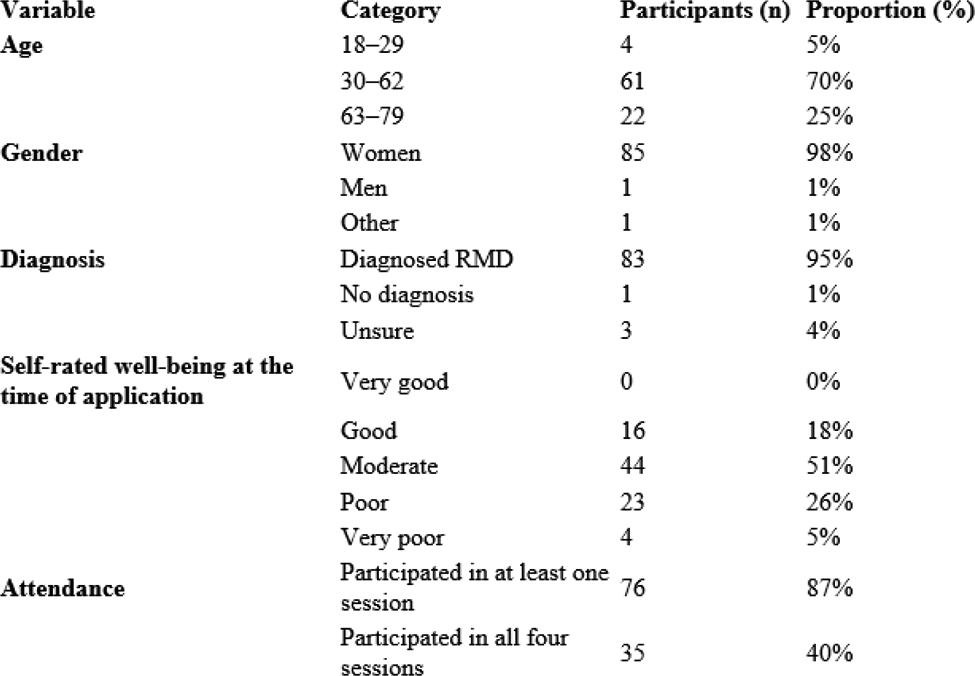
Table 2. Self-reported outcomes from the post-intervention survey (N=48)
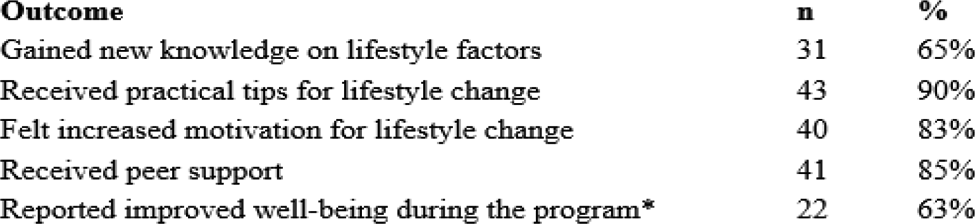
* Question added after the pilot intervention; N=35 for this item.
REFERENCES: [1] Barlow, J., Wright, C., Sheasby, J., Turner, A., & Hainsworth, J. (2002). Self-management approaches for people with chronic conditions: a review. Patient education and counseling, 48(2), 177–187.
[2] Gwinnutt, J. M., Wieczorek, M., Balanescu, A., Bischoff-Ferrari, H. A., Boonen, A., Cavalli, G., de Souza, S., de Thurah, A., Dorner, T. E., Moe, R. H., Putrik, P., Rodríguez-Carrio, J., Silva-Fernández, L., Stamm, T., Walker-Bone, K., Welling, J., Zlatković-Švenda, M. I., Guillemin, F., & Verstappen, S. M. M. (2023). 2021 EULAR recommendations regarding lifestyle behaviours and work participation to prevent progression of rheumatic and musculoskeletal diseases. Annals of the rheumatic diseases, 82(1), 48–56.
[3] Knittle, K., De Gucht, V., & Maes, S. (2012). Lifestyle-and behaviour-change interventions in musculoskeletal conditions. Best Practice & Research Clinical Rheumatology, 26(3), 293–304.
Acknowledgments: NIL.
Disclosure of Interests: None declared.